

AQA Trilogy Biology Protists Malaria
This lesson teaches students about Protists and the example is malaria. All resources are included. This lesson was judged as outstanding. I hope you find it useful.
 Quick View
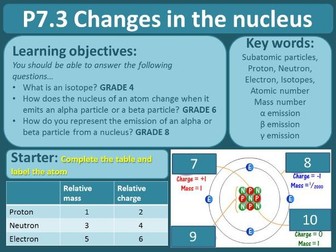
Radioactivity, Lesson 3: Changes in the nucleus (Radioactive decay)
Science - Physics - Radioactivity, Lesson 3: Changes in the nucleus (Radioactive decay)
This lesson is for the New AQA GCSE Sciences.
 Quick View
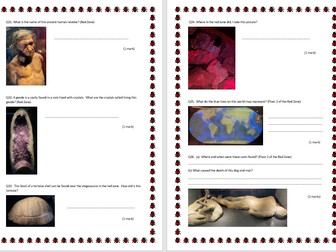
Natural History Museum Quiz (and answers) School Trip
The perfect way of entertaining KS2 and KS3 students on a trip to the Natural History Museum. I have designed a quiz for students to carry out whilst visiting the NHM in South Kensington London. This keeps the students focused, engaged and active. The students thoroughly enjoyed this trip.
 Quick View
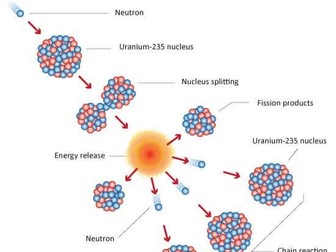
Nuclear Fission
KS4 GCSE Science
Physics
AQA
Triple Science
Grade 9-1
Learning objectives:
You should be able to answer the following questions…
What is nuclear fission? GRADE 4
Explain the difference between spontaneous fission and induced fission? GRADE 6
Describe what happens in a chain reaction? Explain how to control a chain reaction in a nuclear reactor? GRADE 8
undefined
 Quick View
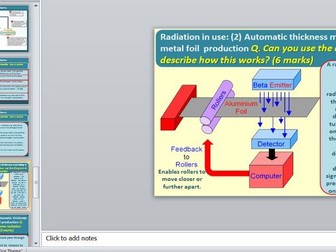
Alpha, beta and gamma radiation
Learning objectives:
You should be able to answer the following questions…
GRADE 4
Can you rank the three types of nuclear radiation in order of their penetrating power, range through air?
Can you describe the process of ionisation?
GRADE 6
Can you describe how a Geiger counter can be used to detect radiation?
Can you describe how penetrating powers are measured?
GRADE 8
Can you evaluate the risks caused by alpha radiation inside and outside the human body?
Can you describe how the thickness of a material being manufactured can be monitored using radiation?
Key words: alpha radiation, beta radiation, gamma radiation, random, ionisation, irradiated
 Quick View
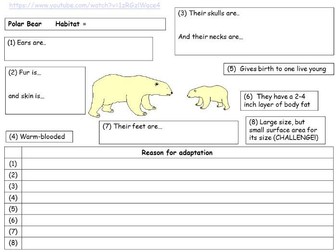
Adaptations and Competition KS3 Science
Ideal for year 7 and 8 students.
Adaptation and Competition
KS3 Science
Biology
All of the worksheets are included in the power-point. These are the black and white slides and can be printed directly from the power-point. The cover photo used for this resource is one of the 5 worksheets included.
I used this lesson for an interview and was given the job ;)
 Quick View
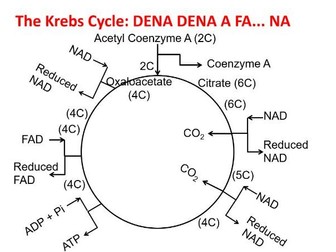
Link Reaction & Krebs Cycle
Lesson 2 - Recaps on glycolysis. Followed by Link Reaction and Krebs Cycle.
I teach AQA A Level Biology.
 Quick View
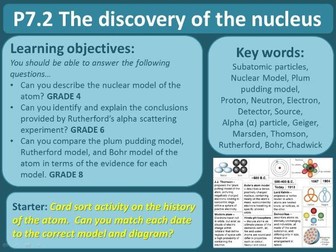
GCSE Radioactivity (Lesson 2) - The discovery of the nucleus (alpha particle scattering)
Rutherford
Geiger & Marsden
Thomson
Bohr
Chadwick
Alpha particle scattering experiment
Nuclear model
Plum pudding model
 Quick View
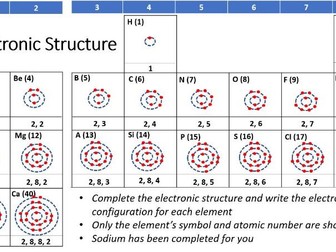
GCSE SCIENCE (CHEMISTRY): ELECTRONIC CONFIGURATION/STRUCTURE
This is a complete lesson on how to teach electron configuration of the first 20 elements of the periodic table.
 Quick View
 Quick View
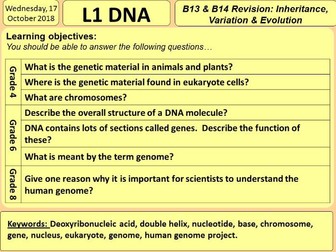
DNA, Chromosomes, Genes and the Genome (GCSE Biology)
GCSE Science
Biology
Planned for AQA Trilogy
Inheritance, Variation and Evolution Topic
 Quick View
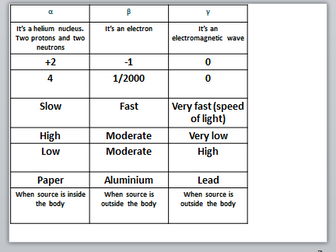
Alpha, Beta and Gamma Radiation Card Sort Activity
Physics
Radioactivity
Atoms and radiation
Alpha
Beta
Gamma
NUCLEAR FUSION (Physics - triple science)
AQA Triple Science Physics
Radioactivity
Nuclear Fusion
Whole lesson
 Quick View
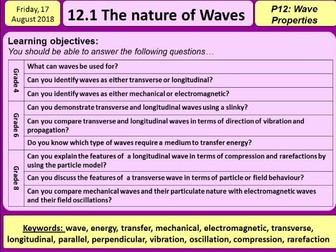
GCSE PHYSICS Wave Properties (lessons 1 to 3)
These are the first three lessons for the GCSE Physics topic Wave Properties.
Lesson 1: The nature of waves
Lesson 2: The properties of waves
Lesson 3: Reflection and refraction
These have been produced to teach AQA GCSE Combined and Triple Science.
Worsheets are included in the powerpoints.
When I refer to ‘text book’ our teachers and students use the Oxford textbooks in class.
 Quick View
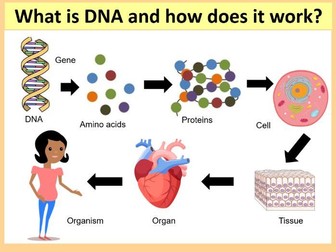
GCSE SCIENCE (BIOLOGY): What is DNA and how does it work?
This is a complete lesson. The powerpoint is included with all questions and answers.
It includes the structure of DNA, how genes code for proteins and how understanding the genome is an important tool for science and medicine.
 Quick View
Radioactivity Student Booklet
AQA Trilogy Combined Science Physics (9-1)
This booklet has been designed to accompany my power points.
This can be printed for students and they write in this booklet every lesson.
 Quick View
 Quick View
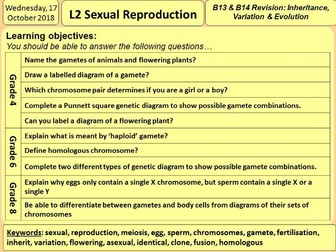
L2 Sexual reproduction and X and Y chromosomes
Meiosis, gametes homologous chromosomes, X and Y chromosomes and Punnett squares
Also makes reference to sexual reproduction in flowering plants