Compose 8-Bit Video Game Music Lesson KS3Quick View
mmacdonald097

Compose 8-Bit Video Game Music Lesson KS3

(0)
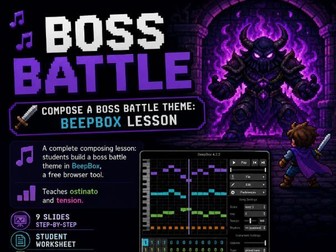
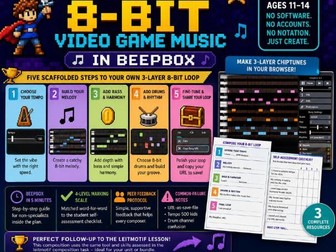
Compose 8-Bit Game Music in BeepBox (3 files: plan, 9 slides, worksheet). Five scaffolded steps from tempo choice to a three-layer loop, saved as a URL. The plan includes a “BeepBox in five minutes” section for non-specialists, a 4-level formative marking scale matched word-for-word to the student self-assessment checklist, and the common-failure notes (URL-as-save-file, tempo 500 kids, drum channel confusion). A complete one-off composing lesson using BeepBox, a free browser tool: no software, no accounts, no notation. Slides, worksheet, marking scale. Ages 11–14. Five scaffolded steps take every student from blank screen to a working three-layer chiptune loop saved as a shareable link; includes 4-level marking scale, matching student self-assessment, peer feedback protocol, full non-specialist teacher notes and tech troubleshooting; zero copyright-sensitive material, so nothing to source; ideal for computer-room lessons, music technology units or as the creative follow-up to any game music listening lesson. This one has the strongest cross-sell hook to the bundle since the bundle’s composition assessment also uses BeepBox: say so explicitly in the description.
Leitmotif Music Lesson: Video Game CharactersQuick View
mmacdonald097

Leitmotif Music Lesson: Video Game Characters

(0)
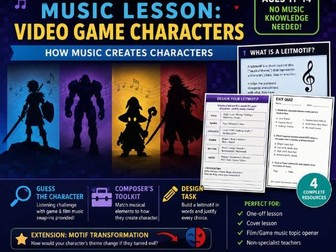
Leitmotifs: How Music Creates Characters (4 files: plan, 10 slides, worksheet, exit quiz with answers). Guess-the-character listening, a composer’s toolkit matching activity, then the design task where students build a leitmotif in words with a justification for every element choice. No notation, no instruments, so it doubles as a cover lesson. The extension is motif transformation (character turns evil). Film swap-ins (Jaws, Imperial March, Hedwig’s Theme) are listed for teachers without game audio. A complete one-off music lesson on leitmotifs in video game music: slides, worksheet, exit quiz and full teacher notes. Ages 11–14. No music knowledge needed. Students guess characters from their themes, learn how pitch, tempo, timbre and dynamics communicate character, then design their own leitmotif with justified choices; includes 10-slide deck with speaker notes, exit quiz with answer key and interpretation notes, differentiation, film music swap-ins, answer guide; works as one-off, cover lesson or film/game music topic opener; audio is teacher-sourced with a full guide (state this plainly); AC v9.0 aligned, mapped to KS3 and NCAS.
A complete one-off music lesson on the history of video game musicQuick View
mmacdonald097

A complete one-off music lesson on the history of video game music

(0)
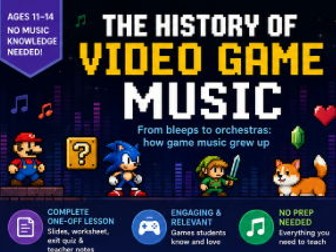
A complete one-off music lesson on the history of video game music: slides, worksheet, exit quiz and full teacher notes. Ages 11–14. No music knowledge needed. Works as an engaging one-off, a topic opener or a cover/relief lesson; students explore three eras (chiptunes, MIDI/synthesisers, orchestral/adaptive) through a listening challenge, timeline content and a 10-question exit quiz with answer key; full teacher background notes mean non-specialists can teach it confidently; differentiated with sentence starters, mood word bank and extension task; audio excerpts are teacher-sourced with a full guide included; written for AC v9.0 but mapped to KS3 and adaptable to US contexts. This esson is adapted from my full Video Game unit - search my store for more information.
Video Game Music: Complete 10-Week UnitQuick View
mmacdonald097

Video Game Music: Complete 10-Week Unit

(0)
A complete 10-week video game music unit: 30x70 minute full lessons with slides, worksheets, lesson plans, two assessment tasks and rubrics. Ages 11–14. No prep. What’s included (over 80 files): 30 sequenced lessons, each with a detailed lesson plan, student worksheet and presentation slides Two full assessment tasks: a composition task using BeepBox (free browser-based tool, no software purchase needed) and a solo keyboard performance task A–E marking rubrics with clear, distinct performance descriptors for both tasks Unit overview and 10-week scope and sequence Listening guides, aural training activities, peer feedback scaffolds and self-assessment tools Unit structure: Students explore the history of game music from 8-bit chiptunes to modern orchestral scores, then learn the elements of music (pitch, rhythm, structure, dynamics, texture, timbre, leitmotif) through the lens of game soundtracks. The unit builds to two assessments: composing an original game music track in BeepBox with a written reflection, and performing a solo keyboard piece from a differentiated set list (Beginner to Extension). Why it works: Game music is the hook that gets reluctant Year 7–8 students engaged with real musical learning. Every lesson includes learning intentions, success criteria, timed lesson sequences and teacher notes written so any teacher (including non-specialists covering a class) can pick it up and run it. Activities are differentiated for mixed-ability classes, including students with no prior music experience. Practical details: 30 x 70-minute lessons (easily adapted to shorter periods) Requires: keyboards, computers/tablets with internet access for BeepBox Written for the Australian Curriculum v9.0 (The Arts – Music, Years 7–8) but skills-based and readily adaptable to KS3, US middle school or MYP contexts Editable Word and PowerPoint formats Please note: sheet music for the performance set list pieces is not included due to copyright. The task documents include a differentiated set list of widely available game music arrangements.
Video Game Music Listening Lesson Years 7-9Quick View
mmacdonald097

Video Game Music Listening Lesson Years 7-9

(0)
Free complete video game music listening lesson for Years 7-9 (KS3, middle school). Lesson plan, student worksheet and full answer key. No prep required. Students compare 8-bit classics with modern orchestral game soundtracks, building music vocabulary (tempo, dynamics, timbre, mood) through guided listening, a same-franchise comparison task (Zelda 1986 vs Breath of the Wild) and a class debate. The big payoff: students discover the melody survives 30 years of technology change. What’s included: Full 70-minute lesson plan with timed sequence, teacher notes for every phase, differentiation (support and extension) and a standalone-use guide so no prior lessons are needed Student worksheet with learning intentions, success criteria, vocabulary bank, word bank, listening grid, comparison table, sentence starters and exit ticket Teacher listening guide and answer key with six suggested tracks, search terms, regional swap-in alternatives, sample responses and a three-level formative marking scale Perfect for: cover/relief lessons, a one-off listening lesson, or as an engaging hook lesson for any music technology, film music or elements of music unit. Works with mixed-ability classes. No audio files needed to be purchased; the guide provides search terms for freely available official tracks. Curriculum: written for Australian Curriculum v9.0 (The Arts: Music, Years 7-8) and maps directly to KS3 listening/appraising and US NCAS Responding standards. Editable Word format so you can adapt anything. This is Lesson 2 of my complete 10-week Game Music unit (30 lessons, 2 assessment tasks with rubrics, slides, sheet music and answer keys for every lesson). Search my shop if this lesson works for your classes.