A persuasive writing worksheet, with features to cut out and match within the sample text.
Also included is a frame to help lower attaining children when writing their own text.
A word document which can be used as an IWB problem, to introduce equivalent (unit) fractions, with a pizza problem story.
Also included is an equivalent fraction block, to be printed and cut out to be used as an ongoing resource for equivalence, and worksheet.
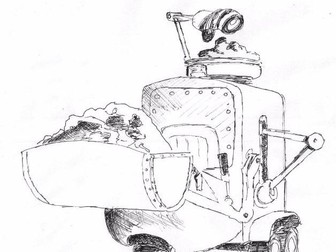
Line drawings of Wallace & Gromit's Cracking Contraptions
For use with explanation texts. I traced these myself, from screen captures, for use with a Year 4 class, for them to annotate and label, for use with writing explanation texts.
Checklist included (Suggested (skeleton) lesson plans included too).
The Roman Empire didn't collapse in 455AD when Rome was sacked by the Vandals!
As a change from normal planning about the Roman Empire, this unit focuses on the whole empire, from West, to East: on the ’Romanisation’ of İstanbul: the Roman Empire by AD 42 and the power of its army; the Hippodrome and obelisks; Hagia Sophia (Aya Sofya); conversion from polytheism to monotheism (Christianity)
Key Questions for Key Concepts:
Similarity & Difference – How did the Romans change and develop the city [now İstanbul]?
Cause & Consequence – Why was a city first built where İstanbul now stands? Why do we call this city İstanbul?
Continuity and Change – When was [İstanbul] capital of the Roman Empire and why did the empire collapse?
Significance - Why did [İstanbul] become capital of the Roman Empire? Why was the Hagia Sophia built, and by whom? Has the Roman Empire had any lasting impact on the world?
NC Core Learning Standards for KS2 History: Pupils should continue to develop a chronologically secure knowledge and understanding of local and world history, establishing clear narratives within and across the periods they study. They should note connections, contrasts and trends over time and develop the appropriate use of historical terms. They should regularly address and sometimes devise historically valid questions about change, cause, similarity and difference, and significance. They should construct informed responses that involve thoughtful selection and organization of relevant historical information. They should understand how our knowledge of the past is constructed from a range of sources and that different versions of past events may exist, giving some reasons for this.
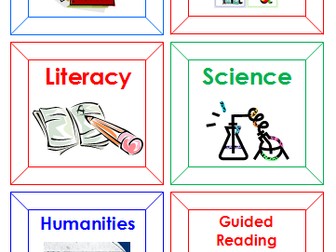
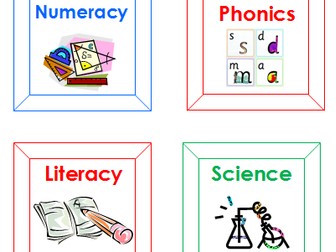
As I got rather bored of writing the timetable on the side of the whiteboard every day, I created this resource (in Publisher), to create a visual timetable, using clip-art, which can be laminated and blu-tacked on instead.
Great for last-minute changes to the timetable, and useful for ESL learners too.
I’ve also included the equivalent book and file labels, to be used in parallel.
Mustafa Kemal Atatürk was a Turkish army officer, revolutionary, and the first President of Turkey. His surname, Atatürk, meaning "Father of the Turks", was granted to him and forbidden to any other person.
This unit focuses on Mustafa Kemal Ataturk and his significance in the founding of the Republic of Turkey. It can fit with a significant person unit.
Key Questions for Key Concepts:
Similarity and Difference: Why is Gallipoli/Çanakkale being remembered this year? What was Atatürk’s involvement?
Cause & Consequence: What caused the Turkish War of Liberation and what were the consequences of it?
Continuity & Change: What changes did Atatürk instigate in the new republic of Turkey?
Significance: Why is Atatürk such a significant figure in Turkey? Why is his image found in public buildings, in every classroom?
Interpretation: How has Atatürk been represented or interpreted in different ways? Why does this happen?
National Curriculum Core Learning Standards for KS2:
Pupils should continue to develop a chronologically secure knowledge and understanding of local and world history, establishing clear narratives within and across the periods they study. They should note connections, contrasts and trends over time and develop the appropriate use of historical terms. They should regularly address and sometimes devise historically valid questions about change, cause, similarity and difference, and significance. They should construct informed responses that involve thoughtful selection and organisation of relevant historical information. They should understand how our knowledge of the past is constructed from a range of sources and that different versions of past events may exist, giving some reasons for this.
Working Scientifically support resources for KS1 and KS2
- graphic overview of Science
- breakdown of programme of study
- pupil tracking for each year
- overview of Working Scientifcally for KS1/LKS2/UKS2
All in pdf format, ready to stick in the front of children’s books, for your tracking of Working Scientifically objectives
1-2 weeks plan for cross-curricular Literacy and Art creative arts week at our school
Paintings featured:
The Family of Darius before Alexander, Paolo Veronese (1570)
The Judgement of Paris (~1635)
The Avenue at Middelharnis, Meindert Hobbema (1689)
Boating on the Seine, Pierre-Auguste Renoir (1875)
Rain, Steam and Speed – The Great Western Railway, J M W Turner (1844)
Tobias and the Angel, Andrea del Verrocchio (~1480)
The Ambassadors, Hans Holbein the Younger (1533)
Seaport with Embarkation of Saint Ursula, Claude (1641)
Apollo and Daphne, Antonio del Pollaiuolo (~1480)
For a handwriting activity, we play 'Scrabble Boggle'. Children are given a 'Boggle' square - 4 x 4 Scrabble letters - either for small letters, tail letters, tall letters, OR for low score letters (most frequently used) or high score letters.
The children then make words from the letters in their lined handwriting books, and we share them on the board (and the children copy board words into their books too), with the highest scores getting house points.
Children all through key stage 2 love it!
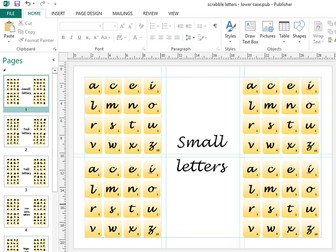
I've included a Publisher file of lower-case letters which I made, all grouped, and clip art of normal Scrabble tiles, also grouped.
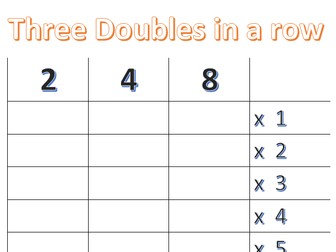
Simple sheets to use doubling of two times table to give four times and doubling again to give eight times.
Can be played as an activity, in pairs, where children take it in turns to roll a 12-sided die, and aim to get three-in-a-row first, to get a point; most points is the winner.
Aimed at year 3, in rows of 3 for Working Towards, rows of 4 for Working At, and extending to challenge of 32x for Greater Depth.
Also includes sheets for 6x and 12x tables, to combine doubling and adding.
Enjoy!
Warm-up activity reviewing features of a biography, and main activity looking at adverbs and adverbial phrases, with prompts for whole-class contributions
Activity to look at the journey our food makes to the UK, to raise children's awareness of where our food comes from, and possibly lead onto climate change and the effect of globalization
Featured food: bananas, tomatoes, potatoes, carrots, strawberries. Journey 'strips' were designed to be stuck on whiteboards for children to write up step-by-step process in groups, to present back to other groups.
Starting with identifying statements on either side of a discussion point (whether we should have zoos), developing children's point of view in response to specific points supporting either side of discussion.
Extension activity to write persuasive letter.
Prime Numbers introduction flipchart, prompting children of their current knowledge, and after sharing, starter task to find prime numbers between 1 and 20. Continuation showing method to find out all prime numbers, and looking at prime factors. Warm-up activity: explain mathematical terms (related to previous learning)


 Quick View
 Quick View
 Quick View
 Quick View
 Quick View
 Quick View
 Quick View