Cambridge Lower Secondary Science –  Unit 9.2: Current and Voltage in Parallel CircuitsQuick View
hamidme

Cambridge Lower Secondary Science – Unit 9.2: Current and Voltage in Parallel Circuits

(0)
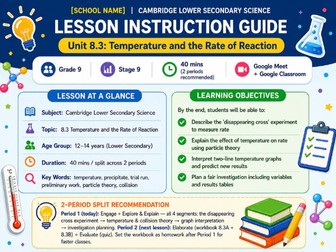
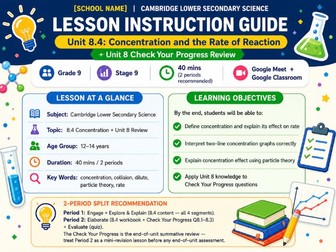
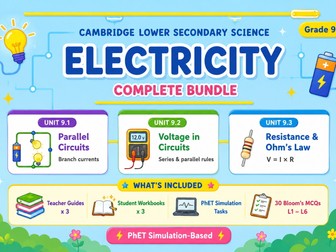
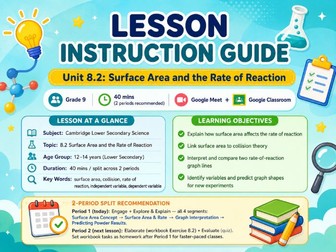
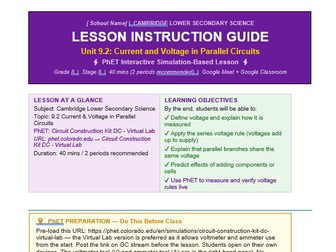
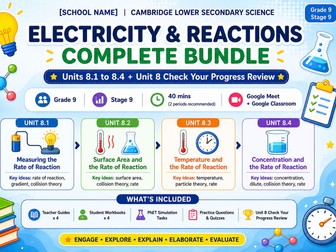
Cambridge Lower Secondary Science: Unit 9.2: Current & Voltage in Parallel Circuits | Teacher Guide + Student Workbook + PhET Make electricity engaging and easy to understand with this complete teaching package for Cambridge Lower Secondary Science Stage 8. This resource combines a comprehensive Teacher Instruction Guide with a Student Workbook Assignment, all built around the PhET Circuit Construction Kit: DC Virtual Lab. Students do not just learn the theory—they investigate, measure, predict, and verify electrical principles through interactive simulations. What’s Included Detailed Teacher Lesson Guide Ready-to-use Google Classroom posts Live teaching scripts for Google Meet or classroom instruction PhET Virtual Lab activities with voltmeter and ammeter investigations Student Workbook with guided activities and textbook exercises Series and parallel voltage investigations Current and voltage calculation practice 10-question Bloom’s Taxonomy MCQ Quiz Assessment and scaffolding strategies Parent communication template Learning Outcomes Students will be able to: Define voltage and explain how it is measured Use voltmeters and ammeters correctly Apply the series voltage rule: Supply voltage = sum of component voltages Explain why all branches in a parallel circuit have the same voltage Predict how adding components affects brightness, voltage, and current Use simulations to investigate electrical circuits independently Perfect For Cambridge Lower Secondary Science (Stage 8) Grade 9 Electricity and Circuits Online and face-to-face teaching Google Classroom and Google Meet lessons STEM and inquiry-based learning environments This colorful and interactive resource encourages conceptual understanding through experimentation, making abstract electrical concepts easier for students to visualize and master.
CAMBRIDGE LOWER SECONDARY SCIENCE LESSON INSTRUCTION GUIDE Unit 9.1: Parallel CircuitsQuick View
hamidme

CAMBRIDGE LOWER SECONDARY SCIENCE LESSON INSTRUCTION GUIDE Unit 9.1: Parallel Circuits

(0)
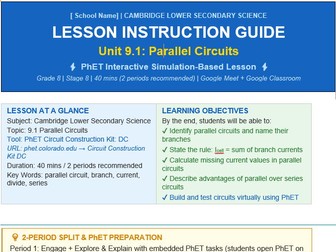
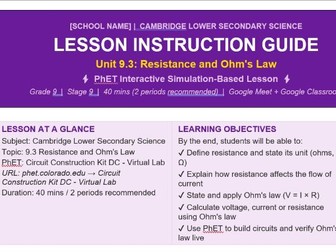
Cambridge Lower Secondary Science – Unit 9.1 Parallel Circuits (Teacher Instruction Guide + PhET Activities) Bring electricity to life with this engaging, ready-to-use Cambridge Lower Secondary Science lesson on Parallel Circuits. This comprehensive Teacher Instruction Guide is designed for Stage 8 / Grade 8 and integrates the PhET Circuit Construction Kit: DC simulation to provide students with a hands-on virtual laboratory experience. What’s Included ✓ Complete lesson plan (40 minutes / 2 periods) ✓ Teacher scripts and classroom explanations ✓ Google Classroom stream and homework posts ✓ Interactive PhET simulation activities ✓ Guided investigations on series vs parallel circuits ✓ Current calculations and problem-solving exercises ✓ 10-question multiple-choice assessment ✓ Differentiation and scaffolding strategies ✓ Parent learning update template Learning Objectives Students will learn to: Identify parallel circuits and their branches Explain how current divides in parallel circuits Apply the rule: Cell current = Sum of branch currents Calculate missing current values Explain why parallel circuits are used in homes and vehicles Build and test circuits using the PhET simulator Ideal For Cambridge Lower Secondary Science (Stage 9) Grade 9 Science Electricity and Circuits Units Online, hybrid, or face-to-face teaching Google Classroom and Google Meet environments This resource emphasises inquiry-based learning, real-world applications, and interactive simulations, helping students move beyond memorisation to genuine understanding of electrical circuits.
CHEMICAL FORMULAEQuick View
hamidme

CHEMICAL FORMULAE

(0)
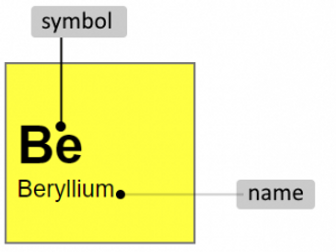
This resource cover a unit of lesson for IGCSE grade 9-10 chemistry. By the end of this unit, you should be able to: write symbols for chemical elements and formulas of chemical compounds deduce the formula of a simple compound from the relative number of atoms present Learn more from scienceklinic website
IGCSE CHEMISTRY: CONSTRUCT WORD EQUATIONS AND SIMPLE BALANCED CHEMICAL EQUATIONS.Quick View
hamidme

IGCSE CHEMISTRY: CONSTRUCT WORD EQUATIONS AND SIMPLE BALANCED CHEMICAL EQUATIONS.

(0)
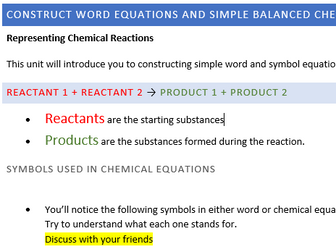
Significance This is an activity/lesson note for grades 9 - 10 (IGCSE/GCSE) students. This method of teaching allows active participation of learners in every parts of the lesson. Learners work based on the instruction in the activity sheets making it easy for an instant assessment by the teacher. Usage The teacher will distribute the sheets to the learners with/without introduction. Learners can work in groups or individually based on the discretion of the teacher. It is encouraging to measure the understanding of the topic through instant assessment.
Chemical FormulaQuick View
hamidme

Chemical Formula

(0)
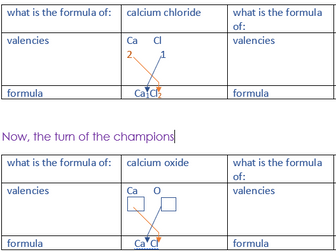
Significant This is an activity/lesson note for grades 9 - 10 (IGCSE/GCSE) students. This method of teaching allows active participation of learners in every parts of the lesson. Learners work based on the instruction in the activity sheets making it easy for an instant assessment by the teacher. Usage The teacher will distribute the sheets to the learners with/without introduction. Learners can work in groups or individually based on the discretion of the teacher. It is encouraging to measure the understanding of the topic through instant assessment.