Here is a plan for which I got outstanding feedback for a day planned with no writing only talking. It contains English, Maths and Science ideas as well as a couple of cross-curricular ideas.
Using the word classes: noun, verb, adjective, preposition, adverb, determiner, pronoun and conjunction, players compete to first be able to create a sentence that makes sense and secondly to have created the silliest or funniest sentence in each round. The game aims to reinforce words that belong to the different word classes (GPS paper in mind) as well as encouraging thought around verb tenses. The verb cards are only in simple present tense so each player has to modify their verbs to match the subject and what tense they want their sentence in. I have found it a good way to encourage reluctant writers to really think about sentence construction. I have included some cards for each word class but we often add to the cards (colour-coded for that reason!) especially with words we are practicing.
Spelling board game for Y3/4 exception words, incorporating prefixes, suffixes and sentence creation. I made this board game as learning these spelling words can be dull. This game gives a bit of fun to learning those key words from the national curriculum. Included is a board with 23 of the Y3/4 words on and the instructions for 3 different games which can be played with it. There are game scoring cards included - although whiteboard recording would also work - depending on your need for evidence gathering. There are also 23 word cards which can be folded so the word in on one side and the definition and use of the suffixes and prefixes are on the other side for self checking in games 2 and 3. If enlarged and printed on A3 several children can play. I personally use it for it pairs. Hope this helps someone.
12 lesson unit on folk tales based on the book The Village that Vanished. This ties in with Black History Month as the book covers the attack of slavers on an African Village. The plans include cold write and hot write suggestions and covers speech punctuation as well as character and setting development. It uses the basic structure of the book to help children plan their own folk tales on something that vanishes in order to be saved.
Phase 1, 2 and 3 for myths and legends in year 5. Classifying text types, comparing two different versions of the same story and exploring open and closed questions. Hope it is helpful. Please leave a comment.
Here are a set of powerpoints and activities for adding the suffixes -ment, -ness, -ful, -less and -ly. These can be used with Y2 children or Y3 to Y6 as revision of the rules and with activites that can be used as evidence of being able to spell these endings independently to compliment evidence gathered from their independent writing.
Planning based on jemmy Button with outcome of writing a similar biographical story about one of the other protagonists -Captain Fitzroy, Charles Darwin, or one of the other captives. There are lessons on possessive apostrophes for singular and plural possession, comparatives and speech layout and punctuation. Expanded noun phrases and fronted adverbials are re-visited and the importance of varying sentence lengths discussed. There are about 20 lessons include with differentiated activities for some of the lessons.
Powerpoint to highlight the importance of a powerful opening in a narrative. I encouraged my class to write three different openings from different perspectives or in a different writing style. They then chose the one that created the best atmosphere and that set the style for the rest of their narratives. Please leave a comment.
Planning and IWB pages for five weeks of English lessons. Covering dialogue, fronted adverbials and descriptive language. There is a lot of talk for writing included with role on the wall, story mapping, partner talk, hot seating and role play. The main outcome is to write a journey story where the main character not only travels but changes within themselves as well. There are mini write of poetry, diaries and letters.
A simple frame for you to add problems to, to unpick misconceptions and provide links between different areas of the Maths curriculum. I would do this on A3 and laminate so that they can be used for different topics and problems. I found that these really drew out discussion and allowed me to focus on different methods which my class were less sure about but which would have been more efficient.
I would suggest using problems from NCETM to really get your pupils thinking.
Aimed at a mixed year 3/4 class to complement topic work on Vikinings this is a two to three -week scheme of work that looks at Beowulf by Michael Morpurgo. It focuses on Fronted Adverbials, Prepositions, similies and metaphors as well as character development, repetition and use of paragraphs. It ends with focus on the speaking objective reads aloud own writing using appropriate intonation and controls the tone and volume so meaning is clear.
4 weeks of planning using Moon Man by Tomi Ungerer. Looking at persuasive letter writing, poetry, newspaper reports, expanded noun phrases, fronted adverbials and present perfect form. There are resources as well as the plans and presentation. It also covers inference, prediction and author voice. It is aimed at Year 4 but could be used for year 5 as well.
This is an entire scheme of work for a block on myths for a mixed year 3/4 class. It has full detailed plans, medium term plans, starters, activities, differentiation and intended outcomes. Main grammar and sentence level objectives are to use and punctuate speech correctly, use fronted adverbial followed by a comma, understand the difference between the plural and possessive -s and to correctly use apostrophes in the singular possessive and plural possessive -s, to vary sentence length to mirror a character's feelings and to use subordinating conjunctions to create complex sentences. I have written the model text used myself to ensure all the main objectives were included within it. I have written in the plans the other texts I have used which are available from libraries, good bookshops and on-line. I hope these will save you time - it took me ages to write and create all the resources.
A four week set of plans based on Leon and the Place Between aimed at a year four class with differentiated activities covering expanded noun phrases, fronted adverbials, vocbulary development, author voice, and character development through diary entry writing, playscript construction, oral rehearsal and learning the story structure. There is also planned lessons for editing and self-evaluation in this set of plans.
11 lessons using 'Throwing a Tree' by Thomas Hardy as the model text. Children explore figurative language and develop preposition use, alliteration and are introduced to other uses of colons and semi-colons. They write an extra verse for the poem and then use its features to innovate on the poem to write from the tree's perspective. They then write independently about another change that could happen around them.
A whole unit on adventure stories with model text, activities, plans and resources. Aimed at mixed year 3 and 4 class covering subordination, perfect present tense, a and an use, exoanded noun phrases, fronted adverbials, speech. I have given ideas for how to engage the children within the plans and have written the model text to reflect the grammar and punctuation of year 3 and 4's.
Aimed at a mixed year 4/5 class this Geography unit covers biomes, land use and natural resources by looking at the three forest biomes - boreal (taiga), temperate deicduous and rainforests. It includes a pre-planning lesson to help generate children's own questions. Most lessons have differentiated challenges (two lessons are the same task for every child and will be differentiated by outcome) using chili challenges which the children choose which task to do themselves. There is writing outcomes, multi-media outcomes and art outcomes. You could use these as they are or adapt to meet your own class' questions.
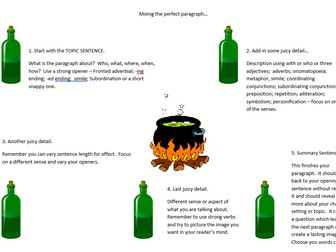
Plan looking at the elements of fairy stories and how we can use these to create our own. Lots of work on building paragraphs and varying sentence types and structures for a year 4 class. Opportunities built in for planning, drafting, editing and re-writing. Visual aids and prompts created and included to help year 4’s with building strong paragraphs.
8 hours of planning (4 full afternoons in blocking of subjects) for materials year 5 looking at irreversible and reversible changes, dissolving, seiving, filtering and evaporating and well as sorting materials based on their properties. This is all done within the guise of a crime scene where a professor has gone missing while he was working on a top secret millitary project.
Aimed at mixed year 5/6 class focussing on producing a high quality descriptive story. Pack includes two lesson plans, powerpoint and homework for the children to complete prior to the writing session. Learning objectives are to use modal verbs to indicate degrees of possibility and to use a range of relative clauses including who, which, -ing and -ed suffixes. I had the children talking about the modal verbs and then we played a game (see plan) - the children then used some of the modal verbs in their creative writing.