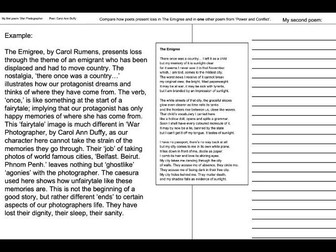
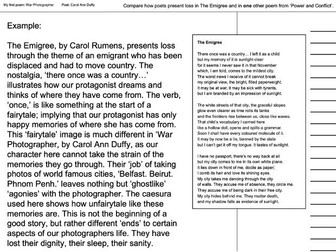
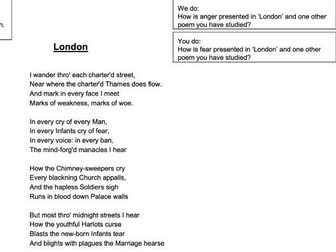
This resource helps students practice the important skill of annotating a poem at the beginning of an exam, adapting their knowledge of the poem to the question provided.
Two questions are asked for each of the poems in the anthology to allow for the teacher to model how to do this according to the way they teach students to do so, before an opportunity for students to then practice themselves.
A revision resource that allows students to prepare for the Power and Conflict part of their exam by forcing them to compare four poems to a poem given to them.
This reinforces their knowledge of their favourite poems, ensuring they have to adapt this knowledge to a variety of questions and poems.
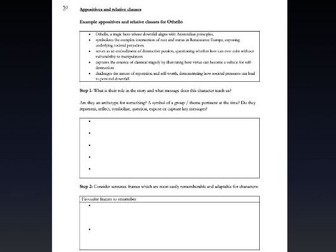
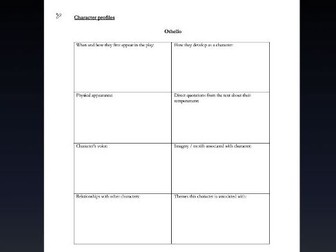
A revision resource to help students think about characters in a deeper way.
The resource provides examples of a range of noun appositives/relative clauses that include ideas such as what the characters symbolize, represent or reflect.
Space is provided for students to think of their own before deciding what ones they will focus on ahead of essay writing.
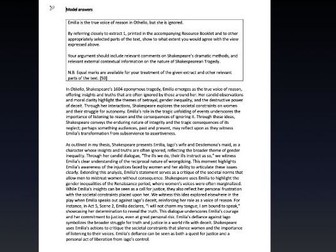
Model answers for Shakespeare’s play, ‘Othello.’
Answers respond to the following questions:
Emilia is the true voice of reason in Othello, but she is ignored.
**
By referring closely to extract 1, printed in the accompanying Resource Booklet and to other appropriately selected parts of the text, show to what extent you would agree with the view expressed above.
Cassio’s downfall is a result of his own weaknesses rather than Iago’s manipulation.
By referring closely to extract 2, printed in the accompanying Resource Booklet and to other appropriately selected parts of the text, show to what extent you would agree with the view expressed above.
Roderigo’s role in Othello highlights the destructive power of jealousy and obsession.
By referring closely to extract 3, printed in the accompanying Resource Booklet and to other appropriately selected parts of the text, show to what extent you would agree with the view expressed above.
Roderigo is merely a tool for Iago’s manipulation rather than a fully developed tragic character.
By referring closely to extract 1, printed in the accompanying Resource Booklet and to other appropriately selected parts of the text, show to what extent you would agree with the view expressed above.
Shakespeare presents Emilia as the play’s most morally courageous character.
By referring closely to extract 1, printed in the accompanying Resource Booklet and to other appropriately selected parts of the text, show to what extent you would agree with the view expressed above.
Cassio is the only character in Othello who truly deserves redemption.
By referring closely to extract 1, printed in the accompanying Resource Booklet and to other appropriately selected parts of the text, show to what extent you would agree with the view expressed above.
This book has been created for AS Level students studying Wuthering Heights through the CCEA exam board.
I am an experienced English teacher with a range of leadership roles across English departments. I was inspired to write this book due to the scarcity of similar resources across different texts and different exam boards.
While nearly every text in every exam board has some form of revision book available, very few focus on specific, explicit strategies for students to actively improve their essay writing- whether at a structural level or in the fine details of individual sentences.
This is the purpose and aim of this book.
To provide practical suggestions to students on how improve the way they communicate their ideas effectively.
Whilst it is possible that you can use the interpretations and ideas explored in this book as touchstones to guide and challenge your own thoughts and revision, this book will not provide revision of Wuthering Heights in a way that other guides do, as suggested above.
This book will break down the Chief Examiner’s report, making it clear what effective and ineffective writing looks like as a result. It will dissect each assessment objective, showing you how to refine and improve your writing in relation to them. Through multiple examples and structured practice opportunities, you’ll be able to develop your skills across characters and themes for each objective.
This book will guide you beyond formulaic PEEL, PETAL / acronymic style essays, helping you develop insightful, coherent and analytical writing. You’ll learn to structure your essays effectively and compelling, enabling you to articulate your ideas with depth and purpose.
I warmly welcome feedback and reviews from students, parents and teachers, as I continue to refine and expand approaches to writing better essays.
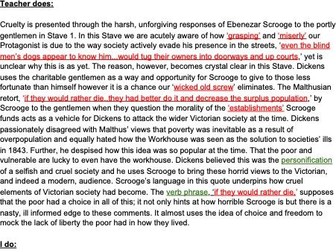
A range of exam style questions on Dicken’s Novella ‘A Christmas Carol’ with example paragraphs completed by the teacher that students can use to write their own underneath. There are 7 exam questions, 7 example paragraphs and some ‘challenge tasks’ for students to complete at the end.
A presentation which requires students to compare their four favourite poems to the poem given in the middle. Each of the 15 poems are provided with a question to compare to the four favourite poems of the student. The aim is to embed knowledge of their four favourite poems and give them an opportunity to compare to every other poem.
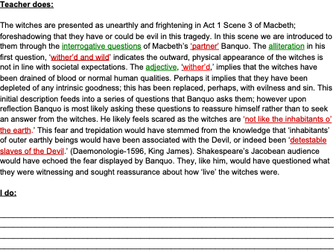
A range of exam style questions on Shakespeare’s play ‘Macbeth’ with example paragraphs completed by the teacher that students can use to write their own underneath. There are 8 exam questions, 8 example paragraphs and some ‘challenge tasks’ for students to complete at the end.
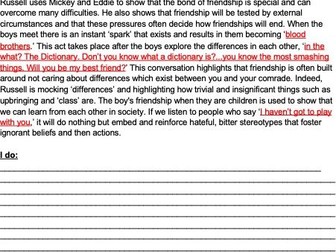
A range of exam style questions on Willy Russell’s play ‘Blood Brothers’ with example paragraphs completed by the teacher that students can use to write their own underneath. There are 8 exam questions and 8 example paragraphs.
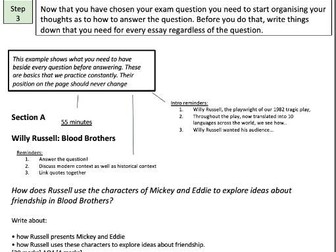
A booklet which instructs students how to annotate the Blood Brothers exam question in the AQA English Literature Exam.
Guided practice followed by independent practice.
Adaptable for other texts in the same section.


 Quick View