French End of Term QuizQuick View
rrmilnes22

French End of Term Quiz

(0)
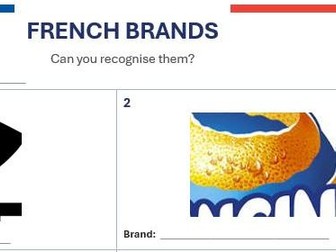
A fun, printable KS3 French culture quiz for Year 8, featuring five rounds on French brands, famous people, food, sport, music and perfume. This engaging French end of term quiz focuses on life and culture in France rather than testing detailed vocabulary or grammar. It is ideal for the final French lesson of the term, an MFL enrichment lesson, form time, a cover lesson or an end of year activity. The resource contains five visually presented quiz rounds: • French brands picture round • French culture and general knowledge • Famous French people picture round • A second French culture round • French perfume and fashion-house picture round Questions cover French landmarks, national celebrations, food, cities, transport, sport, football, cycling, music, film, television, comics, fashion, famous personalities and contemporary French culture. Pupils identify well-known French brands, public figures and designer fragrances from carefully selected images. The quiz is particularly suitable for Year 8, but it could also be used with Year 7 or Year 9 classes. Pupils can complete it individually, in pairs or in teams. The mixture of accessible questions and more challenging picture clues allows pupils of different abilities to contribute. The resource is supplied as an editable Microsoft Word document, so questions and images can be adapted for different classes. A separate one-page teacher answer sheet is included. The complete quiz is worth 56 points, with two points available for each perfume image: one for the French fashion house and one for the fragrance name.
Democracy & Athenians Textbook Companion - OCR Classical Civilization Component 34Quick View
rrmilnes22

Democracy & Athenians Textbook Companion - OCR Classical Civilization Component 34

(0)
An editable 117-page OCR A Level Classical Civilisation H408/34 workbook for Democracy and the Athenians, designed to accompany the Bloomsbury textbook. This comprehensive student booklet follows the structure of the Bloomsbury Component 34 textbook and provides organised space for students to complete its activities, study questions, modern parallels, stretch and challenge tasks, topic reviews and examination practice. It is suitable for classroom teaching, independent study, homework, consolidation and revision. The resource is organised around the complete OCR Democracy and the Athenians course, including Solon, Cleisthenes, fifth-century democratic developments, Ephialtes, Pericles, the institutions of Athenian democracy, the Assembly, Boulē, law courts, sortition, ostracism, the Athenian Empire, democracy idealised, democracy criticised and democracy in Old Comedy. All OCR H408/34 prescribed literary sources are gathered in one place: Aeschylus’ Eumenides; Euripides’ Suppliants; Aristophanes’ Acharnians, Assemblywomen, Knights, Peace, Wasps and Frogs; Thucydides’ Peloponnesian War; Plato’s Republic; and Pseudo-Xenophon’s Constitution of the Athenians, also known as the Old Oligarch. The booklet supports source analysis, comparison of ancient evidence, evaluation of Greek democracy and engagement with modern scholarship. Features include: • direct page references to the Bloomsbury textbook • clearly structured writing spaces • complete prescribed source passages • AO1 knowledge and AO2 analysis practice • 1-mark, 2-mark, 10-mark, 20-mark and 30-mark exam-style questions • topic review and revision activities • modern scholarship and wider-reading prompts • an editable Microsoft Word format for adaptation to your own classes Ideal for Year 12 and Year 13 students studying OCR A Level Classical Civilisation Component 34. Checked against the current OCR H408 specification in July 2026.
KS4 Physics Knowledge OrganisersQuick View
rrmilnes22

KS4 Physics Knowledge Organisers

(0)
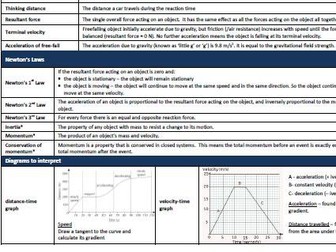
A complete set of editable GCSE Physics knowledge organisers for Years 9, 10 and 11, covering energy, electricity, forces, waves, space and atomic physics. This bundle contains 11 clear, visually presented physics knowledge organisers designed to summarise the essential knowledge pupils need for each topic. A knowledge organiser is a concise reference sheet that brings together key terminology, definitions, scientific facts, equations, tables and labelled diagrams in one accessible place. The following topics are included: • Domestic Electricity • Electric Circuits • Energy Resources • Energy Transfers • Atomic Structure • Particle Model • Electromagnetism • Forces • Motion • Space Physics • Waves Each knowledge organiser follows a consistent, professionally formatted style, making it easy for pupils to locate important information. The sheets include key scientific vocabulary, concise explanations, comparisons, equations, diagrams and topic-specific examples. The Atomic Structure organiser, for example, covers atomic models, isotopes, radioactive decay, half-life, nuclear radiation, fission and fusion. These physics revision resources can be used for: • Independent revision • Retrieval practice • Homework and pre-learning • End-of-topic revision • Catch-up and intervention work • Supporting pupils during lessons • Exam preparation • Printing for exercise books or revision folders All 11 organisers are supplied as editable Microsoft Word documents, allowing teachers to adapt the content for their own classes or curriculum. The Motion knowledge organiser is also included as a PDF for straightforward printing and sharing.
BTEC Applied Science Unit 5 Thermal Physics BTEC NationalsQuick View
rrmilnes22

BTEC Applied Science Unit 5 Thermal Physics BTEC Nationals

(1)
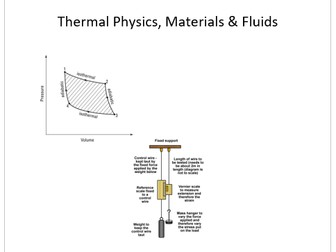
BTEC Applied Science Unit 5 Physics Resources – Comprehensive Scheme of Work and Support Materials This premium resource is tailored specifically for the Physics section of Unit 5 from the BTEC Level 3 Applied Science syllabus, focusing exclusively on thermal physics, materials, and fluids in motion. Designed for teachers delivering this core unit, this resource ensures students are well-prepared for the exam’s Physics component, which forms a key part of the Principles and Applications of Science II (Unit 5). The resource includes a detailed scheme of work that aligns directly with the BTEC specification, covering essential topics like the laws of thermodynamics, specific heat capacity, and energy transfer in systems. For the materials topic, students will explore mechanical properties such as stress, strain, and Young’s modulus, alongside practical applications in engineering and design. The fluids in motion section dives into concepts such as density, viscosity, fluid dynamics, and the principles of Archimedes’ and Bernoulli’s laws. Key features of this resource include: Clear lesson plans that break down complex Physics topics into manageable, student-friendly sections. Custom worksheets and designed to reinforce theoretical knowledge through practical examples and interactive activities. A variety of calculations-based practice questions with step-by-step solutions, helping students master exam-style problems, including applying formulae for energy, efficiency, and fluid flow. Summative revision materials tailored to boost confidence in applying thermal energy principles, stress-strain calculations, and analysing fluid mechanics in real-world contexts. Exam-style questions specific to Physics, with detailed mark schemes to help both teachers and students understand assessment criteria. This resource is perfect for educators looking to streamline their delivery of the Physics section and provide their students with structured, comprehensive support. Each activity and worksheet is aligned with BTEC learning outcomes and mapped to Assessment Objectives (AO1 to AO4), ensuring all critical Physics concepts are covered. Whether you’re teaching thermal energy transfer in systems, exploring mechanical properties of materials, or calculating the dynamics of fluids in motion, this resource supports students in developing both their theoretical understanding and practical application skills. All content is curated to meet the demands of the external assessment and enhance learning through interactive and engaging methods. Enhance your teaching with this BTEC Applied Science Physics resource, ensuring students achieve their best results in Unit 5.
Aeneid World of the Hero -Textbook CompanionQuick View
rrmilnes22

Aeneid World of the Hero -Textbook Companion

(0)
OCR Classical Civilisation World of the Hero. A work book to complement the Bloomsbury textbook. This is purely for the Aeneid section of the text book, from p141 onwards. It allows for students to keep all their responses to the textbook exercises in one location. Aeneid: World of the Hero – Comprehensive Textbook Companion for A Level Classics This resource is a meticulously crafted companion to the Aeneid section of the “World of the Hero” textbook, designed specifically for A Level Classics students and educators. Whether you’re studying Virgil’s epic poem for the first time or seeking to deepen your understanding, this resource provides a structured and precise companion to the textbook covering one of the most important works of classical literature. The resource complements the textbook which itself is tailored to align with the OCR, and A Level specification, ensuring alignment with exam boards’ requirements and offering students a focused understanding of the epic genre, Roman values, and Virgil’s literary techniques. This is a blank companion book that allows the students to work through the text book and keep all of their responses in one simple document. Teachers familiar with the Bloomsbury resources will appreciate the key features of the text In-depth analysis: Each section of the Aeneid is thoroughly examined, with detailed notes on key passages, characters, themes, and literary devices. Topics such as Aeneas’ leadership, the portrayal of pietas (duty), and the relationship between humans and the divine are explored in depth. Textual context: The resource provides essential historical and cultural context, offering insight into how the Aeneid reflects Augustan Rome’s values, politics, and propaganda. Critical thinking prompts: Engaging questions throughout the resource encourage students to critically evaluate themes like heroism, fate, and the conflict between personal desire and public duty, promoting analytical skills required for top exam grades. Exam preparation support: Includes exam-style questions, model answers, and a guide to writing high-level essays, helping students develop their arguments and master the skills needed for success. Interactive activities: Activities designed to support deeper understanding of Virgil’s narrative techniques, such as his use of similes, symbolism, and intertextual references to Homer’s Iliad and Odyssey. Who is this resource for? This companion is ideal for students studying the Aeneid as part of the “World of the Hero” module, as well as educators looking for a flexible and accessible resource to support their teaching. Whether you’re focusing on Aeneas’ role as the archetypal Roman hero, exploring the themes of war and peace, or analysing the epic’s poetic structure, this resource will guide you through every step. With its detailed focus on the Aeneid’s central themes and exam-relevant insights, this resource is an indispensable tool for achieving excellence in A Level Classics.