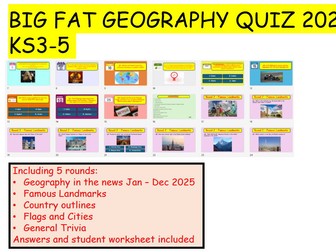
The Big Fat Geography Quiz 2025 is a fun, fast-paced, curriculum-friendly quiz designed for KS3–KS4 geography students. Packed with current global events, visual challenges, and cross-curricular trivia, this resource is perfect for end-of-term lessons, form time, cover work, or whole-school competitions.
Answers and Student Worksheet included.
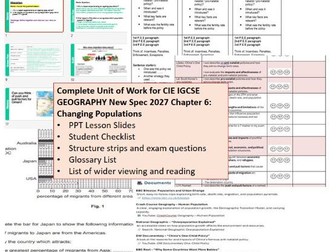
Complete Unit of Work for CIE IGCSE GEOGRAPHY New Spec 2027 Chapter 6: Changing Populations
PPT Lesson Slides - High quality!
Student Checklist
Structure strips and exam questions
Glossary List
List of wider viewing and reading
Homeworks
Model Answers
Exam Skill
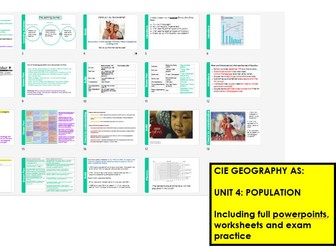
CIE Geography 9696 – Unit 6: Population
A comprehensive, ready-to-teach lesson unit fully aligned with the Cambridge International AS Level Geography (9696) syllabus.
Covers all required content with clear structure, engaging tasks, and assessment practice.
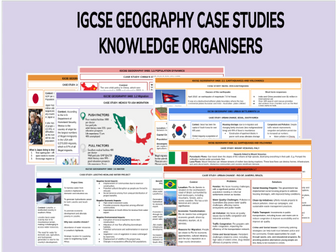
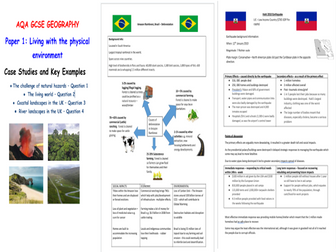
A full set of knowledge orgarnisers for Geography (0460) Cambridge International Exams revision, including Case Studies.
All KO on PPT easily adaptable.
All three themes covered:
** Population and settlement**
1.1 Population dynamics
1.2 Migration
1.3 Population structure
1.4 Population density and distribution
1.5 Settlements (rural and urban) and service provision
1.6 Urban settlements
1.7 Urbanisation
The natural environment
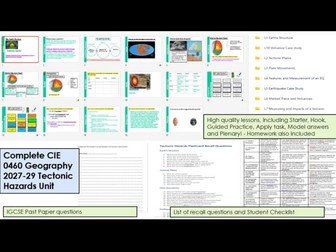
2.1 Earthquakes and volcanoes
2.2 Rivers
2.3 Coasts
2.4 Weather
2.5 Climate and natural vegetation
Economic development
3.1 Development
3.2 Food production
3.3 Industry
3.4 Tourism
3.5 Energy
3.6 Water
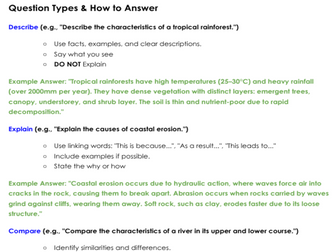
The Ultimate CIE IGCSE Geography (0460) Answering Guide!
Struggling with exam technique? This comprehensive guide is your go-to resource for mastering Paper 1, Paper 2, and Paper 4 of the CIE IGCSE Geography exam! Packed with example questions, model answers, and expert tips, this guide will help you:
Understand what examiners are looking for – Learn how to break down different question types, from short-answer to extended responses.
Ace 7-mark case study questions – Master structured answers with real-world examples and mark scheme insights.
Tackle Paper 4 like a pro – Get step-by-step guidance on hypothesis testing, sampling, data collection, analysis, conclusion writing, and evaluation.
Improve fieldwork skills – Learn how to present data effectively using graphs, charts, and maps, and evaluate reliability like a top student.
Boost your revision – Includes top study methods, useful websites, and examiner-approved techniques to maximize marks.
Perfect for students aiming for top grades! Whether you’re preparing for mocks or final exams, this guide takes the guesswork out of answering geography questions and helps you write like a high-achiever.
if you found the booklet useful please leave a review,
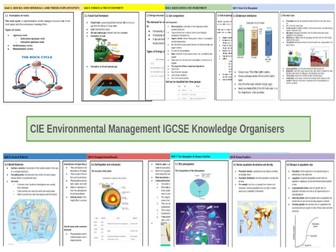
Here’s a complete set of knowledge organisers for CIE IGCSE Environmental Management (0680). These are useful for students, teachers, and revision purposes.
Rocks and Minerals and their Exploitation
Energy and the Environment
Agriculture and the Environment
Water and its Management
Oceans and Fisheries
Atmosphere and Human Activities
Biodiversity and Ecosystem Loss
Human Population
Natural Hazards
Earth’s Resources and Environmental Management
If you find them helpful, I’d appreciate a review!
This comprehensive guide provides clear explanations and practical examples on essential programming concepts like data use, sequence, selection, iteration, and operators. With a focus on pseudocode, you’ll learn how to break down complex tasks into simple, readable steps, making coding easier to understand and implement, perfect for students studying Computer Science.
Key Features:
Beginner-friendly programming concepts: Learn essential concepts like variables, constants, arrays, loops, and operators with easy-to-understand examples.
Step-by-step pseudocode breakdown: Dive into essential pseudocode structures such as declaration, initialization, and program writing, with examples you can apply right away.
Hands-on examples: Practice with a wide variety of programs, from basic variable assignments to more advanced iterations and condition checks.
Clear rules and structure: Understand the syntax rules for naming variables and constants, and apply these rules across different types of data (STRING, INTEGER, BOOLEAN, etc.).
Real-life applications: Use the guide to work through practical coding tasks like calculating totals, averages, and handling user input, all while reinforcing key programming principles.
Ready-to-use teaching materials include engaging lesson slides, information pages, and worksheets—perfect for structured learning and independent study.
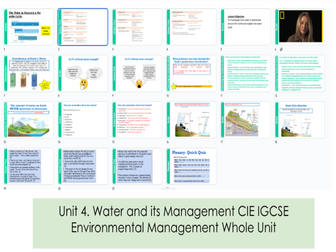
L1: Water Cycle and water as Resource
L2: Water Uses and Supply
L3 and L4: Water availability and its impacts
L5 and L6: Dams
L7: Water Pollution
L8: Improving Water Quality
L9: Waterborne diseases
If you found these resources usesful please leave a review.
Our ready-to-use teaching materials include engaging lesson slides, information pages —perfect for structured learning and independent study.
L1: Introdiction to Oceans and Fisheries
L2: Oceans as a resource
L3: Ocean Currents and El Nino
L4: Fish Distribtion and Problems
L5: Fisheries and Sustainable Fishing
If you are happy with the resorces please leave a resource.
Summary of IGCSE Geography Population Dynamics Revision Flashcards
This set of IGCSE Geography Population Dynamics Revision Flashcards covers essential topics related to population growth, change, and policies, providing clear explanations and case study examples aligned with the CIE syllabus (1.1 – Population Dynamics).
Key Topics Included:
Causes of Population Growth – Factors leading to rapid population increase (e.g., improved healthcare, sanitation, and economic growth).
Over-Population & Under-Population – Definition, causes, consequences, and real-world examples.
Factors Affecting Population Size – Birth rate, death rate, migration, and how they influence population growth or decline.
Contrasting Rates of Natural Population Change – Reasons behind high and low growth rates in different countries.
Population Policies – Strategies governments use to manage population change (e.g., pro-natalist and anti-natalist policies).
Impact of Social & Economic Factors – How healthcare, education, employment, and government decisions influence population trends.
Case Studies:
*Bangladesh (Over-Populated) – High population density, resource pressure, and social challenges.
*Australia (Under-Populated) – Large land area, labor shortages, and immigration policies.
*Niger (High Growth Rate) – Young population, high birth rate, and economic impact.
*Japan (Population Decline) – Aging population, low birth rate, and government responses.
*China’s One-Child Policy – Enforcement methods, exceptions, and long-term effects.
These revision flashcards are ideal for IGCSE students preparing for exams, offering a structured and effective way to study key concepts and case studies. Perfect for classroom learning, independent revision, and last-minute exam prep!
IGCSE Geography Population & Migration Revision Flashcards
This set of IGCSE Geography Population & Migration Revision Flashcards covers essential topics related to migration, its causes, impacts, and case studies, aligned with the CIE/AQA syllabus (1.2 – Population Migration).
Key Topics Included:
Key terms
Causes of Migration
Types of Migration
Impacts of Migration
Migration Challenges.
Journey of Migrants
Case Study: Mexico - USA Migration
These revision flashcards are perfect for IGCSE students preparing for exams, offering a structured way to study key concepts, definitions, and case studies. Ideal for classroom learning, independent revision, and last-minute exam prep!
This set of IGCSE Geography River Revision Flashcards covers key topics related to rivers and drainage basins, providing concise explanations and case study examples.
Key Topics Included:
Hydrological Processes – Characteristics of rivers and drainage basins (e.g., watershed, tributaries, confluence).
River Processes – Erosion, transportation, and deposition.
Formation of Landforms – Waterfalls, potholes, meanders, oxbow lakes, floodplains, levees, and deltas.
Causes of Flooding – Physical (e.g., heavy rainfall, snowmelt) and human (e.g., deforestation, urbanization).
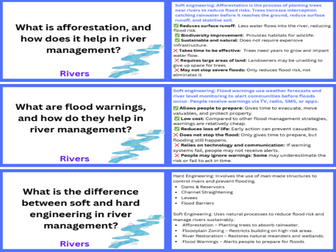
River Management – Hard and soft engineering strategies (e.g., dams, levees, afforestation, floodplain zoning).
Opportunities & Hazards – Benefits of living near rivers (e.g., fertile land, transport) and risks (e.g., flooding, erosion).
Case Study: River Nile – Opportunities, hazards, and management strategies.
These flashcards are ideal for IGCSE students preparing for exams, offering clear and structured revision material.
If happy with the resource please leave a review, much appreciated!
A complete set of lessons including:
Intro to Fieldwork
Data Collection
Data Analysis
Rivers Fieldwork
Coasts Enquiry
Human Enquiry
Paper 4 Walking talking Mock Slides
Student Booklet
Corrosponding worksheet
A complete set of lessons, worksheets and information pages for Unit 3: Agriculture and the Environment CIE IGCSE Environmental Management
What is soil and the soil cycle?
What is agriculture?
How do we increase crop yeilds?
What are the impacts of agriculture?
What is soil erosion erosion and its impacts?
How do we manage and reduce soil erosion?
How do we farm sustainable?
A comprehensive unit of work for CIE IGCSE Environmental Management Unit 2 Energy and Environment
Includes detailed and well structured lesson slides for both teacher and students.
Revision Material: Knowledge organisers and information pages.
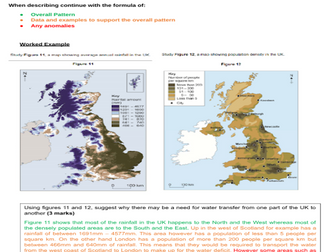
This document is a comprehensive CIE IGCSE Paper 2 Skills Booklet designed for Geography students preparing for Paper 2. It combines an in-depth guide to mapwork, skills-based practice, and detailed explanations, alongside practice questions. Additionally, it comes with a complete Answer Booklet, making it an all-in-one resource for both learning and self-assessment.
Key features include:
Exam Overview:
Covers Mapwork (33% of the marks) and evidence-based questions.
Provides guidance on required tools and exam-specific instructions.
Core Skills and Concepts:
Mapwork Skills: Includes grid references, contour interpretation, cross-section drawing, and map scaling.
Compass and Bearings: Teaches 16-point compass use and calculating bearings.
Data Interpretation:
Explains various graphical methods such as line graphs, bar charts, histograms, scatter graphs, and pie charts.
Offers guidance on identifying human and physical features, settlement patterns, and interpreting map evidence.
Practice Questions:
Features a wide range of practice questions tailored to develop proficiency in all tested areas.
Questions cover theoretical understanding and practical application.
Visual Learning Tools:
Includes sample maps, diagrams, and graph templates to enhance understanding.
Answer Booklet:
Provides clear, step-by-step solutions to all practice questions, enabling students to check their work and understand their mistakes.
This booklet, along with its answer guide, is an essential resource for students aiming to excel in the CIE IGCSE Geography Paper 2, offering structured support, ample practice opportunities, and guided self-assessment.
A comprehensive unit of work for CIE IGCSE Environmental Management unit 1. Rocks and Minerals.
Includes detailed and well structured lesson slides for both teacher and students.
Revision Material: Knowledge organisers and Student Notes and information pages.
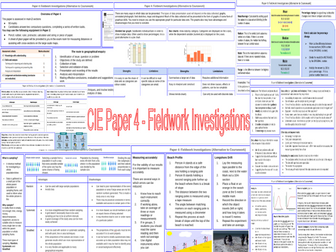
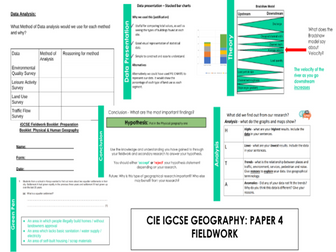
CIE IGCSE Geography Paper 4 (Fieldwork Investigations) Knowledge Organiser PPT and PDF!
A comprehensive knowledge organiser on Fieldwork Investigations! Great revision resource for students!
Includes;
Paper 4 Overview
How to write Hypothesis
Types of research; primary, secondary, quantative, qualitive
Types of Sampling: Ramdom, Systematic and Stratified
Risk Assessments
Metholdolgy: incl. Rivers, Coasts and Urban data collection examples
Different types of data presentations
Fieldsketches and Photographs
Statistical Data
How to write an analysis
How to write a conclusion
Evaluation
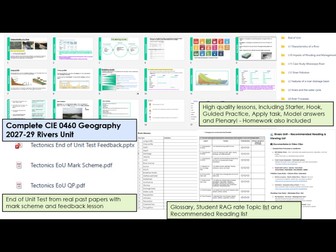
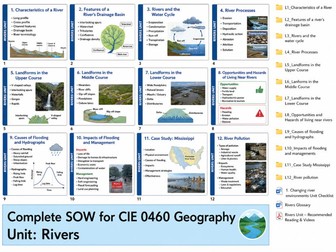
A complete unit of work on RIvers including; Lesson slides, worksheets, checlist, keyterm bank and information pages.
Lesson 1: Water Cycle
Lesson 2: A Rivers Journey
Lesson 3: Rivers at Work
Lesson 4: Landforms of the Upper Course
Lesson 5: Landforms of the Middle and Lower Course
Lesson 6: Floods
Lesson 7: Flood management
Lesson 8/Filler: Importance of Rivers