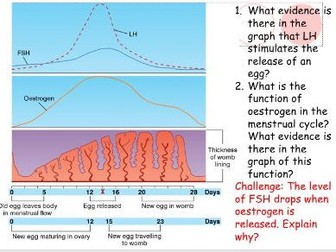
In this lesson, students will learn the roles, interactions and functions on the four main hormones that control the menstrual cycle. This lesson in complete with an info hunt and analysis of a graph task.
This pack is complete with powerpoint presentations and activities for the Homeostasis and Response unit of work. Resources include:
Lesson 1 - Homeostasis
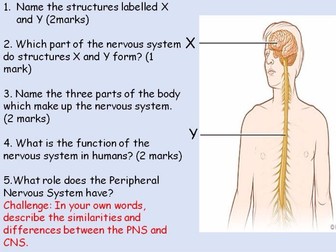
Lesson 2 - The nervous system (+ neuron labeling sheet)
Lesson 3 - Synapses (+synapses labeling sheet)
Lesson 4 - Reflexes
Lesson 5 - Investigating reaction time intro
Lesson 6 - Investigating how practice affects reaction time (required practical)
Lesson 7 - Analysing the reaction time investigation
Lesson 8 - The endocrine system
Lesson 9 - Controlling blood glucose (+storyboard activity sheet)
Lesson 10 - Diabetes and treatment
Lesson 11 - Interpreting diabetes graphs
Lesson 12 - The menstrual cycle
Lesson 13 - hormones in the menstrual cycle (+info search and activity sheet)
Lesson 14 - Contraceptives
Lesson 15 - Which contraceptive?
This pack contains powerpoint presentations and activities for the ecology unit of work. Many of the activities in this pack require students to have access to the AQA science textbook however, these can be easily adapted for use with any relevant textbook. Resources include:
Lesson 1 - Communities
Lesson 2 - Organisms in their environment
Lesson 3 - Abundance and quadrat sampling required practical
Lesson 4 - DIstribution and transect sampling required practical
Lesson 5 - Competition in animals and plants
Lesson 6 - Adapt and survive
Lesson 7 - Feeding relationships
Lesson 8 - Materials cycling
Lesson 9 - The carbon cycle
Lesson 10 - Human impact
Lesson 11 - Land and water pollution
Lesson 12 - Air pollution
Lesson 13 - Deforestation and peat destruction
Lesson 14 - Maintaining biodiversity
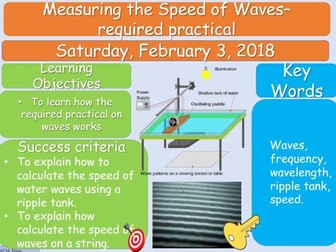
This resource is complete with a power point presentation for the required practical on measuring the speed of water waves using a ripple tank and the speed of waves on a string. A method sheet is also attached to help guide students through the practical activities.
This pack is complete with powerpoint presentations and activities for the particle model of matter unit of work. Resources include:
Lesson 1 - Density
Lesson 2 - Required practical: Calculating the density of regular and irregular objects
Lesson 3 - Changes of state
Lesson 4 - Specific latent heat
Lesson 5 - Particle motion in gases
Lesson 6 - Revision session
This pack is complete with powerpoint presentations and activities for the Waves unit of work. Resources include:<br />
Lesson 1 -Transverse and longitudinal waves
Lesson 2 - Properties of waves
Lesson 3 - Wave speed
Lesson 4 - Required practical: calculating the speed of waves
Lesson 5 - Refraction
Lesson 6 - EM waves
Lesson 7 - Uses of EM waves
Powerpoints and resources for 10 lessons in the B2 Photosynthesis module of the new AQA GCSE specification. These lessons were designed for the Collins specification but also work well for a CGP specification. Lessons include:
1) An introduction into photosynthesis
2) Uses of glucose
3) Structure of a leaf
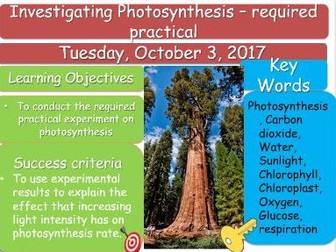
4) Investigating the effect of light intensity on the rate of photosynthesis: required practical
5) Rate limiting factors.
6) Increasing food production
7) Diffusion in living systems
8) Stomata and transpiration
9) Transpiration and translocation
10) Surface area to volume ratio
These lessons have been tailored to mid ability students but can easily be altered to accommodate for any student needs.
This pack contains powerpoint presentations and activities for the electricity unit of work. These lessons were delivered to a higher combined science group. Having a copy of the AQA physics workbook is advisable as there are a few activities in these powerpoints that require the completion of questions inside.
Lessons include:
Circuit symbols
Circuit Characteristics
Current and Voltage in series
Current and Voltage in Parallel
Required Practical - Investigating Resistance in Different Lengths of Wire
Required Practical - I/V Characteristics (Diode, bulb, resistor)
Resistance and V=IR
Resistance in Series and Parallel
Power
More on Power in Circuits
Wiring a Plug
Electricity in the Home
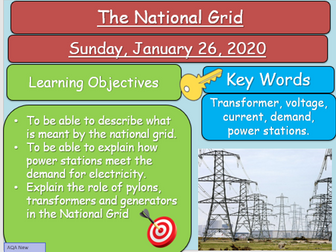
The National Grid
This pack contain powerpoint presentations and activites for the Rates of Reaction unit of work. These resources were plannned for an AQA higher combined science GCSE group. Lesson can be easily adapted to meet needs however, a copy of the AQA Chemistry workbook is advisable a couple of activities over the module involve answering these.
Resources include:
Lesson 1 - Rates of Reaction
Lesson 2 - Factors Affecting Rates of Reaction - Surface Area
Lesson 3 - Factors Affecting Rates of Reaction - Concentration (+required practical info sheet)
Lesson 4 - Factors Affecting Rates of Reaction - Catalysts (+practical info sheet)
Lesson 5 - Calculating Rates from Graphs (+graph sheets to print)
Lesson 6 - Reversible Reactions
Lesson 7 - Le Chatelier’s Principle
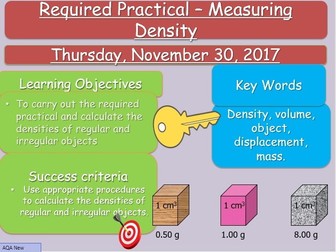
A powerpoint for the P3 required practical in which students must calculate the density of both regular and irregular objects. This powerpoint is complete with a background story into the practical (Archimedes and the crown) and a method complete with animations.
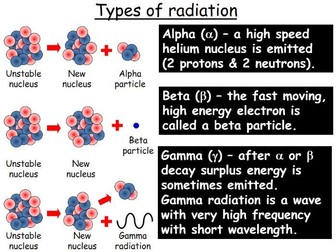
This pack is complete with a presentation and resources on radioactivity. This lesson contains good visual resources which, will allow students to: understand the differences between the types of radiation, complete and construct radioactivity equations for each type of radiation, and explain how dangerous each type of radiation is.
In this lesson, students will learn the differences between antibiotics and painkillers, how antibiotic resistance develops, and the origins of modern medicines. This lesson is complete with a sorting activity, a series of questions on antibiotic resistance, and a puzzle activity. There is also a lesson plan attached.
This pack is complete with powerpoint presentations and activities for a KS3 electricity unit of work. Much of the content of these lessons can be easily tailored to GCSE level.
Resources include:
Lesson 1 - Characteristics of a circuit
Lesson 2 - Static electricity
Lesson 3 - Symbols
Lesson 4 - Series circuits
Lesson 5 - Parallel circuits
Lesson 6 - Current in series and parallel
Lesson 7 - Voltage in series and parallel
Lesson 8 - Resistance
This pack contains lessons and activities for the energy changes unit of work. Many of the activities in this pack require students to have access to the AQA science textbook however, these can be easily adapted for use with any relevant textbook. Resources include:
Lesson 1 - Endothermic and exothermic reactions
Lesson 2 - Reaction profiles
Lesson 3 - Bond energies
Lesson 4 - Chemical cells
Lesson 5 - Fuel cells
Lesson 6 - review lesson
This pack is complete with powerpoint presentations for the atomic structure unit of work. Resources include:
Lesson 1 - The atom
Lesson 2 - Elements and compounds
Lesson 3 - Isotopes
Lesson 4 - Formulae and balancing equations
Lesson 5 - Separating mixtures
Lesson 6 - Separating mixtures - chromatography
Lesson 7 - Separating mixtures - distillation
Lesson 8 - Electronic structure
Lesson 9 - The periodic table and its development
Lesson 10 - Properties of metals and non-metals
Lesson 11 - Ion
Lesson 12 - Group 1 metals
Lesson 13 Group 7 elements
Lesson 14 - Group 0 elements
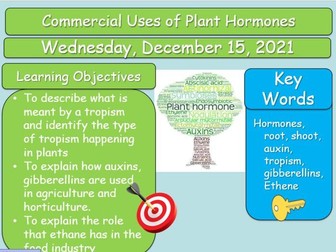
In this lesson, students will describe the different tropisms, explain how auxins, gibberellins are used in agriculture and horticulture, and explain the role that ethane has in the food industry. This lesson runs better if students have access to a textbook. This powerpoint contains the following activities:
A starter question race for the B5 topic
Using the AQA textbook or video to complete the table on the uses of auxins, gibberellins and ethane
Making an information leaflet on the three types of plant hormones (usually takes all lesson so can split into two lesson if desired)
Some exam-style CGP questions for assessment and answers