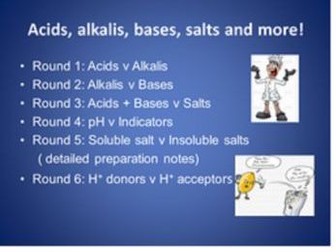
GCSE PPT on  Acids, alkalis, bases and saltsQuick View
Silky22

GCSE PPT on Acids, alkalis, bases and salts

(0)
This 38 slide PPT covers all the major features required for this GCSE topic: definitions (old and new), salt preparation in detail, pH and indicators . This covers at least 4 lessons including two tasks: writing balanced acid/base equations plus naming salts too. Fits in very nicely with practical work e.g indicator colours, salt preparation, measuring pH… Could also be used as a refresher for AS students.
Organic nomenclature made simpleQuick View
Silky22

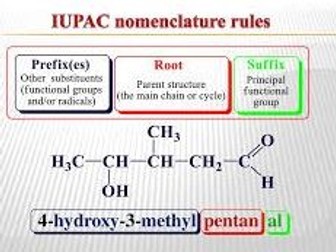
Organic nomenclature made simple

(0)
The Author, a member of IUPAC and an established examiner, “walks” you through the simple steps needed to name complicated Organic molecules correctly. Eight examples from a branched chain isomer of noname and nonene to brached chain ketones. Branched chain alcohols and carboxylic acids too.
(I) GCSE Organic chemistry: Alkanes to EstersQuick View
Silky22

(I) GCSE Organic chemistry: Alkanes to Esters

(0)
A systematic and comprehensive analysis of alkanes, alkenes, alcohols, carboxylic acids and esters. Seven chapters : 1: An introduction to different types of formulae, isomerism and IUPAC naming 2:Alkanes 3: Alkenes 4: Alcohols 5: Carboxylic acids 6: Esters 7: Exercises with answers, and mark scheme comments Author is a member of IUPAC and the Royal Society of Chemistry and an expert examiner for Pearson/ Edexcel.
(I)GCSE Chemistry equilibrium exercises+ answersQuick View
Silky22

(I)GCSE Chemistry equilibrium exercises+ answers

(0)
Author is an examiner, with one of the largest UK boards, and has 40 years of teaching experience and expertise. Eight questions involving seven different chemical equilibrium reactions, and the effect of changing the equilibrium conditions.Answers too! Use 1 or 2 questions for a quiz or the whole document for an end-of-unit test.
Organic chemistry made simpleQuick View
Silky22

Organic chemistry made simple

(0)
Organic Chemistry is a massive topic with thousands, tens of thousands of reactions. This lesson subdivides these reactions into the commonest types. The type of reactant(s) used to perform these different types of reaction is/are also highlighted. If you can “spot” the type of reaction taking place, your journey through Organic chemistry will be much easier, and fun! Reaction mechanisms are not included . Thats for the next lesson.
( I)GCSE Chemistry: Tips for marking scriptsQuick View
Silky22

( I)GCSE Chemistry: Tips for marking scripts

(0)
As an experienced marker for over a decade, I am sharing my experience of mark scheme protocols. What to do if a student gives an alternative answer to your mark scheme e.g uses superscripts, gives the wrong formula but balances the equation successfully, should we award a half-mark, gives more than one answer, gives a wrong test for an ion, but gives the right observation…? What about the correct answer to, say, an empirical formula , but with nonsense working? You get the point, I’m sure.