Comprehensive revision notes for all units in the AQA GCSE Psychology course, including studies and theories summaries (all examination requirements covered). Perfect for end of unit revision or examination preparations
Overviews included:
Memory
Perception
Development
Research Methods
Social Influence
Langauge Thought and Communication
Brain and Neuropsychology
Psychological Problems
Studies
Theories
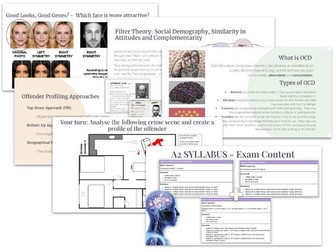
A brief but engaging and interactive selection of AQA A Level Psychology content material for Year 11 taster sessions. Sessions are designed for approximately 1.5 hours each, however they can be altered to suit any time frame. All sessions can be done either online or in class.
6 x AQA A Level Psychology taster lessons with extra resources.
Content Covered:
Session 1: Introduction to A Level Psychology
Session 2: Social Influence
Session 3: Forensic Psychology
Session 4: Psychopathology
Session 5: Attachment
Session 6: Relationships
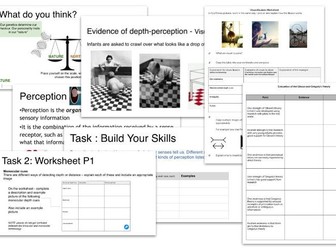
AQA GCSE Psychology - Perception Unit 1.2 Complete Resources
5 Presentation slides (Approximately 10-15 lessons) including tasks and activities, learning outcomes checklist and worksheets
Specification Details:
The difference between sensation and perception.
Monocular depth cues: height in plane, relative size, occlusion and linear perspective.
Binocular depth cues: retinal disparity, convergence.
The real world presents sufficient information for direct perception without inference. Role of motion parallax in everyday perception.
Explanations for visual illusions: ambiguity, misinterpreted depth cues, fiction, size constancy.
Examples of visual illusions: the Ponzo, the Müller-Lyer,
Rubin’s vase, the Ames Room, the Kanizsa triangle and the Necker cube.
Perception uses inferences from visual cues and past experience to construct a model of reality.
Perceptual set and the effects of the following factors affecting perception: culture, motivation, emotion, expectation.
The Gilchrist and Nesberg study of motivation and the Bruner and Minturn study of perceptual set.
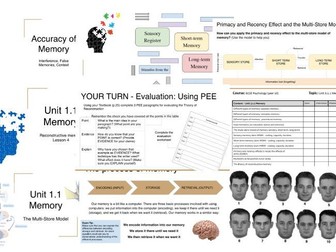
AQA GCSE Psychology - Memory Unit 1.1 Complete Resources
5 Presentation slides (Approximately 10-15 lessons) including tasks and activities, learning outcomes checklist and worksheets
Specification Details:
Different types of memory: episodic memory, semantic memory and procedural memory.
How memories are encoded and stored.
The multi-store model of memory: sensory, short term and long term.
Features of each store: coding, capacity, duration.
Primacy and recency effects in recall: the effects of serial position.
Murdock’s serial position curve study.
The Theory of Reconstructive Memory, including the concept of ‘effort after meaning’.
Bartlett’s War of the Ghosts study.
Factors affecting the accuracy of memory, including interference, context and false memories.
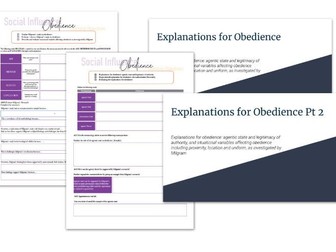
Resources for AQA A Level Psychology Unit 4.1.1 Social Influence - Obedience
Includes presentations and worksheets (EDITABLE PDFs) suitable for in class and online learning (Approximately 3+ full lessons)
Specification content:
• Explanations for obedience: agentic state and legitimacy of authority, and situational variables affecting obedience including proximity and location, as investigated by Milgram, and uniform. Dispositional explanation for obedience: the Authoritarian Personality.
Note:
PDF Worksheets are editable.
All presentations contain in class activites with links to videos and worksheets
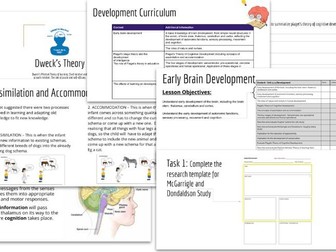
AQA GCSE Psychology - Development Unit 1.3 Complete Resources
9 Presentation slides (Approximately 10-15 lessons) including tasks and activities, learning outcomes checklist and worksheets
Specification Details:
A basic knowledge of brain development, from simple neural structures in the womb, of brain stem, thalamus, cerebellum and cortex, reflecting the development of autonomic functions, sensory processing, movement and cognition.
The roles of nature and nurture.
Piaget’s Theory of Cognitive Development including concepts of assimilation and accommodation.
The four stages of development: sensorimotor, pre-operational, concrete operational and formal operational.
Application of these stages in education.
Reduction of egocentricity, development of conservation. McGarrigle and Donaldson’s ‘naughty teddy study’; Hughes’ ‘policeman doll study’.
Dweck’s Mindset Theory of learning: fixed mindset and growth mindset. The role of praise and self-efficacy beliefs in learning.
Learning styles including verbalisers and visualisers. Willingham’s Learning Theory and his criticism of learning styles.
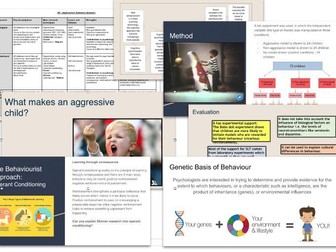
Resources for AQA AS Level Psychology Unit 3.2.1 Approaches in Psychology
Includes presentations and worksheets (EDITABLE PDFs) suitable for in class and online learning (Approximately 3+ full lessons)
Specification content:
Origins of Psychology: Wundt, introspection and the emergence of Psychology as a science.
The basic assumptions of the following approaches:
• Learning approaches: i) the behaviourist approach, including classical conditioning and Pavlov’s research, operant conditioning, types of reinforcement and Skinner’s research; ii) social learning theory including imitation, identification, modelling, vicarious reinforcement, the role of mediational processes and Bandura’s research.
• The cognitive approach: the study of internal mental processes, the role of schema, the use of theoretical and computer models to explain and make inferences about mental processes. The emergence of cognitive neuroscience.
• The biological approach: the influence of genes, biological structures and neurochemistry on behaviour. Genotype and phenotype, genetic basis of behaviour, evolution and behaviour.
Note:
PDF Worksheets are editable.
All presentations contain in class activites with links to videos and worksheets with some answers
Please request other formats if needed.
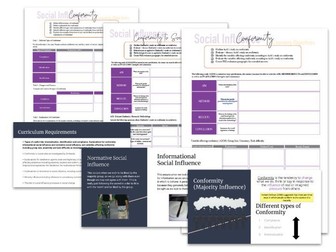
Resources for AQA A Level Psychology Unit 4.1.1 Social Influence - Conformity
Includes presentations and worksheets (EDITABLE PDFs) suitable for in class and online learning (Approximately 4+ full lessons)
Specification content:
Types of conformity: internalisation, identification and compliance
Explanations for conformity: informational social influence and normative social influence
Variables affecting conformity including group size, unanimity and task difficulty as investigated by Asch
Conformity to social roles as investigated by Zimbardo
Note:
PDF Worksheets are editable.
All presentations contain in class activites with links to videos and worksheets
Resources for AQA A Level Psychology Unit 4.1.1 Social Influence - Minority influence and social change
Includes presentations and worksheets (EDITABLE PDFs) suitable for in class and online learning (Approximately 3+ full lessons)
Specification content:
• Explanations of resistance to social influence, including social support and locus of control.
• Minority influence including reference to consistency, commitment and flexibility.
• The role of social influence processes in social change.
Note:
PDF Worksheets are editable.
All presentations contain in class activites with links to videos and worksheets
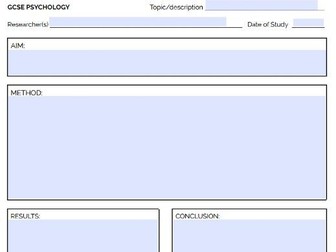
AQA GSCE Psychology - PDF Editable Research Template
Simple template / worksheet for AQA GCSE Psychology Research
Edit straight onto pdf
Suitable for online and in class learning


 Quick View