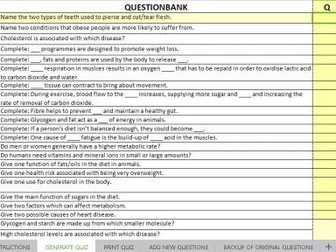
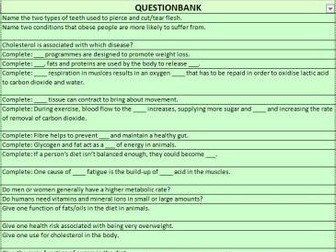
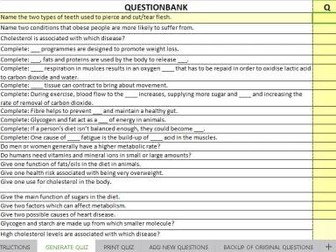
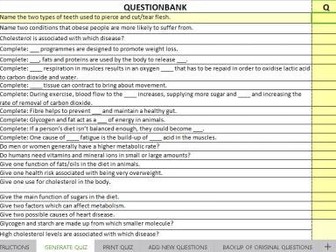
Produce a printable 10, 15 and 20-question factual recall test from a bank of 100 biology questions!
Paid version consists of over 800 biology questions!
Easy to mark - mark schemes included!
Add your own questions! (paid version)
Topics Covered: (paid version)
Diet & Exercise
Respiration
Drug Development / Abuse
Exchange In Animals
Transport In Animals
Nervous System
Immune System
Animal Hormones
Homeostasis
Cells & Cell Transport
Tissues, Organs & Organ Systems
Enzymes
Organism Distribution
Organism Interactions
Energy Flow
Recycling Waste Materials
Humans & The Environment
Cell Division & Inheritance
Genetic Variation
Evolution
Speciation
Exchange In Plants
Transport In Plants
Photosynthesis
Plant Hormones
Produce a printable 10, 15 and 20-question factual recall test from a bank of 100 science questions!
Easy to mark! - each question is out of 1 mark or 2 x 1/2 marks.
Add your own questions! (paid version)
Suitable for 11-14 year-old (Key Stage 3) students!
Topics Covered: (paid version)
Cells To Systems (FREE version)
Diet & Health (FREE version)
Genetics & Evolution
Photosynthesis
Reproduction & Growth
Ecosystems
Respiratory System
Blood Vessels & Blood
Matter (FREE version)
Atoms, Elements & Compounds (FREE version)
Introduction To Chemical Properties & Reactions
Acids & Alkalis
Everyday Chemical Processes & Materials
The Earth & Its Atmosphere
Forces & Motion (FREE version)
Levers & Moments (FREE version)
Electricity & Electromagnetism (FREE version)
Energy
Waves
Space
Pressure
Produce a printable 10, 15 and 20-question factual recall test from a bank of over 800 biology questions!
Easy to mark! - each question is out of 1 mark or 2 x 1/2 marks.
Add your own questions!
Suitable for students undertaking their GCSE in Biology!
Topics Covered:
Diet & Exercise
Respiration
Drug Development / Abuse
Exchange In Animals
Transport In Animals
Nervous System
Immune System
Animal Hormones
Homeostasis
Cells & Cell Transport
Tissues, Organs & Organ Systems
Enzymes
Organism Distribution
Organism Interactions
Energy Flow
Recycling Waste Materials
Humans & The Environment
Cell Division & Inheritance
Genetic Variation
Evolution
Speciation
Exchange In Plants
Transport In Plants
Photosynthesis
Plant Hormones
Produce a printable 10, 15 and 20-question factual recall test from a bank of 360 science questions!
Easy to mark! - each question is out of 1 mark or 2 x 1/2 marks.
Add your own questions!
Suitable for 11-14 year-old (Key Stage 3) students!
Topics Covered:
Cells To Systems
Diet & Health
Genetics & Evolution
Photosynthesis
Reproduction & Growth
Ecosystems
Respiratory System
Blood Vessels & Blood
Matter
Atoms, Elements & Compounds
Introduction To Chemical Properties & Reactions
Acids & Alkalis
Everyday Chemical Processes & Materials
The Earth & Its Atmosphere
Forces & Motion
Levers & Moments
Electricity & Electromagnetism
Energy
Waves
Space
Pressure
Embedded in an imaginative 'storyline', the adventurer must answer (your) teacher-devised multiple-choice questions in order to find the exit to the 'maze'. Correct responses give the adventurer the choice as to which direction to move (e.g. 'forwards', 'backwards' and 'left'), however, incorrectly answered questions or wrong decisions will lead to teleportation to another part of the 'maze'!
If a question is answered incorrectly, the adventurer is sent to another part of the 'maze' from where they must, once again, answer questions correctly in order to progress and find the exit. In doing so, the adventurer will probably come across questions they have previously encountered. This repetition will help to solidify subject knowledge.
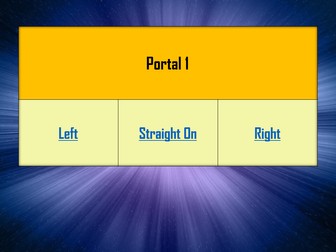
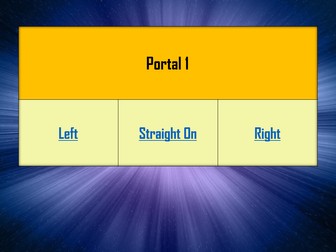
The 'maze' is 'circular'. There are seven 'entrances' ('portals') to the 'maze'. Adventurers may travel in either direction (e.g. 'forwards' or 'backwards') round this route.
Off the 'circle' are six 'dead-ends'. If the adventurer chooses to proceed beyond this point, they will be teleported to the beginning of the 'maze'.
There is one 'exit' to the 'maze'. A question must be answered correctly in order to leave the 'maze'. If it is answered incorrectly, the adventurer will be teleported back to the beginning of the 'maze'.
Adventurers will not know, initially at least, that the 'maze' is 'circular', nor that there are seven 'entrances', which will be interesting for them to work out!
All you need to do is add your own questions and answers to the fully editable slides, make the file available to the students in your class (save as a PowerPoint Show) and let them go on their own adventure whilst learning at the same time!
If the adventurer enters the 'maze' a second time, they are likely to have a different experience as they will probably enter via a different 'portal'. This means even though the questions are the same, they will probably be encountered in a different order, thus maintaining interest.
Note: This product consists of one licence to be used for one class in one educational establishment.
Note: This resource has successfully been tested on a laptop running Windows 10, an iPhone 4s and an iPad Mini 2, all running Microsoft PowerPoint 2013, so will certainly run smoothly on recent technology.
Note: The images used within this resource are not my creations and full recognition and thanks must be given to these talented and creative individuals. The images are "Free for personal and commercial use" and "No attribution (is) required". They have been taken from websites including 'Pexels.com'.
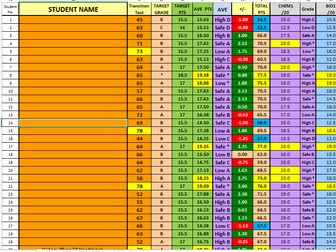
This clever spreadsheet records data from any 10 question test that you have set your students. All you need to add are the names of your students, their target grade and the results of their 10 question tests.
The spreadsheet can record data for 10 tests and 100 students.
I've been using this recording system for over 10 years, and its usefulness / effectiveness has been most noticeable during lessons where students are regularly made aware of their progress, during departmental meetings where weak students can easily be identified and subsequently supported and during meetings with parents.
The main features of this spreadsheet are:
[1] It's simple to input data.
[2] It calculates a mean score out of 10 for each student.
[3] Each test result is given a grade [the grade format may be chosen by the user].
[4] It highlights whether students are underachieving or overachieving relative to their target grade [target grade format may be chosen by the user].
[5] It calculates a total score for the tests undertaken, which may help raise academic standards by promoting healthy competition between students.
[6] It produces a graph of total points against student number. This enables the user to observe performance of all students in a visually effective way.
[7] It provides the user and students with an overall grade based on the tests taken.
Using the spreadsheet is easy, but a couple of tips are provided within it.
Look out for more products of a similar nature, including 15 and 20 question test spreadsheets as well as a quiz generator for Biology!
**This resource is for demonstration purposes only and cannot be edited. Its purpose is to illustrate how the resource looks and functions. The paid version is fully editable.**
Imagine an educational resource that successfully fuses adventure with interactive learning. Well, this is an excellent example of a Create Your Own Adventure (CYOA) activity which does just that!
Embedded in an imaginative 'storyline', the adventurer must answer (your) teacher-devised multiple-choice questions (paid version) in order to find the exit to the maze. Correct responses give the adventurer the choice as to which direction to move (e.g. 'forwards', 'backwards' and 'left'), however, incorrectly answered questions or wrong decisions will lead to teleportation to another part of the maze!
If a question is answered incorrectly, the adventurer is sent to another part of the maze from where they must, once again, answer questions correctly in order to progress and find the exit. In doing so, the adventurer will probably come across questions they have previously encountered. This repetition will further solidify subject knowledge.
The maze is 'circular'. There are seven entrances (portals) to the maze. Adventurers may travel in either direction (e.g. forwards or backwards) round this route.
Off the circle are six dead-ends. If the adventurer chooses to proceed beyond this point, they will be teleported to the beginning of the maze.
There is one exit to the maze. A question must be answered correctly in order to leave the maze. If it is answered incorrectly, the adventurer will be teleported back to the beginning of the maze.
All you need to do is add your own questions and answers to the fully editable slides (paid version), make the file available to the students in your class (as a PowerPoint Show) and let them go on their own adventure whilst learning at the same time!
If the adventurer enters the maze a second time, they are likely to have a different experience as they will probably enter via a different portal. This means even though the questions are the same, they will probably be encountered in a different order, thus maintaining interest.
Note: This resource has successfully been tested on a laptop running Windows 10, an iPhone 4s and an iPad Mini 2, all running Microsoft PowerPoint 2013, so will certainly run smoothly on recent technology.
Note: The images used within this resource are not my creations and full recognition and thanks must be given to these talented and creative individuals. The images are “Free for personal and commercial use” and “No attribution (is) required”. They have been taken from websites including 'Pexels.com'.


 Quick View