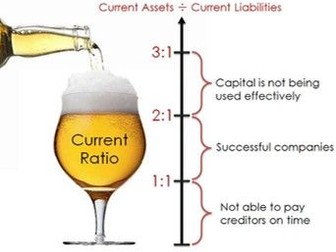
Analysing Brewdogs performanceQuick View
paulfairtlc74

Analysing Brewdogs performance

(0)
Students will analyse BrewDog’s financial accounts and calculate a range of key financial ratios, including profitability, liquidity and gearing, to assess the company’s financial performance and position. They will then use their findings to explore a series of management decisions linked to BrewDog’s administration on 20 September 2026, considering issues such as high levels of debt, cash-flow pressures, expansion, cost control and the impact of decisions on different stakeholders. Students will be required to interpret the financial evidence rather than simply calculate ratios, before using their analysis to make justified recommendations about the decisions BrewDog’s management could have taken to improve its financial position.
Ratio Analysis 2026Quick View
paulfairtlc74

Ratio Analysis 2026

(0)
Students will analyse the latest available financial accounts (as of September 2026) for Wagamama, The Ritz, Coppa Club, and Nando’s, completing ratio analysis tables before comparing performance across the four hospitality businesses; they will identify how outdated accounts limit reliability and consider how major external events such as the Iran war, supply chain disruption, inflation, labour shortages, and shifts in consumer spending may have affected each organisation since the accounts were published, then use this evidence to produce a concise, professional report evaluating financial strength, liquidity, profitability, and overall stability using real data and contextual reasoning.
AQA A-level Entrepreneurship new specQuick View
paulfairtlc74

AQA A-level Entrepreneurship new spec

(0)
The A3 independent study sheets gives students a single space to consolidate key lesson content through retrieval, short‑form application and structured summary, while the Marc Randolph research sheet extends that learning by linking theory to a real entrepreneur. With included answers.
Investment Appraisal ARR Payback and NPVQuick View
paulfairtlc74

Investment Appraisal ARR Payback and NPV

(0)
Students are required to complete an investment appraisal for British Airways, comparing the Boeing 737 and the Boeing 727. They should calculate the payback period, net present value (NPV) and accounting rate of return (ARR) for each investment, and then use these results to discuss which option Sean Doyle should choose and why. In addition, students should include a PESTLE analysis and refer to a news article on the Strait of Hormuz, explaining how British Airways has hedged against the risk of rising oil prices. ANSWERS INCLUDED
Finances of Chelsea Ratios/PED/Cash flowQuick View
paulfairtlc74

Finances of Chelsea Ratios/PED/Cash flow

(0)
This activity introduces students to the business side of football, focusing on how clubs manage finances, analyse cash flow, and make strategic decisions. It explores key concepts such as revenue streams, costs, profitability, and price elasticity, alongside applying the 7Ps marketing mix to real-world scenarios. Students develop their analytical and evaluative skills by examining how pricing and spending impact a club’s overall financial performance.
Ratio analysis/ Marketing/ PED/ Price Elasticity of DemandQuick View
paulfairtlc74

Ratio analysis/ Marketing/ PED/ Price Elasticity of Demand

(0)
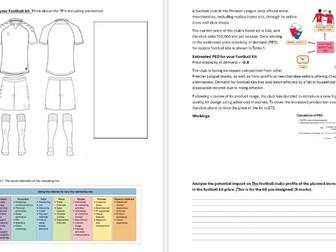
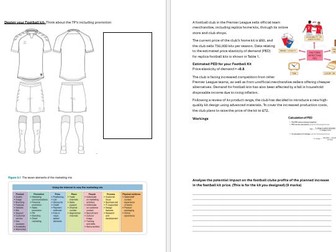
Students will begin by analysing Chelsea FC’s financial accounts using ratio analysis, examining key measures such as profitability, liquidity, and efficiency. They can extend their analysis by comparing Chelsea’s ratios to those of another football club or a similar company to evaluate performance differences. Following this, students will take a creative approach by designing a new football kit, considering the 7Ps of marketing product, price, place, promotion, people, process, and physical evidence to ensure their kit appeals to fans and aligns with marketing strategy. Finally, they will apply price elasticity of demand (PED) concepts to their designed kit, calculating how changes in price could affect the quantity demanded for a club of their choice.
Ratio Analysis/ Decision Trees/ CapacityQuick View
paulfairtlc74

Ratio Analysis/ Decision Trees/ Capacity

(0)
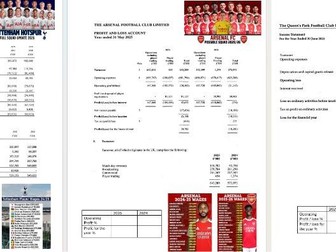
Students will analyse and compare a range of football clubs including Tottenham Hotspur, Queens Park Rangers, Chelsea FC, Arsenal FC, Manchester United, Manchester City and Newcastle United using ratio analysis to evaluate financial performance, including profitability, liquidity and efficiency. They will interpret their findings to determine which club is performing most effectively and justify their conclusions using evidence. Students will then select one club and apply decision-making techniques by constructing two decision trees based on five players from their chosen team, selecting two players for each tree. They will calculate expected values and net gains to assess which decisions provide the greatest benefit, developing their quantitative decision-making skills. Building on this, students will explore a non-routine strategic decision by evaluating whether their chosen club should move to a new stadium, choosing between the Coker or Swifty stadium. They will construct a decision tree, apply probabilities and outcomes, and calculate expected values to recommend the most financially viable option. As an extension, students will analyse capacity utilisation to determine how efficiently the stadium is being used, and suggest realistic strategies to improve attendance, revenue and overall operational performance.
Ratio analysis calculation and analysisQuick View
paulfairtlc74

Ratio analysis calculation and analysis

(0)
Task: You manager in Boohoo has asked you to assess the performance of Next and Asos. You should calculate the Current ratio, acid test ratio, gross profit %, operating profit %, payables days, receivable days. You must then write a report comparing the figures for each company. You should compare both companies figures individually and then compare Next and Asos using the figures. You can use Google to add additional information as the statements are outdated. (Coronavirus) I have used assumptions for the Next accounts I have used the revenue figure, Cost of sales figure and the GP figure. There are a few professional terms that I have excluded as students do not need them. My students have loved it and it has provided good hour and a half to two hours of work with the essay question. Extension- to research other clothing brands and to include them in the essay.