En el restaurante: cultura gastronómica y comunicación en españolQuick View
yasmin_jebrin

En el restaurante: cultura gastronómica y comunicación en español

(0)
This is a structured, scaffolded KS3 (Year 8) Spanish lesson resource focused on the theme “En el restaurante”. It combines cultural knowledge, reading comprehension, and guided written production to support students in moving from vocabulary recall to meaningful communication. The lesson begins with a silent Do Now that revises food vocabulary through Spanish–English matching, with an extension task that promotes grammatical awareness (identifying verbs and food items). This ensures retrieval practice and immediate engagement. A cultural reading text (“Carta de Tío Spanish”) introduces students to typical Spanish dishes from different regions of Spain, developing cultural capital while reinforcing key vocabulary. Comprehension questions in English allow all learners to access the content and demonstrate understanding without language overload. Students then complete a guided gap-fill writing task to model how to order food in a Spanish restaurant, supported by sentence starters and prior learning. An extension translation task provides appropriate challenge for higher-attaining students. The lesson ends with a reflection task, encouraging students to articulate what they have learned, supporting metacognition and consolidation. Overall, the resource is inclusive, well-scaffolded, and knowledge-rich, with clear progression from recognition → comprehension → production, and built-in differentiation through extensions and support prompts.
¿Dónde está Wally? Town Places & Directions (Spanish | KS3 | Present Tense -ar)Quick View
yasmin_jebrin

¿Dónde está Wally? Town Places & Directions (Spanish | KS3 | Present Tense -ar)

(0)
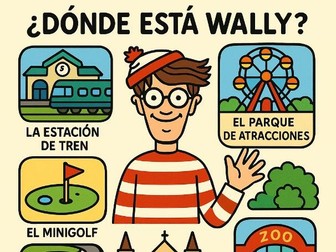
A full, ready-to-teach KS3 Spanish lesson introducing places in town and giving directions, with built-in pronunciation support and present tense -ar verb practice (3rd person). Includes challenge/stretch tasks and a fun “Find Wally” map task that students love. Perfect for: Year 7–8, cover, observations, interviews, or consolidating the “Town & Directions” unit. This 1-hour lesson is designed for high engagement and high structure. It builds language step-by-step, from vocabulary recognition to translation, pronunciation comparison (Spain vs Latin America), and finally communicative output via the ¿Dónde está Wally? direction-writing task. Includes: • Clear starter retrieval task • New vocabulary introduction with visuals • Cultural note on the Spanish ‘z’ pronunciation • Grammar focus: -ar verbs 3rd person singular & plural • Scaffolded direction phrases • Fun map-based Wally speaking/writing activity • Differentiation for slower/faster writers • Challenge extensions included Learning objectives: ✔ Learn and recognise 6 places in town ✔ Understand how Spanish ‘z’ is pronounced in different regions ✔ Use and understand directions: turn left, straight on, across the square, etc. ✔ Write and say short dialogues giving directions Suitable for KS3, non-specialist cover, and interview lessons.
El fin de semana pasado – Full Spanish Lesson (Past Tense / Preterite) Y8–Y10Quick View
yasmin_jebrin

El fin de semana pasado – Full Spanish Lesson (Past Tense / Preterite) Y8–Y10

(0)
A complete, ready-to-teach lesson on the preterite tense using the theme El fin de semana pasado. Ideal for KS3 (Year 8/9) and also works as a GCSE foundation-plus refresher or intervention lesson. This lesson focuses on: Recognising past tense verb endings (regular + key irregulars: fui, jugué, salí, hablé…) Building longer, more confident sentences using time phrases and opinions Listening comprehension with scaffolded support Writing progression from simple to extended responses Includes: ✔ Do Now retrieval activity ✔ Clear verb explanation in student-friendly language ✔ Sentence sorting task (present vs past) ✔ Challenge task focusing on “special verbs” ✔ Listening activity with table template ✔ Scaffold for extended writing & model answers ✔ Plenary reflection task This lesson is designed with SEND support and stretch built in: easy-to-adapt slides, visual clarity, and natural differentiation. Perfect for: Main lesson Cover-friendly teaching Revision before assessments
Year 7 Assembly: The Power of KindnessQuick View
yasmin_jebrin

Year 7 Assembly: The Power of Kindness

(0)
This engaging Year 7 assembly explores the idea that kindness is a form of strength, not weakness. Using the song “Poderosa Diva” (Spain, Eurovision 2025) as a central hook, students reflect on identity, confidence, inclusion, and how small acts of kindness can have a powerful ripple effect within a school community. The assembly is highly interactive and designed to actively involve students through structured discussion, paired talk, reflection, and shared storytelling. It promotes respectful listening, empathy, and inclusive behaviour while reinforcing positive school values. What’s included A fully planned, ready-to-deliver assembly for Year 7 Clear entry routines and expectations to ensure a calm, purposeful start Thought-provoking discussion questions and probing prompts Pair and group talk activities that develop oracy and active listening Real-life kindness stories to build emotional connection Sentence stems and summarising tasks to support all learners A “Kindness Challenge of the Week” to extend impact beyond the classroom. Key themes Kindness as confidence and power Feeling heard and valued Accepting differences (language, personality, background, ability) Inclusion, respect, and community How kindness spreads and creates positive change Why teachers love this resource Encourages student voice and reflection Supports PSHE, SMSC, British Values, and behaviour culture Inclusive and accessible for EAL and SEND learners Easy to adapt for different school contexts Minimal preparation required – just open and deliver Perfect for: Year 7 assemblies, PSHE sessions, tutor time, or whole-school focus weeks on kindness, wellbeing, or inclusion.