1.1.3 Embedded Systems Explained – Purpose, Characteristics & Examples (OCR J277)Quick View
kaismal

1.1.3 Embedded Systems Explained – Purpose, Characteristics & Examples (OCR J277)

(0)
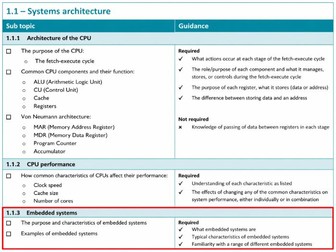
This resource covers 1.1.3 Embedded Systems, introducing students to how computers are used within everyday devices. It includes: The purpose of embedded systems – understanding how they are designed for specific, dedicated tasks Characteristics of embedded systems – such as reliability, efficiency, and real-time processing Examples of embedded systems – including common devices students encounter in daily life Students will develop: A clear understanding of what embedded systems are The ability to identify and explain their key characteristics The ability to recognise and apply knowledge to real-world examples This resource is ideal for GCSE Computer Science (OCR J277) and supports both classroom teaching and revision.
GCSE Computer Science (OCR J277) – CPU Performance (1.1.2)Quick View
kaismal

GCSE Computer Science (OCR J277) – CPU Performance (1.1.2)

(0)
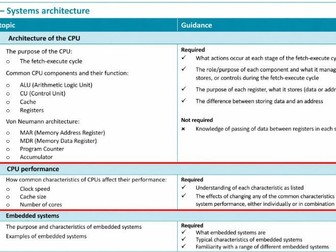
This resource focuses on 1.1.2 CPU Performance, helping students understand how key characteristics impact the overall performance of a processor. It covers: Clock speed – how the number of cycles per second affects processing speed Cache size – how storing frequently used data closer to the CPU improves efficiency Number of cores – how multiple cores allow parallel processing and multitasking Students will develop: A clear understanding of each performance factor The ability to explain how changes to these characteristics affect system performance The ability to analyse performance both individually and in combination This resource is ideal for GCSE Computer Science (OCR J277) and supports both revision and classroom delivery.
J277 - 1.1 System ArchitectureQuick View
kaismal

J277 - 1.1 System Architecture

(0)
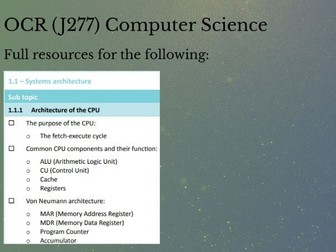
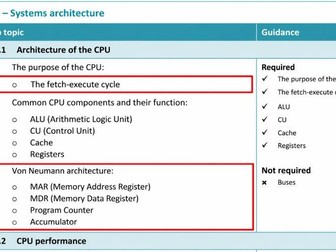
This section covers 1.1.1 of the specification. The resource covers three parts: 1.1.1. Part 1 and task 1.1.1. Part 2 and Task 1.1.1. Part 3 and Task This resource covers key concepts from 1.1.1 Architecture of the CPU, focusing on essential knowledge required for understanding how a computer processor operates. It includes: The purpose of the CPU The fetch–execute cycle (step-by-step process of how instructions are processed) It also develops understanding of common CPU components and their functions, including: Arithmetic Logic Unit (ALU) Control Unit (CU) Cache Registers In addition, the resource introduces the Von Neumann architecture, with clear explanations of: Memory Address Register (MAR) Memory Data Register (MDR) Program Counter (PC) Accumulator This material is ideal for GCSE Computer Science students (OCR J277) and supports both revision and classroom teaching.
OCR GCSE Computer Science - 1.1 System ArchitectureQuick View
kaismal

OCR GCSE Computer Science - 1.1 System Architecture

(0)
Self-created PPT and lesson tasks with mark scheme for OCR GCSE Computer Science (J277). Each section is broken down into sub-sections and the PowerPoints are very designed to an exception standard. I have been using my lesson resources and achieved outstanding GCSE results.