Worksheet "Chemistry: A Volatile History - The Order of the Elements"Quick View
ciribeiro

Worksheet "Chemistry: A Volatile History - The Order of the Elements"

(0)
Two editable worksheet for pupils to complete as they watch the documentary Chemistry: A Volatile History - The Order of the Elements presented by Professor Jim Al-Khalili. The documentary tells the history of the Periodic Table, and it is a good way to introduce this subject. The worksheets include twenty short-answer questions, as well the answers and answer timings in the documentary, and they are different in both documents.
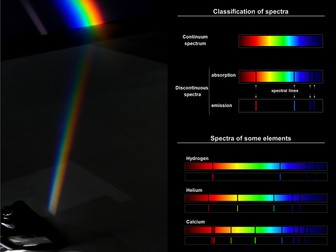
How do we know what stars are made of? (Spectroscopy)Quick View
ciribeiro

How do we know what stars are made of? (Spectroscopy)

(0)
This is a presentation (and the teacher’s script) for secondary students to teach spectra in the context of Astronomy. It explains what spectra are, how each chemical element has a characteristic spectrum and how this knowledge can be applied to identify the composition of a hypothetical star. The presentation can be used as an introduction to the teaching of Bohr’s atomic model.
What is the cause of the spectral lines? (Spectroscopy)Quick View
ciribeiro

What is the cause of the spectral lines? (Spectroscopy)

(1)
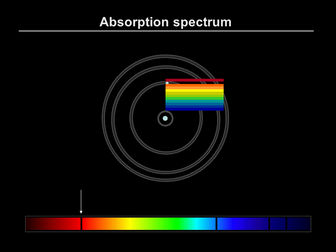
This is a presentation (and the teacher’s script) for secondary students to teach spectroscopy and Bohr’s atomic model. The presentation uses schematics to show how Bohr’s model explains the absorption and emission spectra of the element hydrogen.
Northern StarQuick View
ciribeiro

Northern Star

(0)
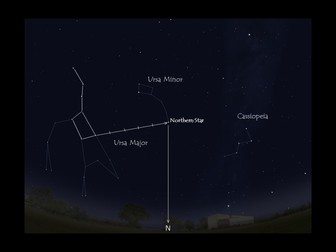
The presentation (and script) explains how you can find the south using the constellation of Northern Star. This is achieved first by a video that simulates the night sky throughout the night and then with schematics that explain how to find the north in the horizon. The images used in this presentation were obtained from Stellarium, a free planetarium program.
Bundle World Oceans DayQuick View
ciribeiro

Bundle World Oceans Day

(0)
Bundle of material to celebrate the World Oceans Day and activities to explore the challenge they face due to climate change. It contains: 7 posters (5 horizontal and 2 vertical) size A3 to advertise the World Oceans Day. These are fully editable, so you can add your school logo or any other logo you want. 6 experimental protocols you can do with your pupils to explain how climate change affects the oceans. They explore ocean acidification, ocean currents and sea level rise. 6 posters size A3 fully editable to support the experiments. A brief introduction to the oceans and climate change, which support the experiments. The experiments can also be used to raise awareness of the problems of climate change and used in another context than the World Oceans Day.
International Day of Mathematics / Pi DayQuick View
ciribeiro

International Day of Mathematics / Pi Day

(0)
Posters intended to celebrate the International Day of Mathematics, or Pi Day. The material is fully editable and consists in: Two sets of posters (9 with portrait orientation and 7 with landscape orientation) printable up to size A2. The images in the posters illustrate the themes: Honeycomb Conjecture, Golden Angle, Symmetries, Fractals, Chaos Theory, Pi, Logarithmic Spiral and Prime Numbers. Two of the posters make an introduction to The International Day of Mathematics where you can add your school logo or any other logo needed; The posters are accompanied by smaller posters, intended to be A5 in size, to be place near each poster and explain the relation between Mathematics and the image; A document with links to YouTube videos related to the themes of the posters that can be exhibited in a TV at school.