 Quick View
Practice Paper 3 - AQA A-Level Business (Arrowsmith Automation Ltd.)
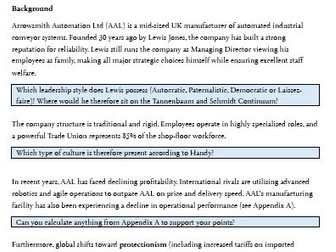
This Paper is designed to perfectly mimic the layout, data density, and strategic focus of the AQA A-Level Business Paper 3 (Investigating a Strategic Decision) terminal exam, covering topics which have not yet been covered in depth across Paper 1 and Paper 2. It features a deep, multi-layered business case study centered on “Arrowsmith Automation Ltd” (AAL), a traditional UK engineering firm facing structural, operational, and international trade pressures.
The resource seamlessly weaves together a wide range of interconnected topics from across the AQA specification, forcing students to look at a business holistically:
Strategic Planning Frameworks: Practical application of Ansoff’s Matrix quadrants (contrasting a low-risk Market Penetration option with a high-risk Diversification option).
Quantitative Decision-Making: Financial risk appraisal using Decision Trees, requiring calculations of Expected Values (EV) and Net Financial Outcomes under high-sales and low-sales probabilities.
Operational Performance Metrics: Evaluation of operational efficiency through student calculations of Labour Productivity and Capacity Utilisation.
Organisational Culture & Leadership: Analysis of Charles Handy’s cultural frameworks (shifting from a bureaucratic Role Culture to an agile Task Culture) and the operational impacts of changing leadership styles (Paternalistic, Democratic, and Laissez-Faire).
Managing Change: Assessing workforce Resistance to Change and evaluating strategic solutions using Schlesinger & Kotter’s methods (such as Participation and Involvement vs. Explicit Coercion).
Industrial Relations: Navigating the strategic constraints of high Trade Union density (85% shop-floor representation) and threat of industrial action during corporate restructuring.
The Flexible Organisation: Exploring the long-term competitiveness of adopting workforce flexibility.
The External Environment: Navigating the real-world operational threats of shifting global trade dynamics, specifically comparing Open Trade vs. Protectionism (such as steel tariffs).