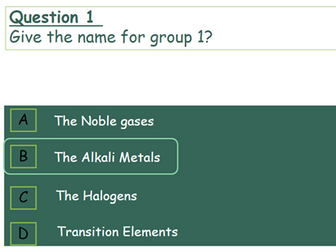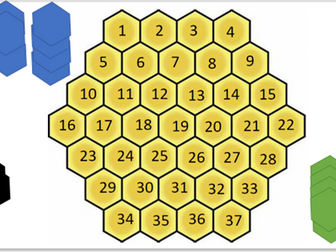
A game of blockbuster based on the AQA paper 1 for chemistry (C1 - C5) all of the questions are based off past exam questions. All questions and hyperlinks are done and ready made to go.
Questions are used to test the knowledge and understanding aimed at triple chemistry students.
A booklet of worksheets, following the AQA combined chemistry specification for both higher and foundation tiers. Answers are provided as a separate booklet for both sets of work - higher and foundation.
These booklets include:
The Periodic Table
Subatomic particles and atomic structure
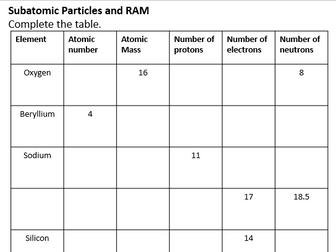
Subatomic particles and RAM
Electronic Structure
Isotopes
The development of the atom
Atoms, element and compounds
Separation techniques (filtration, chromatography and distillation)
Metals and non-metals
Group 1
Group 7
Group 0
Balancing equations
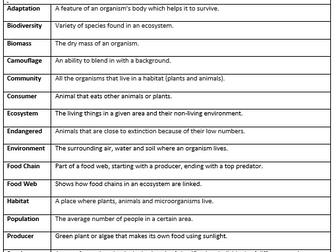
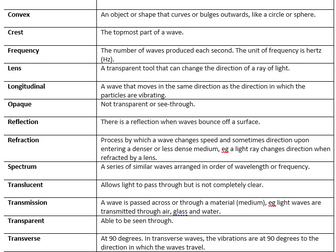
Biology keys words for KS3 with a VI (24pt) font too. The topics of the key words are for:
Cells
Reproduction
The Human Body
Microbes
Health and Fitness
Ecology
Plants
Genes
These key words were made for SEN students.
Physics keys words for KS3 with a VI (24pt) font too. The topics of the key words are for:
Electricity (year 7)
Energy (year 7)
Waves (year 7)
Forces (year 7)
Electricity (year 8)
Energy (year 8)
Waves (year 8)
Forces (year 8)
These key words were made for SEN students.
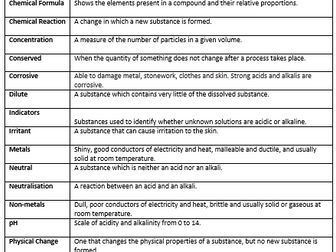
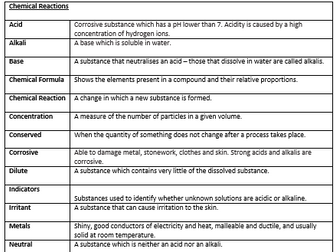
Chemistry keys words for KS3 with a VI (24pt) font too. The topics of the key words are for:
Particles (Y7)
Chemical Reactions (Y7)
All Around Us
Particles (Y8)
Chemical Reaction (Y8)
The Periodic Table
Chemical Reaction (Y9)
These key words were made for SEN students.
A booklet of worksheets, following the AQA GCSE Combined Science (Chemistry) specification for both higher and foundation tiers. Answers are provided as a separate booklet for both sets of work - higher and foundation.
These booklets include:
Ionic bonds
Ionic compounds
Properties of ionic compounds
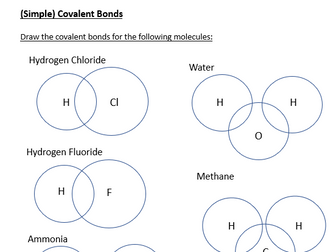
Covalent bonds
Properties of covalent compounds
Limits to covalent structures (Higher only)
Giant covalent molecules
Allotropes of carbon
Metallic bonding
Alloys vs pure metals
Properties of metals
What type of bonding?
States of matter
State symbols
Changing states
Limits to the three states (Higher only)
Determine the state
Polymers
This resources includes key words for KS3 biology, chemistry and physics, as well as the common working scientifically words. They also all come with a standard format and a VI (24pt) version too.
Biology topics are:
• Cells
• Reproduction
• The Human Body
• Microbes
• Health and Fitness
• Ecology
• Plants
• Genes
Chemistry topics are:
• Particles (Y7)
• Chemical Reactions (Y7)
• All Around Us
• Particles (Y8)
• Chemical Reaction (Y8)
• The Periodic Table
• Chemical Reaction (Y9)
Physics topics are:
• Electricity (year 7)
• Energy (year 7)
• Waves (year 7)
• Forces (year 7)
• Electricity (year 8)
• Energy (year 8)
• Waves (year 8)
• Forces (year 8)
these were made for SEN students, but can be used by anybody.
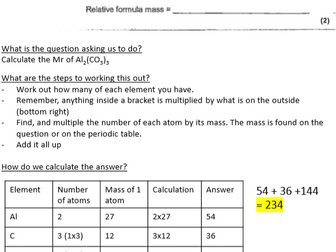
This booklet is made for AQA Triple Chemistry students to help them with mole calculations.
The booklet includes:
An exam question
Explanation of what the question is actually asking
What equation should they use?
Steps on how to tackle the question
Calculation done by the steps explained
Explanation for where the marks come from
Common errors that students make.
Exam questions cover:
Calculating Mr
Calculating Theoretical mass through an experiment
Calculating Percentage Yield
Calculating Atom Economy
Calculating Mass from a given concentration of a solution
Calculating concentration from a titration
A booklet of worksheets, following the AQA GCSE Chemistry specification for both higher and foundation tiers. Answers are provided as a separate booklet for both sets of work - higher and foundation.
These booklets include:
Metal Oxides
Reactivity Series
Carbon Displacement (Extraction of metals via reduction)
Metal reactions with acids
pH scale
Neutralisation reactions
Strong and Weak acids (HT only)
Soluble Salts Required Practical
Ionic Equations (HT only)
Electrolysis
Molten electrolysis
Molten electrolysis half equations (HT only)
Aqueous electrolysis
Aqueous electrolysis half equations (HT only)
Will this substance be electrolysed?
A booklet of worksheets, following the AQA combined chemistry specification for both higher and foundation tiers. Answers are provided as a separate booklet for both sets of work - higher and foundation.
These booklets include:
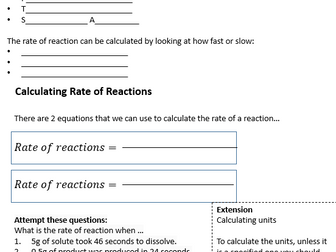
Calculating the rate of reaction
Factors that effect the rate: Concentration
Factors that effect the rate: Gas pressure
Factors that effect the rate: Temperature
Factors that effect the rate: Catalyst
Activation energy
Collision Theory
Calculating rate of reaction with a tangent on a curve (Higher only)
Reversible reactions
Equilibrium (Higher only)
Effect of changing conditions: Concentration (Higher only)
Effect of changing conditions: Temperature (Higher only)
Effect of changing conditions: Pressure (Higher only)
Calculating conditions for ‘What we want’ (Higher only)
A booklet of worksheets, following the AQA combined chemistry specification for both higher and foundation tiers. Answers are provided as a separate booklet for both sets of work - higher and foundation.
These booklets include:
Crude Oil
Hydrocarbons
Properties of hyrocarbons
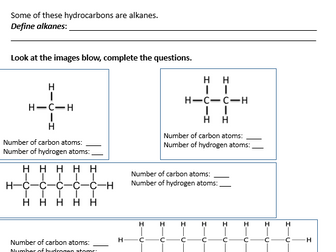
Alkanes
fractional distillation
Combustion
Cracking
Alkenes
Alkene formulas and structures (Chemistry Only)
Alkene reactions (Chemistry Only)
Simple polymers and their uses.
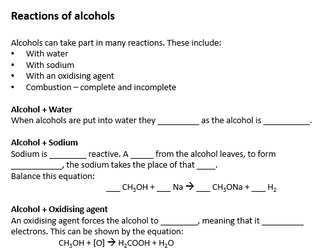
Alcohols (Chemistry only)
Carboxylic Acids (Chemistry only)
Carboxylic acid being weak acids (Higher Chemistry only)
Condensation Polymerisation (Higher Chemistry only)
Amino Acids (Higher Chemistry only)
DNA (Higher Chemistry only)
A booklet of worksheets, following the AQA combined chemistry specification for both higher and foundation tiers. Answers are provided as a separate booklet for both sets of work - higher and foundation.
These booklets include:
Purity
Formulations
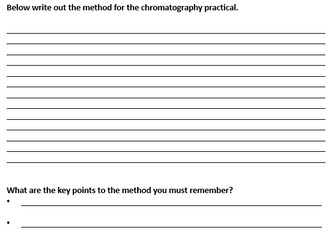
Chromatography Required Practical - method
Chromatography Analysis (RF values)
Chromatography exam style questions
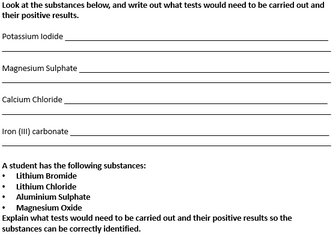
Gas Tests
Flame tests (Chemistry only)
Metal precipitate tests (Chemistry only)
Carbonate test (Chemistry only)
Sulphate test (Chemistry only)
Halide test (Chemistry only)
Determining ions (Chemistry only)
Instrumental methods (Chemistry only)
Flame emission Spectroscopy (Chemistry only)
A booklet of worksheets, following the AQA combined chemistry specification for both higher and foundation tiers. Answers are provided as a separate booklet for both sets of work - higher and foundation.
These booklets include:
Crude Oil
Hydrocarbons
Properties of hyrocarbons
Alkanes
fractional distillation
Combustion
Cracking
Alkenes
Simple polymers and their uses.
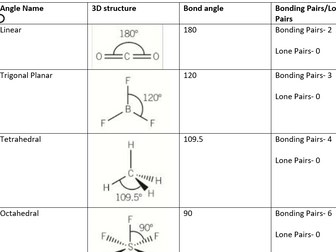
This worksheet is made for students to practice the bond angles and shapes for A level Chemistry. Different sheets have different ‘missing information’ which they will need to remember to complete, this also comes with the answers too. There are different work sheets so the information that is missing alters on the sheet to ensure a mixture of testing levels are available.
A booklet of worksheets, following the AQA combined chemistry specification for both higher and foundation tiers. Answers are provided as a separate booklet for both sets of work - higher and foundation.
These booklets include:
Renewable and finite resources
Potable Water
Desalination
Water purification and analysis - Required Practical
Water Waster Treatment
Extracting metals from ores (Higher only)
Life Cycle Assessment
Reduce, Reuse and Recycle
A booklet of worksheets, following the AQA GCSE Chemistry specification for both higher and foundation tiers. Answers are provided as a separate booklet for both sets of work - higher and foundation.
These booklets include:
Conservation of mass
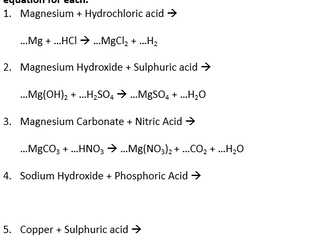
Balancing equations
Relative Formula Mass
Change in mass with a gas
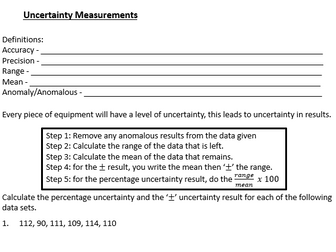
Uncertainty measurement calculations
Moles (HT only)
Amount of substance (HT only)
Balancing equations using moles (HT only)
Limiting reagents (HT only)
Concentration of solution
Concentration of solution - mol/dm3 (HT only)
Titrations (HT only)
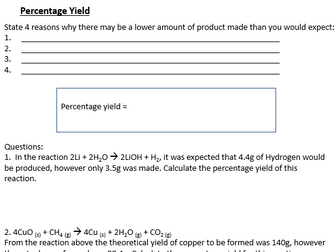
Percentage yield
Atom Economy
Gas volumes (HT only)
A booklet of worksheets, following the AQA GCSE Chemistry specification for both higher and foundation tiers. Answers are provided as a separate booklet for both sets of work - higher and foundation.
These booklets include:
Conservation of mass
Balancing equations
Relative Formula Mass
Change in mass with a gas
Uncertainty measurement calculations
Moles (HT only)
Amount of substance (HT only)
Balancing equations using moles (HT only)
Limiting reagents (HT only)
Concentration of solution
Atom Economy
A booklet of worksheets, following the AQA combined chemistry specification for both higher and foundation tiers. Answers are provided as a separate booklet for both sets of work - higher and foundation.
These booklets include:
Purity
Formulations
Chromatography Required Practical - method
Chromatography Analysis (RF values)
Chromatography exam style questions
Gas Tests
A booklet of worksheets, following the AQA combined chemistry specification for both higher and foundation tiers. Answers are provided as a separate booklet for both sets of work - higher and foundation.
These booklets include:
Renewable and finite resources
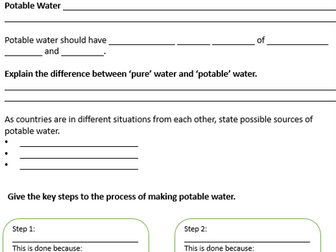
Potable Water
Desalination
Water purification and analysis - Required Practical
Water Waster Treatment
Extracting metals from ores (Higher only)
Life Cycle Assessment
Reduce, Reuse and Recycle
Rusting (Chemistry Only)
Useful Alloys (Chemistry Only)
Polymers (Chemistry Only)
Ceramics, Composites and Glass (Chemistry Only)
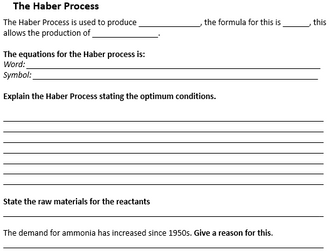
The Haber Process (Chemistry Only)
Making fertilisers (Chemistry Only)
3 different colouring in tasks, students must colour in the boxes in the correct colour by referring to where the stated element is on the periodic table. Through this, an image will appear that relates to christmas (Santa, christmas tree and snowman).