AQA GCSE Combined Science Foundation: Particle Model, Density & Internal EnergyQuick View
chem1984

AQA GCSE Combined Science Foundation: Particle Model, Density & Internal Energy

(0)
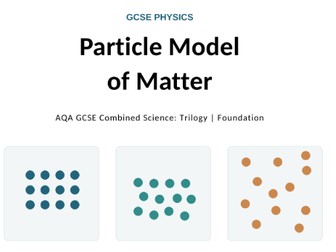
Support students with particle model revision using short explanations, clear diagrams and worked examples to complete together. Designed for AQA GCSE Combined Science: Trilogy Foundation, this resource covers: Particle arrangement and movement in solids, liquids and gases. Changes of state and conservation of mass. Density calculations and methods for measuring density. Internal energy, heating and changes of state. Gas particle motion and pressure, including the effect of temperature at constant volume. What’s included Six-page student worksheet: five core teaching sections and an optional page of additional density calculations.
AQA A-Level Biology: Mitosis Revision & Exam Practice PowerPointQuick View
chem1984

AQA A-Level Biology: Mitosis Revision & Exam Practice PowerPoint

(0)
An 11-slide revision PowerPoint for students who have already studied the cell cycle and mitosis. Activities include diagnostic questions, identifying and sequencing stages, explaining chromosome movement, interpreting changes in DNA mass and planning an extended response about genetically identical cells. Progressive answer reveals support independent attempts, paired discussion and whole-class feedback. Individual question parts reveal separately in Slide Show mode. Includes one PowerPoint file, suitable for revision lessons, consolidation and guided exam practice at ages 16–18. Editable slide text with some embedded question images. This resource focuses on review and application rather than a full introductory lesson. Independently produced and not endorsed by AQA.
AQA A-Level Biology Required Practical 2: Mitosis & Mitotic IndexQuick View
chem1984

AQA A-Level Biology Required Practical 2: Mitosis & Mitotic Index

(0)
A 26-slide teaching and practice PowerPoint supporting AQA A-level Biology Required Practical 2: preparing stained root-tip squashes and observing mitosis. The resource covers meristems, root-tip preparation, the purposes of practical steps, identifying mitotic stages, sampling, calculating mitotic indices and estimating the time spent in stages of the cell cycle. Worked examples and application questions develop mathematical skills and practical evaluation. Answers reveal progressively in Slide Show mode, with separate reveals for question parts. Includes one PowerPoint file with editable text and some embedded images. Use alongside your school’s practical method and risk assessment; this is not a technician preparation pack. Suitable for ages 16–18. Independently produced and not endorsed by AQA.
AQA A-Level Biology: Cancer, Cell-Cycle Control & Treatments PowerPointQuick View
chem1984

AQA A-Level Biology: Cancer, Cell-Cycle Control & Treatments PowerPoint

(0)
A 23-slide PowerPoint connecting control of the cell cycle with cancer for AQA A-level Biology. Content covers uncontrolled cell division, tumour development, benign and malignant tumours, risk factors and the effects of treatments on dividing cells. Students apply cell-cycle knowledge to treatment mechanisms and practise interpreting graphs and numerical data. Some treatment examples extend the core teaching content and provide contexts for application questions. Answers reveal progressively in Slide Show mode, supporting discussion and feedback one question part at a time. Includes one PowerPoint file with editable text and some embedded images. Suitable for students aged 16–18. Independently produced and not endorsed by AQA.
AQA A-Level Biology: Mitosis, Chromosomes & Chromatids PowerPointQuick View
chem1984

AQA A-Level Biology: Mitosis, Chromosomes & Chromatids PowerPoint

(0)
A 14-slide PowerPoint exploring chromosome structure and the stages of mitosis for AQA A-level Biology. Topics include homologous chromosomes, sister chromatids, centromeres, spindle fibres, prophase, metaphase, anaphase, telophase and cytokinesis. Diagrams, microscopy images and application questions support explanations of chromosome movement and the production of genetically identical nuclei. Answers reveal progressively in Slide Show mode, including separate reveals for question parts. Includes one PowerPoint file. Slide text can be edited; embedded images are not fully editable diagrams. Suitable for teaching and consolidation with students aged 16–18.
AQA A-Level Biology: Cell Cycle PowerPoint with Click-to-Reveal AnswersQuick View
chem1984

AQA A-Level Biology: Cell Cycle PowerPoint with Click-to-Reveal Answers

(0)
Teach and revisit the cell cycle with this 24-slide PowerPoint for AQA A-level Biology. The presentation covers interphase, DNA replication, the relationship between the cell cycle and mitosis, and the importance of cell division. Teaching slides are supported by questions and answers that reveal progressively in Slide Show mode, allowing students time to attempt each part before discussing the response. Suitable for classroom teaching, revision and guided exam practice. Includes one PowerPoint file. Slide text can be edited; some figures and question extracts are embedded images. Designed for ages 16–18.
AQA A-Level Biology Cell Division Bundle – Mitosis, Cancer & Required Practical 2Quick View
chem1984

AQA A-Level Biology Cell Division Bundle – Mitosis, Cancer & Required Practical 2

(0)
Five coordinated PowerPoints containing 98 slides for teaching and revising the cell cycle, mitosis, cancer and Required Practical 2. Included: • Cell Cycle – 24 slides • Mitosis – 14 slides • Mitosis Review – 11 slides • Cancer – 23 slides • Required Practical 2: Mitosis and Mitotic Index – 26 slides The presentations combine teaching content, diagrams, microscopy images, calculation practice and exam questions. Answers reveal progressively in Slide Show mode, with separate reveals for individual question parts so students can attempt each answer before receiving feedback. Related questions follow the teaching content, with unnecessary duplication reduced across the five decks. Suitable for classroom teaching, consolidation and revision with students aged 16–18. Supplied as five PowerPoint files with editable teaching text. Some diagrams and question extracts are embedded images. The practical presentation should be used alongside your school’s practical method and risk assessment. These are the same five presentations available individually; there is no need to purchase both the bundle and the separate resources.
AQA A-Level Chemistry: Aldehydes & Ketones – Reactions, Mechanisms & TestsQuick View
chem1984

AQA A-Level Chemistry: Aldehydes & Ketones – Reactions, Mechanisms & Tests

(0)
Two editable PowerPoint presentations covering reactions of aldehydes and ketones for AQA A-level Chemistry. Includes 35 slides with explanations, worked mechanisms, practice questions and answers. Lesson 1: Reactions of carbonyls Carbonyl structure and polarity Nucleophilic addition with cyanide ions Formation of hydroxynitriles Chirality, enantiomers and racemic mixtures Worked examples and exam practice Lesson 2: Further reactions of carbonyls Oxidation recap, equations, distillation and reflux Tollens’ reagent, Fehling’s solution and acidified potassium dichromate Reduction using NaBH₄ Nucleophilic addition mechanisms Optical activity and exam practice Both presentations include starter activities and reflection prompts. Selected questions have click-to-reveal answers, alongside existing worked-answer slides. Supplied as two editable .pptx files. Use PowerPoint Slide Show mode for the answer animations. Suitable for KS5 students aged 16–18, for classroom teaching or revision.
AQA A-Level Biology: Microscopy, Magnification & Graticule CalibrationQuick View
chem1984

AQA A-Level Biology: Microscopy, Magnification & Graticule Calibration

(0)
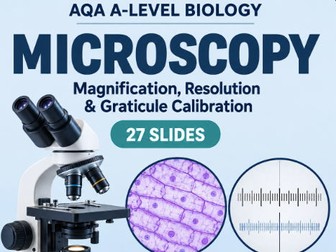
An editable 27-slide PowerPoint covering light and electron microscopy, magnification, resolution, unit conversions, scale bars and eyepiece graticule calibration. Includes micrographs, practical guidance, worked calculations and independent exam-style questions with separate click-to-reveal answers. Aligned with AQA section 3.2.1.3.
AQA A-Level Biology: Cell Fractionation & Ultracentrifugation PowerPointQuick View
chem1984

AQA A-Level Biology: Cell Fractionation & Ultracentrifugation PowerPoint

(0)
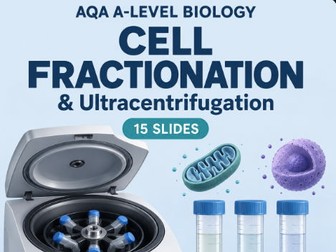
An editable 15-slide PowerPoint explaining homogenisation, filtration and differential centrifugation. Covers cold, isotonic and buffered conditions, pellets and supernatants, and the isolation of organelles. Includes retrieval activities and application questions with separate click-to-reveal answers. Aligned with AQA section 3.2.1.3.
AQA A-Level Biology: Cell Structure, Microscopy and Cell Fractionation – 4 PowerPoint BundleQuick View
chem1984

AQA A-Level Biology: Cell Structure, Microscopy and Cell Fractionation – 4 PowerPoint Bundle

(0)
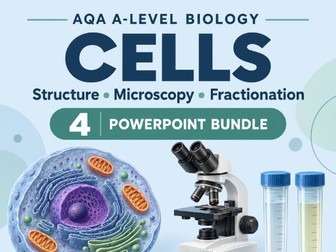
Support your teaching of the AQA A-level Biology Cells topic with four editable PowerPoint presentations covering: Eukaryotic cells: organelle structure and function, animal and plant cells, protein secretion and micrograph interpretation. Prokaryotic cells and viruses: bacterial structures, binary fission, viral structure and replication. Microscopy: magnification, resolution, light and electron microscopes, unit conversions, scale bars and eyepiece graticule calibration. Cell fractionation and ultracentrifugation: homogenisation, filtration, preparation conditions and separation of cell components. The bundle includes retrieval activities, labelled diagrams, independent exam-style practice questions and worked calculations. Answers reveal separately for each question part, allowing students time to respond before discussing the answer. Diagram labels also reveal progressively. Included: four editable PowerPoints containing 88 slides in total, including image-credit slides, plus an image-credit and licence record. Suitable for classroom teaching, revision and consolidation. Use PowerPoint Slide Show mode for the answer and label reveals. Aligned with AQA A-level Biology sections 3.2.1.1–3.2.1.3. This is an independent resource and is not endorsed by AQA. Practice questions and answer guidance are not official AQA examination materials.
AQA A-Level Biology: Eukaryotic Cells – Structure & Function PowerPointQuick View
chem1984

AQA A-Level Biology: Eukaryotic Cells – Structure & Function PowerPoint

(0)
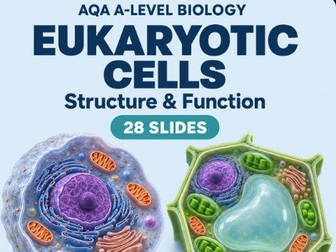
An editable 28-slide PowerPoint covering animal and plant cells, organelle structure and function, protein secretion and micrograph interpretation. Includes diagrams with progressive label reveals, retrieval activities and independent exam-style questions with separate click-to-reveal answers. Aligned with AQA section 3.2.1.1.
AQA A-Level Biology: Prokaryotic Cells & Viruses PowerPointQuick View
chem1984

AQA A-Level Biology: Prokaryotic Cells & Viruses PowerPoint

(0)
An editable 18-slide PowerPoint covering bacterial structures, binary fission, viral structure and replication. Includes diagrams with progressive label reveals, bacterial growth calculations, comparison questions and separate click-to-reveal answers. Aligned with AQA section 3.2.1.2, with extension material on HIV replication.
AQA GCSE Biology Foundation: Cell Division and Transport Revision WorkbookQuick View
chem1984

AQA GCSE Biology Foundation: Cell Division and Transport Revision Workbook

(0)
Support GCSE Foundation students with this structured revision workbook covering chromosomes, mitosis, diffusion, osmosis and active transport. Designed for AQA GCSE Combined Science: Trilogy, the resource combines concise revision notes, scaffolded activities, whiteboard checks and practice questions. It is suitable for teacher-led revision, small-group intervention and tutoring. The workbook includes: Chromosomes, DNA and genes. Mitosis and the stages of the cell cycle. Diffusion and factors affecting its rate. Osmosis and its effects on plant cells. The potato osmosis investigation, including percentage change in mass. Active transport in root hair cells and the small intestine. A comparison of the three transport processes. Linked videos and questions throughout. Supplied as a Word document, allowing teachers to adapt the teaching text and activities. Embedded question images are not individually editable.
Atomic Structure Revision Worksheet | AQA GCSE Combined Science FoundationQuick View
chem1984

Atomic Structure Revision Worksheet | AQA GCSE Combined Science Foundation

(0)
Support students in linking bonding and structure to the properties of substances with this Foundation GCSE revision booklet, designed for use alongside AQA Combined Science: Trilogy. Covers ionic bonding, electron transfer, ion charges, giant ionic lattices, covalent bonding, dot-and-cross diagrams, simple molecules, intermolecular forces, diamond, silicon dioxide and graphite. Includes explanations, diagrams, comparison tables, guided completion activities, whiteboard checks and practice questions. Activities address common misconceptions about melting points, electrical conductivity and the difference between bonds and intermolecular forces. Suitable for revision lessons, intervention groups and tutoring. Supplied as a Word document with adaptable text and layout; embedded question images are not individually editable. A separate answer key is not included.
Structure and Bonding Revision Worksheet | AQA GCSE Combined Science FoundationQuick View
chem1984

Structure and Bonding Revision Worksheet | AQA GCSE Combined Science Foundation

(0)
Support students in linking bonding and structure to the properties of substances with this Foundation GCSE revision booklet, designed for use alongside AQA Combined Science: Trilogy. Covers ionic bonding, electron transfer, ion charges, giant ionic lattices, covalent bonding, dot-and-cross diagrams, simple molecules, intermolecular forces, diamond, silicon dioxide and graphite. Includes explanations, diagrams, comparison tables, guided completion activities, whiteboard checks and practice questions. Activities address common misconceptions about melting points, electrical conductivity and the difference between bonds and intermolecular forces. Suitable for revision lessons, intervention groups and tutoring. Supplied as a Word document with adaptable text and layout; embedded question images are not individually editable. A separate answer key is not included.
IB Chemistry: Hybridisation and Molecular Geometry Lesson & Revision PackQuick View
chem1984

IB Chemistry: Hybridisation and Molecular Geometry Lesson & Revision Pack

(0)
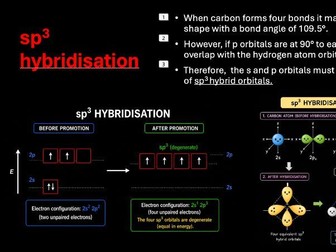
A visually engaging IB Chemistry resource covering hybridisation, molecular geometry, orbital overlap, and covalent bonding theory. Designed for Higher Level and strong Standard Level students, this lesson pack introduces electron promotion, σ and π bonding, and the relationship between electron domains, hybridisation, bond angles, and molecular shape. The resource includes: sp, sp² and sp³ hybridisation Electron-domain geometry vs molecular shape Covalent bonding and orbital overlap Promotion of electrons in carbon σ and π bonding Molecular geometry examples CO₂, BF₃, CH₄ and related examples Quick-fire questions True/false diagnostic checks Exam-style questions with answers IB-style summary and revision slides High-contrast infographic slides suitable for projection and online teaching Designed with a modern black-background format to improve classroom visibility and student engagement. Suitable for: IB Chemistry HL IB Chemistry SL (higher attaining students) A-Level Chemistry bridging University foundation chemistry preparation Keywords IB Chemistry, hybridisation, hybridization, molecular geometry, VSEPR, orbital overlap, covalent bonding, sp3, sp2, sp, sigma bonding, pi bonding, bond angles, IB HL Chemistry, A Level Chemistry
Introduction to the UK Biology Challenge – Reasoning, Vocabulary and Ecology (KS3–GCSE)Quick View
chem1984

Introduction to the UK Biology Challenge – Reasoning, Vocabulary and Ecology (KS3–GCSE)

(0)
A complete introductory lesson and enrichment resource designed to prepare students for the UK Biology Challenge and similar biology reasoning competitions. This resource is particularly suitable for: High-attaining KS3 students GCSE Biology students International students transitioning into the UK curriculum Biology clubs and enrichment sessions Summer school preparation courses The presentation focuses on developing: Biological reasoning Scientific vocabulary Rapid recall Ecology and adaptation knowledge Genetics and cell biology understanding Competition-style problem solving Topics covered include: Ecology and food chains Adaptations and survival Cell biology and genetics Experimental biology Biological vocabulary development Timed competition practice UK wildlife and ecology examples Ectotherms and endotherms Exam-style reasoning questions Includes: Warm-up quick-fire rounds Discussion prompts Timed mini challenge activities Fully explained answers Biology Challenge-style multiple choice questions International student support strategies Suggested documentary extensions This resource is designed to help students move beyond memorisation and begin “thinking like biologists”. Ideal for: 1–2 hour enrichment lessons Biology Challenge preparation Gifted and talented groups International school bridging courses Summer biology programmes Learning Objectives Students will: Apply biological reasoning to unfamiliar questions Improve scientific vocabulary and reading accuracy Develop confidence with UK-style biology problem solving Strengthen ecology, genetics and adaptation knowledge Practise interpreting competition-style questions under time pressure
Biosheets™ – Specialised cells and Stem cells (IGCSE / GCSE Biology Worksheet + Mark Scheme)Quick View
chem1984

Biosheets™ – Specialised cells and Stem cells (IGCSE / GCSE Biology Worksheet + Mark Scheme)

(0)
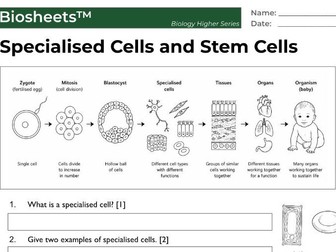
A structured, exam-focused worksheet covering specialised cells, stem cells, and ethical issues, designed for GCSE / IGCSE Biology (Edexcel/AQA compatible). This resource supports students in moving from core knowledge to exam-style evaluation, with a clear progression through recall, application, and extended writing. What’s included Double-sided worksheet Visual diagrams (black & white, exam-style) including: differentiation pathway (zygote → organism) specialised cells (e.g. sperm, plant cells, neurone) stem cell locations (human and plant) Short-answer questions (1–3 marks) Diagram-based application questions Comprehension passage on stem cell ethics Extended response questions (up to 4 marks) Open-ended evaluation question (ideal for higher ability)
Biosheets™ – Levels of Organisation (IGCSE / GCSE Biology Worksheet + Mark Scheme)Quick View
chem1984

Biosheets™ – Levels of Organisation (IGCSE / GCSE Biology Worksheet + Mark Scheme)

(0)
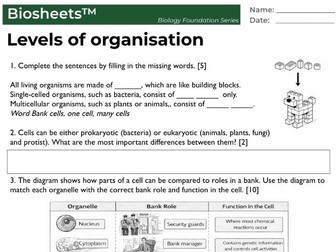
This worksheet introduces the levels of organisation and basic cell biology for IGCSE / GCSE students. It is designed as a structured foundation activity that moves from simple recall to deeper understanding of cell structure and plant cell function. Students complete a range of exam-style tasks including: • Fill-in-the-blank questions on cells and unicellular vs multicellular organisms • Short questions comparing prokaryotic and eukaryotic cells • A visual matching activity linking cell organelles to roles in a bank to help students understand organelle functions • Animal and plant cell labelling diagrams • Matching plant-specific organelles to their functions • A photosynthesis definition exercise with a word bank • Extended written questions on cell walls, vacuoles, and plant cell structure • A levels of organisation ordering activity (organelle → organism) • A 6-mark extended response explaining how plant cell structure supports photosynthesis • An extension research task on the endosymbiotic theory The worksheet includes clear diagrams, scaffolded questions, and space for written answers, making it suitable for classwork, homework, revision, or cover lessons. Includes: • Printable student worksheet (2 pages) • Full exam-style mark scheme • Extension research question for higher-ability students Ideal for: • IGCSE Biology • GCSE Biology • KS4 Cell Biology revision • Foundation or mixed-ability classes needing structured practice on cell structure and plant cells.
Biosheets™: Characteristics of living things (MRS GREN)Quick View
chem1984

Biosheets™: Characteristics of living things (MRS GREN)

(0)
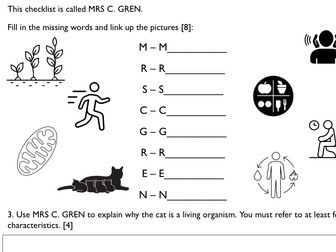
IGCSE Biology Worksheet – Characteristics of Living Organisms (MRS C. GREN) + Mark Scheme & Extension Task A structured, exam-focused worksheet designed to introduce and assess understanding of the Characteristics of Living Organisms. This resource takes students from everyday classification (stone, phone, cat) to scientific reasoning using MRS C. GREN (including Control/homeostasis). It moves beyond memorisation and develops explanation, comparison and evaluation skills. What’s included: • Engaging classification starter task • MRS C. GREN fill-in activity • Application and explanation questions • Higher-order thinking tasks (seed dormancy, virus debate, robot comparison) • Extension research question for stretch and challenge • Full mark scheme included Skills developed: • Scientific classification • Use of biological terminology • Written explanation • Addressing misconceptions • Evaluation of borderline cases Suitable for: • IGCSE Biology (Core & Extended) • GCSE Biology (Topic 1 foundations) • High-attaining KS3 students Estimated time: 40–45 minutes Printable worksheet format Ideal for consolidation, homework, cover work or short assessment.