A complete, ready-to-teach resource covering the Core Topics:
Systems and interactions
Power
Sovereignty
Legitimacy
Interdependence
Theoretical perspectives
Content is precisely matched to the IB Guide and includes clear EAL-friendly explanations, contemporary examples, key vocabulary and TOK links. Selected examples are deliberately reused to reduce student memorisation and strengthen application across the course. Supplied as an editable Word document—no additional textbook is required.
A complete, ready-to-teach Development and Sustainability resource precisely matched to the IB Global Politics Guide. It includes accessible explanations, key terminology, contemporary examples, supporting statistics, different political perspectives, TOK links, summaries and structured assessment activities (lesson tasks).
The resource develops students’ analytical writing and prepares them for Paper 2. It also includes a detailed case study covering the UNDP, the Sustainable Development Goals and gender equality in India. Supplied as editable Word documents—no additional textbook is required.
A complete, ready-to-teach Peace and Conflict resource precisely matched to the IB Global Politics Guide. It includes accessible explanations, key terminology, contemporary conflicts, relevant evidence, competing perspectives, TOK links, summaries and structured assessment activities (lesson tasks).
The resource develops students’ analytical writing and prepares them for Paper 2. It also includes a detailed case study of the UN’s involvement in Sudan and South Sudan. Supplied as editable Word documents—no additional textbook is required.
A complete, ready-to-teach Rights and Justice resource precisely matched to the IB Global Politics Guide. It includes accessible explanations, key terminology, contemporary examples, statistics, political perspectives, TOK links, summaries and structured assessment activities (lesson tasks).
The resource develops students’ analytical writing and prepares them for Paper 2. It also includes a detailed UN case study examining the UNHRC, UN Security Council and the Rohingya crisis. Supplied as editable Word documents—no additional textbook is required.
This is a complete, fully resourced IB DP Psychology unit for the Human Relationships Context, designed for the new specification first assessed in 2027. The unit is structured around the official Area of Study headings and uses relevant Content learning objectives to address each one. It includes all core explanations, key studies, conceptual analysis, critical thinking points, exam-style questions and end of unit assessment material, so no additional teacher input is needed. Each section is weighted to allow for 4, 6 and 15 mark questions, so it is not overly written and remains EAL focused.
The unit focuses on group behaviour and interpersonal relationships. It supports students in understanding acculturation, compliance techniques, conformity, cultural dimensions, social identity theory, social learning theory, chemical messengers, cognitive explanations, communication/language, and strategies for improving relationships. Conceptual analysis is built into each Area of Study, with clear links to bias, causality, change, measurement, perspective and responsibility. This makes the resource ideal for teachers who want a ready-to-use unit that teaches both the Content and the conceptual thinking required for the new IB Psychology course.
This resource contains five complete IB DP Psychology Paper 3 HL sample exam booklets for the new course, first assessed in 2027. Each booklet includes a full set of Paper 3-style questions and source materials, allowing students to practise graph interpretation, data analysis, research considerations and 15-mark synthesis responses. The papers are designed to mirror the structure and demands of the Paper 3 exam, helping students build confidence with source-based analysis and evaluation.
The five sample papers cover engaging HL extension topics, including cultural norms and mental health treatment, motivation and children’s social development, bilingualism and cognitive flexibility, social media and conformity, and globalization and gender norms. Each sample includes multiple sources such as graphs, tables, qualitative findings, observations, interviews and case-study-style evidence. This pack is ideal for teachers who want ready-made Paper 3 practice materials and for students who need realistic exam-style preparation for the 2027 IB Psychology specification (Paper 3).
This is a complete, fully resourced IB DP Psychology unit for the Health and well-being Context, designed for the new specification first assessed in 2027. The unit is structured around the official Area of Study headings and uses relevant Content learning objectives to address each one. It includes all core explanations, key studies, diagrams, conceptual analysis, critical thinking points and exam-style questions end of unit tests, so no additional teacher input is needed. Each section is weighted to allow for 4, 6 and 15 markers so it is not overly written as well as being EAL focused.
The unit focuses on PTSD as the mental health disorder and social media addiction as the health problem. It supports students in understanding biological explanations, cognitive models, cultural differences, environmental factors, prevalence of health problems, social learning theory, and stress and health. Conceptual analysis is built into each Area of Study, with clear links to bias, causality, change, measurement, perspective and responsibility. This makes the resource ideal for teachers who want a ready-to-use unit that teaches both the Content and the conceptual thinking required for the new IB Psychology course.
This is a complete, fully resourced IB DP Psychology unit for the Human Development Context, designed for the new specification first assessed in 2027. The unit is structured around the official Area of Study headings and uses relevant Content learning objectives to address each one. It includes all core explanations, key studies, diagrams, conceptual analysis, critical thinking points, exam-style questions and end of unit assessment material, so no additional teacher input is needed. Each section is weighted to allow for 4, 6 and 15 mark questions, so it is not overly written and remains EAL focused.
The unit focuses on models of development and the development of self. It supports students in understanding brain development, neuroplasticity, critical periods, sociocultural factors in development, stage theories and continuous models, theory of mind, attachment, enculturation of social norms, peer influence and childhood experiences. Conceptual analysis is built into each Area of Study, with clear links to bias, causality, change, measurement, perspective and responsibility. This makes the resource ideal for teachers who want a ready-to-use unit that teaches both the Content and the conceptual thinking required for the new IB Psychology course.
This is a complete, fully resourced IB DP Psychology unit for the Learning and Cognition Context, designed for the new specification first assessed in 2027. The unit is structured around the official Area of Study headings and uses relevant Content learning objectives to address each one. It includes all core explanations, key studies, diagrams, conceptual analysis, critical thinking points, exam-style questions and end of unit assessment material, so no additional teacher input is needed. Each section is weighted to allow for 4, 6 and 15 mark questions, so it is not overly written and remains EAL focused.
The unit focuses on thinking and learning and cognitive processes, with memory used as the main cognitive process. It supports students in understanding cognitive biases, classical and operant conditioning, dual processing theory, schema theory, social learning theory, biological factors in cognition, cognitive models, cultural factors in cognitive processes, environmental influences on cognition and strategies for improving cognitive processes. Conceptual analysis is built into each Area of Study, with clear links to bias, causality, change, measurement, perspective and responsibility. This makes the resource ideal for teachers who want a ready-to-use unit that teaches both the Content and the conceptual thinking required for the new IB Psychology course.
This resource is a complete guide to the IB DP Psychology Internal Assessment for the new course, first assessed in 2027. It supports students through every stage of the IA research proposal, including the introduction, research methodology, data collection and discussion. The booklet explains how to define a population of interest, identify a real-life problem, select and justify a research method, create a data collection tool, address ethical considerations and discuss potential findings and implications for policy or practice.
The resource is designed to make the IA process clear and manageable for students. It includes planning prompts, writing frames, concept links, sensitive topic guidance and a detailed checklist to help students meet the assessment requirements. It is ideal for teachers who want a ready-made IA support booklet and for students who need structured guidance on how to plan, justify and write a strong psychology research proposal.
This resource provides a comprehensive guide for how to answer Exam Questions for the New Psychology Guide (First assessment 2027). It breaks down Paper 1, Paper 2 and Paper 3 HL into clear, student-friendly sections, with exam structures, timings, command terms, writing frameworks and model answers.
This resource is a complete guide to IB DP Psychology Class Practicals for the new course, first assessed in 2027. It provides students and teachers with clear guidance on the four required practical contexts: Health and well-being, Human development, Human relationships, and Learning and cognition. The booklet explains the recommended research methods for each context, including interviews, observations, surveys/questionnaires and experiments, while also covering procedure, sampling, ethical considerations, sample findings and links to the six key concepts: bias, causality, change, measurement, perspective and responsibility.
It provides a comprehensive writing frame as well as 3 Excellent Examples.
The resource is designed to support preparation for Paper 2 Section A by showing students exactly how to apply their class practical knowledge in exam responses. It includes writing frames, exam timings, model answers, consent and debrief templates, and accessible explanations of core research methods. This makes it ideal for teachers who want a ready-made class practical booklet and for students who need structured support in understanding, recording and applying their class practical experience.
This is a complete, fully resourced IB DP Psychology Research Methods resource for SL students, designed for the new specification first assessed in 2027. Although SL students are not assessed through Paper 3, they still need a strong foundational understanding of research methodology because research methods run through the whole course, including class practicals, Paper 1 and Paper 2. This resource is therefore designed to help SL students understand the basic research methodology they need without the extra Paper 3 HL focus.
The resource introduces students to quantitative and qualitative research, descriptive and inferential statistics, correlation coefficients, thematic analysis, reliability, validity, generalisability, transferability, credibility, researcher bias, participant bias and reflexivity. It also explains the main research methods used in psychology, including experiments, observations, surveys/questionnaires, interviews, correlational studies and case studies, as well as key sampling techniques such as self-selected, opportunity, stratified, random and snowball sampling.
This is ideal for teachers who want a ready-to-use SL research methods booklet and for students who need clear, accessible support with the methodological language used throughout IB Psychology. It gives SL students the knowledge they need to understand studies, class practicals and unseen research material, while keeping the focus on basic research-method understanding rather than Paper 3 exam preparation.
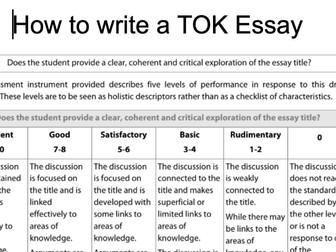
This is a comprehensive guide for writing a TOK Essay. It is designed to help students understand the formal requirements of the essay, how it is assessed, and how to structure a clear, coherent and critical response to a prescribed title. The resource explains the word count, formatting expectations, teacher interactions, use of Areas of Knowledge and the importance of specific examples.
The guide provides a clear essay structure, including an introduction, four main body paragraphs and a conclusion. It uses the PEAL paragraph structure to show students how to build each paragraph around a Point of View, Example, Analysis/Evaluation and Link. It also explains how to use TOK Concepts, Areas of Knowledge, Knowledge Questions and implications to develop stronger analysis rather than writing a descriptive essay.
The resource includes practical advice on avoiding common mistakes, such as drifting away from the title, using generic examples, overloading paragraphs with too many examples, or failing to evaluate different points of view. It also contains a checklist to help students ensure they have addressed the assessment requirements. This makes it ideal for teachers who want a ready-to-use TOK Essay support booklet and for students who need a clear, structured guide to writing a high-quality TOK Essay.
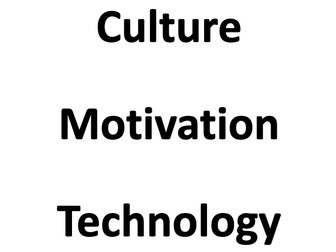
An IB Psychology First Assessment 2027 Higher Level Extensions resource, designed to help HL students understand how Culture, Motivation, and Technology can be applied across the four Contexts and carefully calibrated to meet the example HL learning outcomes of the New Guide.
The resource clearly connects the HL Extensions to Health and Well-being, Human Development, Human Relationships, and Learning and Cognition, helping students see how each extension can be used to develop stronger conceptual understanding.
It is designed to be EAL-friendly, with clear explanations, structured paragraphs, accessible key terminology, and student-friendly links between theory, real-world examples, and exam preparation.
The resource supports preparation for Paper 3, where HL students are assessed on the Higher Level Extensions. It gives teachers and students a clear framework for applying Culture, Motivation, and Technology across different areas of psychology, while also building critical thinking around bias, generalisability, causality, measurement, and interpretation.
This is a complete, fully resourced IB DP Psychology Research Methods resource for Paper 3 HL students, designed for the new specification first assessed in 2027. The resource is structured around the demands of Paper 3, with clear support for graph interpretation, data analysis, research considerations and synthesis/evaluation. It includes all core explanations, examples, diagrams, data interpretation guidance, research-method summaries and exam-focused terminology, so no additional teacher input is needed.
The resource supports students in understanding quantitative and qualitative research, including bar graphs, box and whisker plots, distributions, frequency tables, histograms, line graphs, outliers, scatterplots, descriptive statistics, inferential statistics, correlation coefficients and thematic analysis. It also covers key Paper 3 research considerations, including credibility, bias, transferability, reliability, validity, generalisability and reflexivity.
The booklet also includes clear explanations of the main research methods used in psychology, including experiments, observations, surveys/questionnaires, interviews, correlational studies and case studies, alongside sampling techniques and methodological strengths and limitations. This makes it ideal for teachers who want a ready-to-use HL Paper 3 research methods booklet and for students who need structured, accessible support with interpreting sources, analysing data and evaluating research claims.
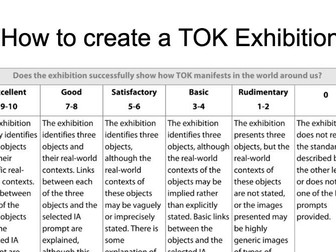
This is a comprehensive guide for creating a TOK Exhibition. It is designed to help students understand the formal requirements of the task, how it is assessed, and how to build a clear exhibition based on one of the official 35 TOK IA prompts. The resource explains the role of the exhibition, the 950-word limit, the need for three specific objects, the importance of real-world context, and how to link each object clearly to the selected prompt.
The guide supports students through the full exhibition process, including choosing a theme, selecting objects with specificity, writing commentaries, justifying the inclusion of each object, using TOK Concepts, and adding references. It provides a clear writing structure based on Point, Explanation, Analysis and Link, helping students avoid vague or generic object descriptions.
The resource also includes a writing frame, checklist, the full list of official IA prompts, and the 12 TOK Concepts: Evidence, Certainty, Truth, Interpretation, Power, Justification, Explanation, Objectivity, Perspective, Culture, Values and Responsibility. This makes it ideal for teachers who want a ready-to-use TOK Exhibition support booklet and for students who need a clear, structured guide to producing a focused and well-justified TOK Exhibition.
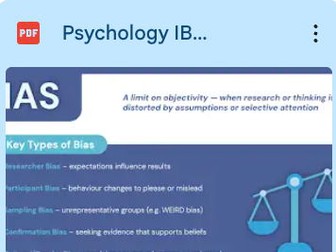
This is a set of IB DP Psychology concept posters designed to bring the six key concepts to life in the classroom: bias, causality, change, measurement, perspective and responsibility. Each poster gives students a clear definition, key terminology and a “why it matters” section, making the concepts easier to understand and apply in lessons and exam responses.
The posters cover essential concept-related language such as researcher bias, participant bias, correlation and causation, determinism and agency, operationalisation, validity, reliability, ethical responsibility, alternative explanations and the biological, cognitive and sociocultural approaches.
They are ideal for classroom display, revision walls or student reference sheets. The aim is to make the six IB Psychology concepts visible, memorable and usable, helping students move beyond description and develop stronger conceptual analysis throughout the course.
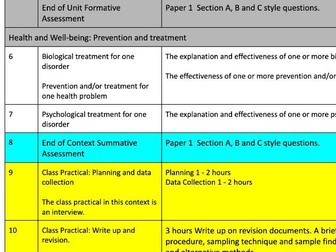
An IB Psychology First Assessment 2027 example Scheme of Work/Course Outline, showing how the full course can be structured across Year 1 and Year 2 using the 4Cs: Contexts, Content, Concepts, and Class Practicals.
It maps the four Contexts — Health and Well-being, Human Development, Human Relationships, and Learning and Cognition — across the course, while showing how Areas of Study, assessment, Class Practicals, the IA, and HL Paper 3 can be sequenced clearly.
The resource includes suggested timings, assessment summaries, example questions, formative and summative assessment points, and guidance for Paper 1, Paper 2, and HL Paper 3. It is designed to help teachers plan a coherent course that integrates Content, Concepts, Contexts, research methodology, TOK links, international mindedness, and the IB Learner Profile.
An IB Psychology (First assessment 2027) example unit of work for the Health and Well-being Context, showing how Areas of Study can be connected clearly to Content Learning Objectives, Concepts, and exam preparation.
It is designed to be EAL-friendly, with clear explanations, structured paragraphs, accessible key terminology, and student-friendly links between theory, research, Concepts, and exam questions.
The resource includes example Paper 1 questions and is calibrated for 4-mark, 6-mark, and 15-mark responses, helping students move from concise knowledge, to scenario-based application, to extended discussion and evaluation. Example schemes of work and complete resources are also available on this website.
An IB Psychology (First assessment 2027) example unit of work for the Human Relationships and Well-being Context, showing how Areas of Study can be connected clearly to Content Learning Objectives, Concepts, and exam preparation. It is designed to be EAL-friendly, with clear explanations, structured paragraphs, accessible key terminology, and student-friendly links between theory, research, Concepts, and exam questions. The resource includes example Paper 1 questions and is calibrated for 4-mark, 6-mark, and 15-mark responses, helping students move from concise knowledge, to scenario-based application, to extended discussion and evaluation. Example schemes of work and complete resources are also available on this website.


 Quick View