A complete guide to Jekyll and Hyde.
Includes the FULL TEXT with annotations, notes and prompt questions for students.
At the end of each chapter there are revision questions and space for guided note-taking.
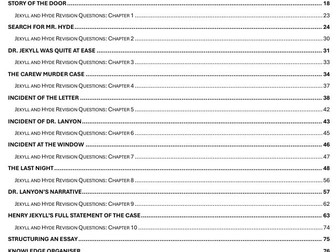
Includes knowledge organiser, vocab list and thematic prompts.
For staff delivering the taught element of the EPQ, this powerpoint walks through how to use MS Word to do two key organisational elements:
Create a reference which then can be used to automatically generate a bibliography (includes commentary on plagiarism).
Use in-built ‘style’ features to use headings, sub-headings etc to then automatically generate a table of contents.
This is ideal to use in the early stages, prior to really getting into the research, to ensure that referencing is being used appropriately throughout, then returning to as students begin to write their essays.
Contains:
Powerpoint with instructions on notes pages for delivering staff
5 sources to practise referencing skills
This includes a complete scheme of work and resources for a 20-lesson unit on Child Language Development for English Language A-Level.
includes:
Scheme of work
Suggested lesson activities
Lesson resources: articles, power-points, handouts
Independent learning tasks
Annotated transcripts to give teachers guidance on what to look for
This includes 60 questions for the OCR A-Level English Literature paper pre-1900 literature including Rossetti and A Doll’s House as well as all other texts for this unit.
There are:
10 full papers to use in the classroom
A list of all 60 questions
Suggestions for how to use these questions in the classroom, beyond simply essay writing, to develop strategic critical thinking and exam techniques.
All in .docx format, editable resources.
Contains:
Exam question: “Starting with this extract, explain how far you think Shakespeare presents Macbeth as a ruthless killer.” Extract - Act 1, Scene 2
Model essay


 Quick View