Just starting the Tudor unit? Look no further.
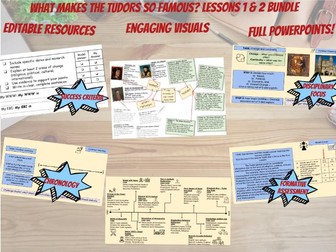
Lesson 1 provides a comprehensive timeline of the Tudor era to give students a strong overview of the topic, emphasising chronology skills.
Lesson 2 provides a look at the Mystery of the Princes in the Tower, showing what legitimacy looked like just before the Tudor Era, and the lengths some would go to, to secure power!
Lesson 1 - What made the Tudor period so distinctive?
Lesson 2 - What happened to the ‘Princes in the the Tower’?
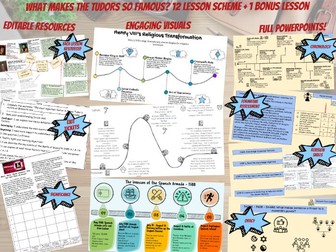
Transform your Year 8 students into Tudor Historians with this comprehensive 12-lesson scheme exploring England’s most famous dynasty.
Students will investigate why the Tudor period (1485-1603) fundamentally changed English politics, religion, and society while developing sophisticated historical skills.
With a bonus lesson on Elizabethan Golden Age in English society (Lesson 13)
What makes this special?
Emphasis on writing skills
Explicit teaching of second order historical concepts
End of Unit Assessment on Historical Skills (Second Order Concepts)
Complete with differentiation for SEND students with visual organisers and sentence starters.
Embedded retrieval practice with 40+ ready-made questions
Full SMSC and British Values integration
Assessment materials with peer-marking opportunities
Embedded mini-whiteboard checks for understanding or pose-pause-pounce-bounce no-handsup questioning sequences
Rich in formative assessment strategies
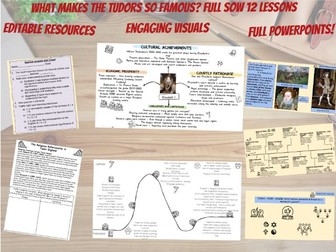
Transform your Year 8 students into Tudor historians with this half-scheme of 5 exploring England’s most famous dynasty.
Students will investigate why the Tudor period (1485-1603) fundamentally changed English politics, religion, and society while developing sophisticated historical skills.
1 - Overview and timeline of the Tudor era
2 - What really happened to the Princes in the Tower?
3 - How did the Tudors successfully seize power?
4 - What were the causes of Henry’s break from Rome?
5 - How did the dissolution of monasteries affect English society?
What makes this special?
Complete with differentiation for SEND students with visual organisers and sentence starters.
Frequent chances to promote oracy, with visual stimulus to get the conversations going
Embedded retrieval practice with 40+ ready-made questions
Full SMSC and British Values integration
Assessment materials with peer-marking opportunities
Embedded mini-whiteboard checks for understanding or pose-pause-pounce-bounce no-handsup questioning sequences
Rich in formative assessment strategies
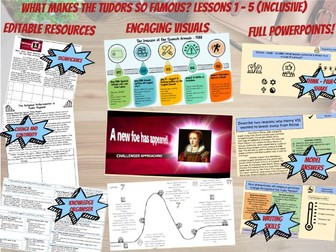
Transform your Year 8 students into Tudor historians with this half-scheme of 6 lessons exploring England’s most famous dynasty.
Students will investigate why the Tudor period (1485-1603) fundamentally changed English politics, religion, and society while developing sophisticated historical skills.
6 - Mid- term assessment
7 - How dramatically did religion change in Tudor England?
8 - Why did Mary, Queen of Sctos pose such a threat?
9 - What was the cause of English Victory over the Armada?
10 - Bridging lesson - linking Tudor exploration into Slavery.
11 - Revision - Knowledge organiser and revision strategies included!
12 - End of Unit Second-Order Concepts skills assessment included!
13 - BONUS LESSON: How far was Elizabethan England a Golden Age?
What makes this special?
Complete with differentiation for SEND students with visual organisers and sentence starters.
Frequent chances to promote oracy, with visual stimulus to get the conversations going
Embedded retrieval practice with 40+ ready-made questions
Full SMSC and British Values integration
Assessment materials with peer-marking opportunities
Embedded mini-whiteboard checks for understanding or pose-pause-pounce-bounce no-handsup questioning sequences
Rich in formative assessment strategies


 Quick View