Reaction Mechanisms & Rate-Determining Step | Edexcel IAL Chemistry | KineticsQuick View
hotmail401120

Reaction Mechanisms & Rate-Determining Step | Edexcel IAL Chemistry | Kinetics

(0)
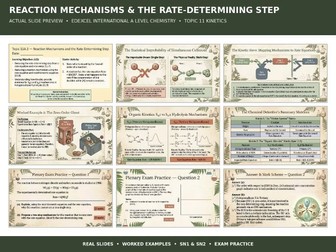
A complete, ready-to-teach lesson covering reaction mechanisms and the rate-determining step (RDS) for Pearson Edexcel International A Level Chemistry – Topic 11: Kinetics. This lesson develops students’ understanding of how experimentally determined rate equations can provide evidence for reaction mechanisms and how the slow, rate-determining step influences the overall rate of a reaction. Topics covered include: Understanding reaction mechanisms Multi-step reactions The rate-determining step (RDS) Connecting rate equations to reaction mechanisms Using reaction order to identify species involved in the RDS Intermediates within reaction mechanisms Testing proposed mechanisms against experimental evidence Applying kinetics knowledge to unfamiliar reactions Exam-style questions and calculations Students are guided from the fundamental ideas through to applying rate equations to proposed mechanisms, helping them develop the reasoning required for more challenging A Level kinetics questions. The PowerPoint includes clear explanations, worked examples, student activities, application questions and answers, making it suitable for classroom teaching as well as independent revision. Specification: Pearson Edexcel International A Level Chemistry Topic: Topic 11 – Kinetics Level: IAS/IAL Chemistry Ideal for classroom teaching, revision, cover lessons or independent study. Part of a complete Edexcel IAL Chemistry Topic 11: Kinetics lesson series.
Rate Equations, Rate Constants & Order of Reaction | Edexcel IAL Chemistry | KineticsQuick View
hotmail401120

Rate Equations, Rate Constants & Order of Reaction | Edexcel IAL Chemistry | Kinetics

(0)
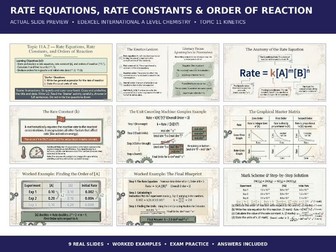
A complete, ready-to-teach PowerPoint covering rate equations, rate constants and order of reaction for Pearson Edexcel International A Level Chemistry – Topic 11: Kinetics. This lesson develops students’ understanding of how experimental rate data can be used to determine the relationship between reactant concentration and reaction rate. Students are guided through interpreting rate equations, identifying reaction orders and working with the rate constant, k. Topics covered include: Understanding and writing rate equations The meaning of reaction order Zero, first and second order reactions Determining the order with respect to individual reactants Overall order of reaction Understanding the rate constant, k Calculating the rate constant from experimental data Units of the rate constant Interpreting experimental kinetics data Applying rate equations to calculations Exam-style application of kinetics concepts The lesson is designed to build students’ confidence with both the conceptual and mathematical aspects of kinetics, with clear explanations and opportunities to apply their understanding. Suitable for use as a full classroom lesson, revision resource, independent study resource or examination preparation. Specification: Pearson Edexcel International A Level Chemistry Topic: Topic 11 – Kinetics Level: IAS/IAL Chemistry Part of a complete Edexcel IAL Chemistry Topic 11: Kinetics lesson series.
Effect of Temperature on the Rate Constant | Edexcel IAL Chemistry | KineticsQuick View
hotmail401120

Effect of Temperature on the Rate Constant | Edexcel IAL Chemistry | Kinetics

(0)
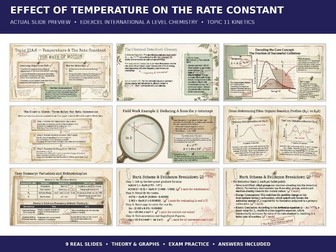
A complete, ready-to-teach lesson covering the effect of temperature on the rate constant, k, for Pearson Edexcel International A Level Chemistry – Topic 11: Kinetics. This lesson develops students’ understanding of why increasing temperature increases the rate of a chemical reaction and, importantly, how this is linked to an increase in the rate constant, k. Students are guided through the particle-level explanation of temperature and reaction rate before connecting this to collision theory, activation energy and the Maxwell–Boltzmann distribution. Topics covered include: The effect of temperature on reaction rate The relationship between temperature and the rate constant, k Collision theory Activation energy Maxwell–Boltzmann distributions How temperature changes the distribution of molecular energies The proportion of particles with energy greater than or equal to Ea Explaining why k increases as temperature increases Applying these ideas to rate equations Exam-style explanations and application questions The lesson is structured to help students move beyond simply stating that particles “collide more frequently” and develop the detailed explanations required for International A Level Chemistry examination questions. The PowerPoint includes clear explanations, diagrams, worked examples, student activities and opportunities for exam-style practice, making it suitable for both initial teaching and revision. Specification: Pearson Edexcel International A Level Chemistry Topic: Topic 11 – Kinetics Level: IAS/IAL Chemistry Ideal for classroom teaching, revision, independent study or examination preparation. Part of a complete Edexcel IAL Chemistry Topic 11: Kinetics lesson series.
Activation Energy & Catalysis | Edexcel IAL Chemistry | Topic 11 KineticsQuick View
hotmail401120

Activation Energy & Catalysis | Edexcel IAL Chemistry | Topic 11 Kinetics

(0)
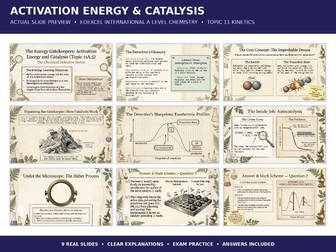
A complete, ready-to-teach lesson covering activation energy and catalysis for Pearson Edexcel International A Level Chemistry – Topic 11: Kinetics. This lesson develops students’ understanding of the energy requirements for successful reactions and how catalysts increase reaction rate by providing an alternative reaction pathway with a lower activation energy. Students are supported in connecting the particle-level explanation of reactions with activation energy, energy profiles and the action of catalysts, before applying their understanding to exam-style questions. Topics covered include: Activation energy, Ea Energy requirements for successful reactions Energy profile diagrams The effect of activation energy on reaction rate How catalysts increase the rate of reaction Alternative reaction pathways Comparing catalysed and uncatalysed reactions Interpreting energy profile diagrams Applying activation energy and catalysis concepts to exam questions The PowerPoint provides a structured progression from core knowledge through to application, helping students develop the explanations and chemical reasoning required at International A Level. Suitable for classroom teaching, revision, independent study or examination preparation. Specification: Pearson Edexcel International A Level Chemistry Topic: Topic 11 – Kinetics Level: IAS/IAL Chemistry Part of a complete Edexcel IAL Chemistry Topic 11: Kinetics lesson series.
Edexcel IAL Chemistry Topic 11: Kinetics | Complete Lesson PowerPoint BundleQuick View
hotmail401120

Edexcel IAL Chemistry Topic 11: Kinetics | Complete Lesson PowerPoint Bundle

4 Resources
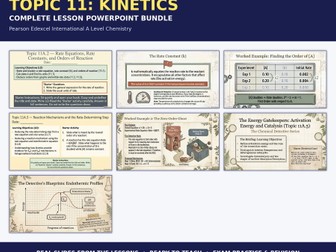
A complete Pearson Edexcel International A Level Chemistry Topic 11: Kinetics teaching bundle containing a full series of ready-to-teach PowerPoint lessons. The lessons are designed to take students from the fundamental ideas of reaction rates through to the more challenging quantitative and analytical aspects of A Level kinetics, including rate equations, reaction order, rate constants, reaction mechanisms, the rate-determining step, activation energy and the effect of temperature. This bundle covers: Techniques for measuring the rate of a reaction Initial-rate and continuous-monitoring methods Rate equations Rate constants, k Determining reaction order Zero, first and second order reactions Calculating and interpreting the units of k Using experimental data to determine rate equations Reaction mechanisms The rate-determining step (RDS) Using rate equations as evidence for proposed mechanisms Activation energy Catalysis and alternative reaction pathways The effect of temperature on reaction rate The effect of temperature on the rate constant Maxwell–Boltzmann distributions Applying kinetics concepts to unfamiliar and exam-style problems The lessons contain a combination of clear explanations, worked examples, calculations, diagrams, student activities, checks for understanding and exam-style practice, providing a structured sequence for teaching the complete topic. The resources have been designed specifically for Pearson Edexcel International A Level Chemistry, with an emphasis on developing both students’ understanding of the chemistry and their ability to apply it successfully to examination questions. Ideal for: Full classroom teaching of Topic 11 International A Level Chemistry teachers Student revision Exam preparation Independent study Cover lessons Purchasing the bundle provides the complete Topic 11: Kinetics lesson series together in one resource, rather than purchasing each PowerPoint individually. Specification: Pearson Edexcel International A Level Chemistry Topic: Topic 11 – Kinetics Resource type: Complete PowerPoint lesson bundle
Edexcel IAL Chemistry Topics 11 Measuring Rates Of ReactionQuick View
hotmail401120

Edexcel IAL Chemistry Topics 11 Measuring Rates Of Reaction

(0)
Techniques for Measuring the Rate of a Reaction | Edexcel IAL Chemistry | Topic 11 Kinetics A complete, ready-to-teach lesson covering techniques for measuring rates of reaction and methods for obtaining rate data, designed specifically for Pearson Edexcel International A Level Chemistry – Topic 11: Kinetics (11.3–11.4). This lesson helps students understand not only the different experimental techniques available, but also how to select and justify the most appropriate technique for a particular reaction. Topics covered include: Titration as a method of obtaining rate data Colorimetry and monitoring changes in absorbance Measuring mass change when a gas escapes Measuring the volume of gas evolved Selecting and justifying an appropriate experimental technique The difference between a measuring technique and an experimental method The initial-rate method Clock reactions and using 1/time as an approximation of initial rate Continuous monitoring Concentration–time graphs Calculating rate from the gradient of a tangent Links to the iodine–propanone core practicals The lesson includes a clear lesson roadmap, retrieval starter, Tier 3 vocabulary, worked examples, quick-check questions, application tasks and exam-style plenary questions with answers and mark schemes. Students are encouraged throughout to apply their knowledge to unfamiliar reactions and justify experimental choices, helping develop the practical and analytical skills required for International A Level examination questions. Specification: Pearson Edexcel International A Level Chemistry Topic: Topic 11 – Kinetics Specification points: 11.3–11.4 Level: IAS/IAL Chemistry Ideal for classroom teaching, revision, cover lessons or independent study. Part of a complete Edexcel IAL Chemistry Topic 11: Kinetics lesson series.