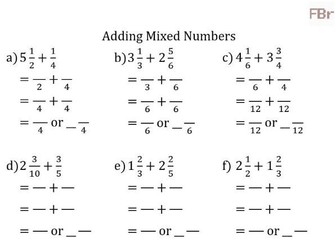
Two worksheets with answers for adding and subtracting mixed numbers respectively. Starts off with scaffolding and gains independence as you go through. Some tricky numbers, so better for higher ability students.
Available in PDF and docx format.
A worksheet I used for homework covering:
Simplifying Expressions (Collecting Like Terms)
Expanding Single Brackets
Factorising to Single Brackets
Substitution
Contains answers too.
Each section builds up in difficulty and has questions to get misconceptions to arise (e.g. collecting x² and x together)
Available in PDF and DOCX (so you can change numbers if you’d like)
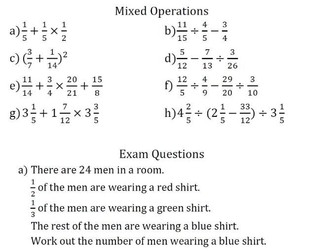
A worksheet containing a section on adding/subtracting, multiplying and dividing fractions. Also contains a section of mixed operation questions and accompanied by some exam questions using fractions.
Aimed more at GCSE students, contains good practice of using all four operations with fractions. Contains answers too.
A sheet on having to label the key points of the graph (roots, intercept and turning point) - ideal for a quick starter or refresher about the points.
The other sheet is on finding the coordinates of these points from the given graphs.
Available in DOCX or PDF.
Four examples of algebra word problems. Shows the importance of comprehending the question given through the use of highlighting and how to formulate an equation.
Two worksheets/homeworks on plotting quadratic graphs. With answers.
First is just plotting, second includes related questions too.
No axis numbers given, so good practice to draw appropriate scales as it is asked of them at GCSE.
A worksheet (+answers) made up of 3 sections:
Section A - Angles on a Straight Line
Section B - Angles around a Point
Section C - Angles on a straight line/around a point problems
Section A
Practises applying the angle rule that angles on a straight line sum to 180 degrees. Question 4 tackles the misconception that students do where they don’t look at angles around each point separately.
Section B
Practises applying the angle rule that angles around a point sum to 360 degrees.
Begins simple then progresses in difficulty. Final question could be done as an extend activity.
Section C
This is all about getting the students to see when to apply each rule. It is important that they see the straight lines and apply that rule instead as it simpler. Ends with some word problems to promote literacy and being able to solve problems.
A set of questions about recognising and identifying different graph types. Aimed at Foundation GCSE, would be a good starting point for higher. Answers included at the end.
Available in PDF and DOCX format.
A PowerPoint on the naming conventions behind Polygons. A lot of people know up to 12-sided polygons (dodecagon) but with this PowerPoint you can show the naming conventions and be able to name any Polygon up to a 999-sided polygon!
…it’s an enneahectaenneacontakaienneagon if you were wondering. A great literacy-based task, which can be used as an end-of-term activity.
The way I’ve used this PowerPoint is to show how the roots of words can reveal information about the word (same from words like percentage).
Then I get them to name the more basic polygons, starting from what they know and stretching it with the basic rule (just add -gon) at the end as a prefix.
Next is the rule for 21-99 which is where you add the word kai as along with a tens digit and ones digit words. This lets them begin to use these new basic rules to form a new polygon.
I show a picture of a hectagon (100 sides) next to get them to have a look and discuss what they notice about it. The main conclusion is that it looks like a circle at this point. So we can say that the more sides we add, the more round a polygon will look.
Finally, we introduce the rule for up to 999-sides. You now have to add the hundreds unit as well. This is why I enjoy this lesson, it is all about applying new rules to be able to form these words.
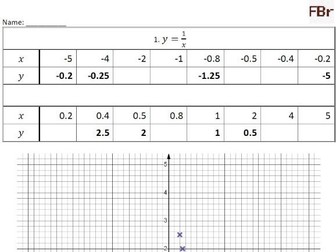
A worksheet on plotting reciprocal graphs, with several questions about each graph. Answers provided too. Could be differentiated by choosing to do some questions and leaving others.
DOCX and PDF provided.
A lesson on factorising quadratic equations. Builds on assumed prior knowledge of factorising to single brackets and being able to expand double brackets.
Worksheet for multiplying mixed numbers, with an example and answers too. Includes cross-cancelling as it will make their lives much easier.
DOCX and PDF format available.
A worksheet where students have to spot mistakes to uncover the mystery of what happened! Good as a homework or a main activity worksheet for a lesson. Covers converting between Fractions, Decimals and Percentages - it does contain recurring decimals too.
Answers provided as well.
Inspired by: https://justmaths.co.uk/2013/04/29/whodunnit-bidmas/
This was made for World Book Day. It covers the topic of proportion and using unitary values. Fairly easy for you to adjust numbers if you want easier/harder.
When it got to the potion part, I got the students to wave their pens as wands for it coming up with a different movement for each - good fun!
Contains an extract from the book at the beginning which we read, along with a couple of clips from the films too. You could obviously skip those and focus on the maths, where this would take up part of a lesson I’d imagine then.
Scaffolded questions to do with area and volume similarity. Includes short little starter for practising changing between the different scale factors.
Answers included.
Uses ratios as the basis for solving these questions - if you wish to teach it a different way then you could still use the questions themselves.
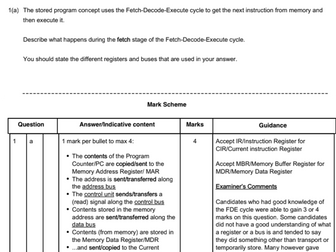
For use with the OCR A Level Computer Science H446 specification. Exam questions are mainly taken from years 2022-2024, but other years were used if required. Created using the OCR Exam Builder.
Contains exam questions for all the topics in the specification:
1.1.1 Structure and function of the processor
1.1.2 Types of processor
1.1.3 Input, output and storage
1.2.1 Systems software
1.2.2 Applications generation
1.2.3 Software development
1.2.4 Types of programming language
1.3.1 Compression, encryption and hashing
1.3.2 Databases
1.3.3 Networks
1.3.4 Web technologies
1.4.1 Data types
1.4.2 Data structures
1.4.3 Boolean algebra
1.5.1 Computing related legislation
1.5.2 Moral and ethical issues
2.1.1 Thinking abstractly
2.1.2 Thinking ahead
2.1.3 Thinking procedurally
2.1.4 Thinking logically
2.1.5 Thinking concurrently
2.2.1 Programming techniques
2.2.2 Computational methods
2.3.1 Algorithms
A short 8 question starter.
3 basic questions on multiplying fractions.
3 basic questions on dividing fractions.
2 worded problems, 1 of each type.
Answers are provided.
Both PDF and Word Document formats provided. 2 to a page.
15 multiple choice questions about the D-Day landings in World War 2. Used for a form quiz during the anniversary, but could be used when dealing with the topic itself in History.
Contains pictures related to the event, along with additional information about the answers too to help educate about this historic event.
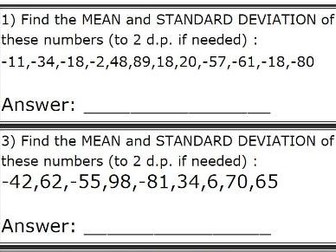
No frills worksheet on calculating the mean and standard deviation from a list of numbers.
Designed to be used by A Level students practising inputting these straight into their calculators.
Base numbers and style of worksheet generated by Interactive Maths and then edited by me.
Worksheets to practice factorising quadratic equations using the box method.
Contains instructions to refer to as well as questions to practice using them.
Contains a sheet where you can do an example on the board with them filling it in and then a worksheet with 18 questions and answers to complete.
Deals with quadratic equations of the style ax²+bx+c where a>1. This box method is ideal for those on the lower end of higher, as it flows nicely once they get used to using the box.
Exam questions designed for the OCR GCSE J277 specification. These are all to do with tracing algorithms by the use of trace tables, reading flow charts or following OCR reference language.
Exam questions taken from the J277, J276 and A451 specifications but all are on the same theme.


 Quick View