Christmas Puzzle Packs KS1 & KS2 Bundle: Maths and Word PuzzlesQuick View
alexdownie18

Christmas Puzzle Packs KS1 & KS2 Bundle: Maths and Word Puzzles

(0)
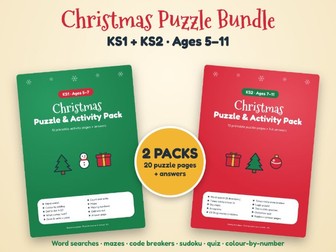
Two festive puzzle packs in one bundle: one for KS1 (ages 5-7) and one for KS2 (ages 7-11). Print and go for the last weeks of the autumn term, wet play, early finishers or a Christmas activity afternoon. Every pack includes full answer pages. KS1 Christmas Puzzle Pack (ages 5-7), 10 activity pages Christmas word search (across and down only) Count and write, plus simple word problems Colour by adding (sums within 10, reveals a Christmas tree) Help the elf maze Dot to dot 1 to 20 Missing numbers: counting in 1s, 2s, 5s and 10s What comes next? Picture patterns Odd one out My Perfect Present: draw and write Cracker jokes KS2 Christmas Puzzle Pack (ages 7-11), 10 puzzle pages 15-word search in 8 directions Times tables code breaker with a secret message Times tables and division colour-in Logic grid puzzle: who got which present? Large maze Two 6x6 sudoku puzzles (easier and harder) Christmas anagrams with clues 10-question Christmas quiz The Elf Shop: money problems with change Christmas riddles and write your own Two A4 PDFs, ready to print in colour or black and white. Every puzzle has been checked, with one solution each.
Growing Up Online: KS3 PSHE Bundle (AI, Deepfakes, Misogyny)Quick View
alexdownie18

Growing Up Online: KS3 PSHE Bundle (AI, Deepfakes, Misogyny)

3 Resources
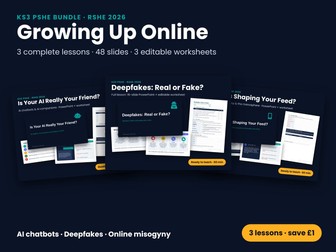
Three complete, ready-to-teach KS3 PSHE lessons on the biggest online issues facing young people today, covering key 2026 RSHE content on AI, deepfakes and online misogyny. Save £1 compared with buying them separately. Each lesson is about 60 minutes and includes a fully editable 16-slide PowerPoint with detailed teacher notes, a clear I do / We do / You do structure, an editable Word worksheet with a teacher answer page, and a safeguarding note. Lessons included Is Your AI Really Your Friend? AI chatbots and AI companions. How chatbots really work, benefits and risks, the THINK checklist for using AI wisely, and when to talk to a real person. Deepfakes: Real or Fake? What deepfakes are, the STOP, LOOK, CHECK, ASK checklist for spotting fakes, consent and harm, up-to-date UK law (including the 2026 offence of creating sexual deepfakes), and what to do, including Childline’s Report Remove. Who’s Shaping Your Feed? Online misogyny and the manosphere. How algorithms pull young people towards extreme content, why it appeals, six red flags, healthy vs harmful messages, and how to challenge safely. It supports boys rather than shaming them, and doesn’t name individual influencers. Every lesson includes: starter, key words, modelled We do example, four scenario cards with suggested answers, exit ticket (3-2-1), self-assessment and a support slide. Ideal for a half-term online safety unit for Years 8 and 9, or as standalone lessons. Created by a secondary school teacher, using AI tools to assist with design and content. All content has been checked by the author. Statistics and laws were checked in November 2026.
Deepfakes PSHE Lesson KS3: Real or Fake?Quick View
alexdownie18

Deepfakes PSHE Lesson KS3: Real or Fake?

(0)
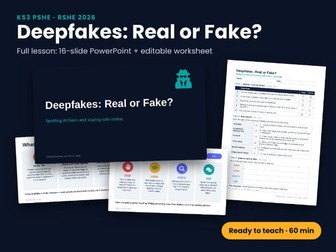
A complete, ready-to-teach KS3 PSHE lesson on deepfakes and AI fakes: 16-slide PowerPoint with teacher notes plus an editable worksheet with answers. Covers the 2026 RSHE guidance. Schools have had to teach about deepfakes since the statutory RSHE guidance came into force in September 2026. This one-hour lesson for Years 8 and 9 helps pupils understand what deepfakes are, spot AI fakes, and know what to do if a deepfake is made of them, in an age-appropriate, non-graphic way. Learning objectives Explain what a deepfake is and how AI makes one Use a checklist (STOP, LOOK, CHECK, ASK) to judge whether something might be fake Know the UK law and where to get help if a deepfake is made of you What’s included 16-slide PowerPoint, fully editable, with detailed teacher notes on every slide Clear I do / We do / You do structure, with each phase labelled on the slides Starter quiz, key words, a modelled voice-clone scam example and four scenario cards (fake school announcement, a classmate’s face swapped into a video, sextortion, and a celebrity crypto scam) Up-to-date UK law slide, including the Online Safety Act 2023 and the new offence of creating sexual deepfakes (in force from 6 February 2026) Clear advice on what to do, including Childline’s Report Remove and why pupils must never screenshot a nude image of an under-18 Exit ticket (3-2-1) and self-assessment against the objectives Support slide: Childline, Report Remove, CEOP and Shout 4-page worksheet in Word (editable) and PDF, with a teacher answer page Safeguarding notes and a suggested DSL briefing Lesson length: about 60 minutes. Scenario C (sextortion) can be left out for younger or more vulnerable groups. Created by a secondary school teacher, using AI tools to assist with design and content. All content has been checked by the author. Statistics and laws were checked in November 2026; please check for updates before teaching.
AI Chatbots & AI Friends PSHE Lesson KS3Quick View
alexdownie18

AI Chatbots & AI Friends PSHE Lesson KS3

(0)
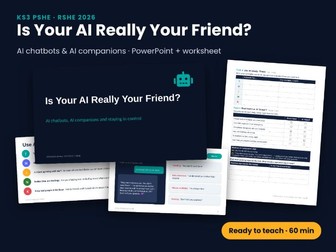
A complete, ready-to-teach KS3 PSHE lesson on AI chatbots and AI companions: 16-slide PowerPoint with teacher notes plus an editable worksheet with answers. Covers AI literacy in the 2026 RSHE guidance. Most young people now use AI chatbots, and almost a third of those who do say a chatbot is like a friend (Vodafone, 2026). This balanced one-hour lesson for Years 8 and 9 explains how chatbots really work, weighs up the benefits and the risks, and teaches pupils to use AI wisely and know when to talk to a real person instead. No scare tactics: AI is presented as a useful tool with real limits. Learning objectives Explain how AI chatbots work, and what they can’t do Weigh up the benefits and risks of AI chatbots and AI ‘friends’ Use AI safely and know when to talk to a real person instead What’s included 16-slide PowerPoint, fully editable, with detailed teacher notes on every slide Clear I do / We do / You do structure, with each phase labelled on the slides True/false starter with answers, plus key words (chatbot, AI companion, hallucination, personal data, dependence) ‘How does a chatbot work?’ explained simply: trained, predicts, responds Up-to-date UK statistics on how young people use AI chatbots Five risks to watch out for: made-up answers, privacy, being built to keep you hooked, replacing people, and unsafe advice A made-up AI companion chat to analyse together (isolation, fake closeness, secrecy) ‘Real friend or AI friend?’ comparison activity The THINK checklist for using AI wisely Four scenario cards (homework hallucinations, spending hours with an AI companion, asking AI for diet advice, and privacy), with suggested answers ‘When to talk to a real person’ slide, an exit ticket (3-2-1), self-assessment and support slide 5-page worksheet in Word (editable), with a teacher answer page and safeguarding note Lesson length: about 60 minutes. Created by a secondary school teacher, using AI tools to assist with design and content. All content has been checked by the author. Statistics were checked in November 2026; please check for updates before teaching. Also available: Deepfakes PSHE Lesson KS3: Real or Fake? and Online Misogyny & Manosphere PSHE KS3.
Online Misogyny & Manosphere PSHE KS3Quick View
alexdownie18

Online Misogyny & Manosphere PSHE KS3

(0)
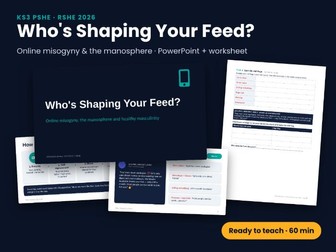
A complete, ready-to-teach KS3 PSHE lesson on online misogyny, the manosphere and healthy masculinity: 16-slide PowerPoint with teacher notes plus an editable worksheet with answers. Covers the 2026 RSHE guidance. The statutory RSHE guidance in force from September 2026 requires schools to tackle misogyny and the influence of online content. This one-hour lesson for Years 8 and 9 helps pupils understand why some online influencers appeal to young people, how algorithms pull them towards more extreme content, and how to think critically and respond, without shaming boys or naming individual influencers. Learning objectives Explain what misogyny and the ‘manosphere’ are Spot the tactics some online influencers use to pull people in Challenge harmful messages respectfully and know where to get help What’s included 16-slide PowerPoint, fully editable, with detailed teacher notes on every slide Clear I do / We do / You do structure, with each phase labelled on the slides Agree/disagree starter with an evidence slide, plus key words (misogyny, manosphere, algorithm, echo chamber, stereotype, healthy masculinity) ‘How your feed can pull you in’ algorithm pipeline explained Why it appeals: empathetic discussion with recent UK survey data Six red flags to spot, and a made-up influencer post to analyse together Who gets hurt (girls, boys and relationships), with up-to-date statistics Harmful vs healthy messages sorting activity and positive role models discussion Four realistic scenario cards, with suggested answers in the notes Practical steps: resetting your feed, asking questions, challenging safely, supporting others and reporting Exit ticket (3-2-1), self-assessment and support slide (Childline, Shout, Report Harmful Content) 5-page worksheet in Word (editable), with a teacher answer page and safeguarding note Lesson length: about 60 minutes. Created by a secondary school teacher, using AI tools to assist with design and content. All content has been checked by the author. Statistics were checked in November 2026; please check for updates before teaching. Also available: Deepfakes PSHE Lesson KS3: Real or Fake?
11+ Maths Mock Papers Set 2 with SolutionsQuick View
alexdownie18

11+ Maths Mock Papers Set 2 with Solutions

(0)
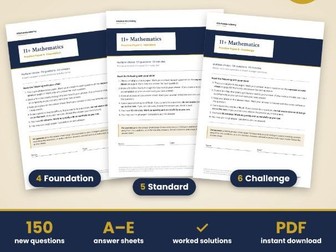
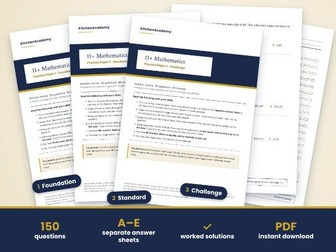
Three more full 11+ maths mock papers for tutors and teachers (Set 2: Papers 4–6), graded Foundation to Challenge, with answer sheets, worked solutions and a KS2 topic tracker. A second set of ready-to-use 11+ maths mocks for tutors and teachers preparing pupils for grammar school entrance tests. All 150 questions are new, so pupils who have finished Set 1 can keep practising. It needs no preparation: print and go. The papers are graded in difficulty, so you can use them across a whole course of tuition: Paper 4, Foundation: builds confidence with the multiple-choice format Paper 5, Standard: typical test level, ideal as a timed mock Paper 6, Challenge: multi-step reasoning for pupils aiming for the top scores Each paper includes: 50 multiple-choice questions (A–E) to be completed in 50 minutes A separate answer sheet, to practise test technique A one-page answer key for quick marking A fully worked solution for every question, with common mistakes highlighted (useful for feedback sessions) A topic tracker that maps every question to a topic, so you can see each pupil’s gaps and plan the next sessions Coverage: number and place value, calculation, fractions, decimals and percentages, ratio and proportion, algebra and sequences, measurement and time, geometry, statistics and problem solving, all in line with the KS2 curriculum. Ways to use it: As a progress check after Set 1, to see how far each pupil has come As timed mock exams in Year 5 and early Year 6, to build stamina and pacing As homework, with the worked solutions used for review in the next lesson With small groups, using the topic tracker to group pupils by the topics they need most Format: 3 PDF files on A4, ready to print. 150 questions in total. Written by a secondary maths teacher. Every answer has been checked for accuracy. These are independent practice papers, not affiliated with any test provider. Test formats vary by area, so check your target schools’ admissions pages for details of their tests.
11+ Maths Mock Papers Bundle with SolutionsQuick View
alexdownie18

11+ Maths Mock Papers Bundle with Solutions

(0)
Three full 11+ maths mock papers for tutors and teachers, graded from Foundation to Challenge, with answer sheets, worked solutions and a KS2 topic tracker. A ready-to-use set of 11+ maths mocks for tutors and teachers preparing pupils for grammar school entrance tests. It needs no preparation: print and go. The papers are graded in difficulty, so you can use them across a whole course of tuition: Paper 1, Foundation: introduces the multiple-choice format and builds confidence Paper 2, Standard: typical test level, ideal as a timed mock Paper 3, Challenge: multi-step reasoning for pupils aiming for the top scores Each paper includes: 50 multiple-choice questions (A–E) to be completed in 50 minutes A separate answer sheet, to practise test technique A one-page answer key for quick marking A fully worked solution for every question, with common mistakes highlighted (useful for feedback sessions) A topic tracker that maps every question to a topic, so you can see each pupil’s gaps and plan the next sessions Coverage: number and place value, calculation, fractions, decimals and percentages, ratio and proportion, algebra and sequences, measurement, geometry, statistics and problem solving, all in line with the KS2 curriculum. Ways to use it: As a baseline assessment at the start of 11+ tuition, using Paper 1 to find each pupil’s starting point As timed mock exams in Year 5 and early Year 6, to build stamina and pacing As homework, with the worked solutions used for review in the next lesson With small groups, using the topic tracker to group pupils by the topics they need most Format: 3 PDF files on A4, ready to print. 150 questions in total. Written by a secondary maths teacher. Every answer has been checked for accuracy. These are independent practice papers, not affiliated with any test provider. Test formats vary by area, so check your target schools’ admissions pages for details of their tests.