Forming Ions and Ionic Bonding | BTEC Applied Science Unit 1Quick View
rocheaji

Forming Ions and Ionic Bonding | BTEC Applied Science Unit 1

(0)
A complete, ready-to-teach lesson for Unit 1 (Principles and Applications of Science I), chemistry section: electron transfer, ion configurations and dot-and-cross diagrams for ionic compounds. Learning objectives: Predict the charge on an ion from the position of the element in the periodic table. Write electron configurations of ions and identify isoelectronic noble gases. Draw dot-and-cross diagrams to show the formation of ionic compounds. Deduce formulae of ionic compounds and describe the ionic lattice. What’s included: Student worksheet (PDF and editable Word) Teacher version with model answers and mark schemes (PDF and editable Word) Teacher notes: lesson flow, common misconceptions and practical/safety notes Retrieval starter (5 marks) Structured tasks with key-idea boxes and clear diagrams Check for Understanding quiz (10 marks) with a confidence self-assessment Exam-style practice (15 marks), ending with a levels-marked 6-mark question with indicative content Specification coverage: A1 · Ionic bonding: ions formed by electron transfer; the electrostatic attraction between oppositely charged ions. A1 · Electronic structure: electron configurations and dot-and-cross diagrams of ions. About 60 minutes of teaching; the exam-style section works in class or as homework. All questions are original. Written for the Pearson BTEC Level 3 Nationals in Applied Science. Not endorsed by Pearson. Single-school licence.

Periodic Table Blocks and Electron Configuration | BTEC Applied ScienceQuick View
rocheaji

Periodic Table Blocks and Electron Configuration | BTEC Applied Science

(0)
A complete, ready-to-teach lesson for Unit 1 (Principles and Applications of Science I), chemistry section: periods, groups and the s, p and d blocks, linked to electron configuration. Learning objectives: Describe how the periodic table is arranged in order of atomic number, in periods and groups. Identify the s, p and d blocks and explain them using electron configurations. Deduce an element’s period, group and block from its configuration, and the reverse. Explain how Mendeleev’s predictions supported the periodic table. What’s included: Student worksheet (PDF and editable Word) Teacher version with model answers and mark schemes (PDF and editable Word) Teacher notes: lesson flow, common misconceptions and practical/safety notes Retrieval starter (5 marks) Structured tasks with key-idea boxes and clear diagrams Check for Understanding quiz (10 marks) with a confidence self-assessment Exam-style practice (15 marks), ending with a levels-marked 6-mark question with indicative content Specification coverage: A1 · Periodic table: the layout of the periodic table in periods and groups, and the s, p and d blocks. A1 · Electronic structure: linking electron configuration to position in the periodic table. About 60 minutes of teaching; the exam-style section works in class or as homework. All questions are original. Written for the Pearson BTEC Level 3 Nationals in Applied Science. Not endorsed by Pearson. Single-school licence.

Ionic Bond Strength: Ionic Radius and Charge | BTEC Applied ScienceQuick View
rocheaji

Ionic Bond Strength: Ionic Radius and Charge | BTEC Applied Science

(0)
A complete, ready-to-teach lesson for Unit 1 (Principles and Applications of Science I), chemistry section: how ionic radius and ionic charge affect the strength of ionic bonding. Learning objectives: Compare the sizes of ions with their atoms and explain the difference. Explain trends in ionic radius down a group and across an isoelectronic series. Explain how ionic radius and ionic charge affect the strength of ionic bonding. Use melting point data to compare the strength of ionic bonding in different compounds. What’s included: Student worksheet (PDF and editable Word) Teacher version with model answers and mark schemes (PDF and editable Word) Teacher notes: lesson flow, common misconceptions and practical/safety notes Retrieval starter (5 marks) Structured tasks with key-idea boxes and clear diagrams Check for Understanding quiz (10 marks) with a confidence self-assessment Exam-style practice (15 marks), ending with a levels-marked 6-mark question with indicative content Specification coverage: A1 · Ionic bonding: the effect of ionic radius and ionic charge on the strength of ionic bonding. About 60 minutes of teaching; the exam-style section works in class or as homework. All questions are original. Written for the Pearson BTEC Level 3 Nationals in Applied Science. Not endorsed by Pearson. Single-school licence.
Orbitals and the Aufbau Principle | BTEC Applied Science Unit 1Quick View
rocheaji

Orbitals and the Aufbau Principle | BTEC Applied Science Unit 1

(0)
A complete, ready-to-teach lesson for Unit 1 (Principles and Applications of Science I), chemistry section: sub-shells, orbitals, electrons-in-boxes and electron configurations up to krypton. Learning objectives: Describe sub-shells and orbitals, including the shapes of s and p orbitals. Use the Aufbau principle and Hund’s rule to draw electrons-in-boxes diagrams. Write full and shortened electron configurations for elements up to krypton. Write configurations for ions and explain the exceptions chromium and copper. What’s included: Student worksheet (PDF and editable Word) Teacher version with model answers and mark schemes (PDF and editable Word) Teacher notes: lesson flow, common misconceptions and practical/safety notes Retrieval starter (5 marks) Structured tasks with key-idea boxes and clear diagrams Check for Understanding quiz (10 marks) with a confidence self-assessment Exam-style practice (15 marks), ending with a levels-marked 6-mark question with indicative content Specification coverage: A1 · Electronic structure: sub-shells (s, p, d) and orbitals; electron configurations using s, p, d notation. A1 · Electronic structure: the Aufbau principle for filling orbitals. About 60 minutes of teaching; the exam-style section works in class or as homework. All questions are original. Written for the Pearson BTEC Level 3 Nationals in Applied Science. Not endorsed by Pearson. Single-school licence.
Moles and Molarity | BTEC Applied Science Unit 1Quick View
rocheaji

Moles and Molarity | BTEC Applied Science Unit 1

(0)
A free, complete sample lesson for Unit 1 (Principles and Applications of Science I), chemistry section: the mole, molar mass, concentration and making a standard solution. Learning objectives: Define the mole and use the Avogadro constant. Convert between mass, moles and molar mass. Calculate concentrations in mol dm⁻³ and g dm⁻³, converting cm³ to dm³. Describe how to make up a standard solution accurately. What’s included: Student worksheet (PDF and editable Word) Teacher version with model answers and mark schemes (PDF and editable Word) Teacher notes: lesson flow, common misconceptions and practical/safety notes Retrieval starter (5 marks) Structured tasks with key-idea boxes and clear diagrams Check for Understanding quiz (10 marks) with a confidence self-assessment Exam-style practice (15 marks), ending with a levels-marked 6-mark question with indicative content Specification coverage: A1 · Quantities: the mole, the Avogadro constant and molar mass. A1 · Quantities: concentration of solutions (molarity) in mol dm⁻³ and g dm⁻³. About 60 minutes of teaching; the exam-style section works in class or as homework. All questions are original. Written for the Pearson BTEC Level 3 Nationals in Applied Science. Not endorsed by Pearson. Free to use under the Creative Commons NoDerivatives licence. Like this lesson? The full Unit 1 course (55 lessons) and chemistry, biology and physics bundles are available in the Delocalised Science shop.
BTEC Applied Science Unit 1 Chemistry: Bohr theory and shells (A01) – worksheet + answersQuick View
rocheaji

BTEC Applied Science Unit 1 Chemistry: Bohr theory and shells (A01) – worksheet + answers

(0)
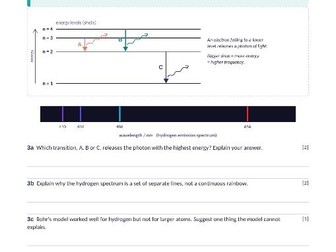
"A complete, ready-to-teach lesson for Unit 1 (Principles and Applications of Science I), chemistry section: sub-atomic particles, electron shells and the evidence from line spectra. Learning objectives: • State the relative mass, charge and position of protons, neutrons and electrons. • Work out the numbers of sub-atomic particles in atoms and ions. • Describe the Bohr model and write shell arrangements for the first 20 elements. • Explain how line spectra provide evidence for fixed energy levels, and state a limitation of the Bohr model. What’s included: • Student worksheet (PDF and editable Word) • Teacher version with model answers and mark schemes (PDF and editable Word) • Teacher notes: lesson flow, common misconceptions and practical/safety notes • Retrieval starter (5 marks) • Structured tasks with key-idea boxes and clear diagrams • Check for Understanding quiz (10 marks) with a confidence self-assessment • Exam-style practice (15 marks), ending with a levels-marked 6-mark question with indicative content Specification coverage: • A1 · Electronic structure: Bohr theory: electrons in fixed energy levels (shells) around the nucleus. • A1 · Atomic structure: protons, neutrons and electrons; atomic number and mass number. About 60 minutes of teaching; the exam-style section works in class or as homework. All questions are original. Written for the Pearson BTEC Level 3 Nationals in Applied Science. Not endorsed by Pearson. Single-school licence."
Redox and Transition Metal Oxidation States | BTEC Applied ScienceQuick View
rocheaji

Redox and Transition Metal Oxidation States | BTEC Applied Science

(0)
A complete, ready-to-teach lesson for Unit 1 (Principles and Applications of Science I), chemistry section: oxidation, reduction, oxidation numbers and transition metal oxidation states. Learning objectives: Define oxidation and reduction in terms of electrons and write half-equations. Assign oxidation numbers using rules and use them to identify redox reactions. Explain why transition metals show variable oxidation states. Name compounds using Roman numerals and link oxidation states to colours. What’s included: Student worksheet (PDF and editable Word) Teacher version with model answers and mark schemes (PDF and editable Word) Teacher notes: lesson flow, common misconceptions and practical/safety notes Retrieval starter (5 marks) Structured tasks with key-idea boxes and clear diagrams Check for Understanding quiz (10 marks) with a confidence self-assessment Exam-style practice (15 marks), ending with a levels-marked 6-mark question with indicative content Specification coverage: A2 · Chemical properties: oxidation and reduction in terms of electrons and oxidation numbers. A2 · Chemical properties: variable oxidation states of transition metals. About 60 minutes of teaching; the exam-style section works in class or as homework. All questions are original. Written for the Pearson BTEC Level 3 Nationals in Applied Science. Not endorsed by Pearson. Single-school licence.
Displacement Reactions: Metals and Halogens | BTEC Applied ScienceQuick View
rocheaji

Displacement Reactions: Metals and Halogens | BTEC Applied Science

(0)
A complete, ready-to-teach lesson for Unit 1 (Principles and Applications of Science I), chemistry section: displacement of metals and halogens, ionic equations and uses. Learning objectives: Predict and explain metal displacement reactions using the reactivity series. Predict and explain halogen displacement reactions and their colour changes. Write ionic equations and half-equations for displacement reactions. Explain the trend in reactivity of the halogens and describe industrial uses. What’s included: Student worksheet (PDF and editable Word) Teacher version with model answers and mark schemes (PDF and editable Word) Teacher notes: lesson flow, common misconceptions and practical/safety notes Retrieval starter (5 marks) Structured tasks with key-idea boxes and clear diagrams Check for Understanding quiz (10 marks) with a confidence self-assessment Exam-style practice (15 marks), ending with a levels-marked 6-mark question with indicative content Specification coverage: A2 · Chemical properties: displacement reactions of metals and of halogens. A2 · Uses: linking displacement reactions to uses of substances. About 60 minutes of teaching; the exam-style section works in class or as homework. All questions are original. Written for the Pearson BTEC Level 3 Nationals in Applied Science. Not endorsed by Pearson. Single-school licence.

Period 2 and 3 Elements with Oxygen: Oxides | BTEC Applied ScienceQuick View
rocheaji

Period 2 and 3 Elements with Oxygen: Oxides | BTEC Applied Science

(0)
A complete, ready-to-teach lesson for Unit 1 (Principles and Applications of Science I), chemistry section: period 2 and 3 elements burning in oxygen, and the structure and acid–base nature of the oxides. Learning objectives: Describe and write equations for reactions of period 2 and 3 elements with oxygen. Relate the structure and bonding of the oxides to their melting points. Classify oxides as basic, amphoteric or acidic and write equations for their reactions with water. Explain the trend in oxides across period 3. What’s included: Student worksheet (PDF and editable Word) Teacher version with model answers and mark schemes (PDF and editable Word) Teacher notes: lesson flow, common misconceptions and practical/safety notes Retrieval starter (5 marks) Structured tasks with key-idea boxes and clear diagrams Check for Understanding quiz (10 marks) with a confidence self-assessment Exam-style practice (15 marks), ending with a levels-marked 6-mark question with indicative content Specification coverage: A2 · Chemical properties: reactions of period 2 and 3 elements with oxygen. A2 · Chemical properties: the acid–base character of the oxides formed. About 60 minutes of teaching; the exam-style section works in class or as homework. All questions are original. Written for the Pearson BTEC Level 3 Nationals in Applied Science. Not endorsed by Pearson. Single-school licence.

Electronegativity and Period 3 Melting Points | BTEC Applied ScienceQuick View
rocheaji

Electronegativity and Period 3 Melting Points | BTEC Applied Science

(0)
A complete, ready-to-teach lesson for Unit 1 (Principles and Applications of Science I), chemistry section: electronegativity, bonding type and the melting points of the period 3 elements. Learning objectives: Define electronegativity and explain its trends across a period and down a group. Use electronegativity differences to predict ionic, polar covalent or non-polar covalent bonding. Describe the structure and bonding of the period 3 elements. Explain the trend in melting points across period 3. What’s included: Student worksheet (PDF and editable Word) Teacher version with model answers and mark schemes (PDF and editable Word) Teacher notes: lesson flow, common misconceptions and practical/safety notes Retrieval starter (5 marks) Structured tasks with key-idea boxes and clear diagrams Check for Understanding quiz (10 marks) with a confidence self-assessment Exam-style practice (15 marks), ending with a levels-marked 6-mark question with indicative content Specification coverage: A1 · Periodicity: electronegativity and its trends; predicting bond type from electronegativity difference. A1 · Periodicity: trends in melting and boiling points across period 3, linked to structure and bonding. About 60 minutes of teaching; the exam-style section works in class or as homework. All questions are original. Written for the Pearson BTEC Level 3 Nationals in Applied Science. Not endorsed by Pearson. Single-school licence.

Metals with Water and Acids: Reactivity Series | BTEC Applied ScienceQuick View
rocheaji

Metals with Water and Acids: Reactivity Series | BTEC Applied Science

(0)
A complete, ready-to-teach lesson for Unit 1 (Principles and Applications of Science I), chemistry section: reactions of metals with water, steam and dilute acids, and the reactivity series. Learning objectives: Describe and write equations for reactions of metals with cold water and steam. Describe and write equations for reactions of metals with dilute acids, including ionic equations. Use experimental results to place metals in a reactivity series. Explain trends in reactivity in groups 1 and 2 using ionisation energy. What’s included: Student worksheet (PDF and editable Word) Teacher version with model answers and mark schemes (PDF and editable Word) Teacher notes: lesson flow, common misconceptions and practical/safety notes Retrieval starter (5 marks) Structured tasks with key-idea boxes and clear diagrams Check for Understanding quiz (10 marks) with a confidence self-assessment Exam-style practice (15 marks), ending with a levels-marked 6-mark question with indicative content Specification coverage: A2 · Chemical properties: reactions of metals with water and with dilute acids. A2 · Chemical properties: the reactivity series of metals. About 60 minutes of teaching; the exam-style section works in class or as homework. All questions are original. Written for the Pearson BTEC Level 3 Nationals in Applied Science. Not endorsed by Pearson. Single-school licence.

Magnification Calculations and Graticules | BTEC Applied Science Unit 1Quick View
rocheaji

Magnification Calculations and Graticules | BTEC Applied Science Unit 1

(0)
A free, complete sample lesson for Unit 1 (Principles and Applications of Science I), biology section: magnification, units, scale bars and eyepiece graticules. Learning objectives: Use I = A × M to calculate magnification, image size or actual size. Convert between mm, µm and nm. Use a scale bar to find actual size. Calibrate an eyepiece graticule with a stage micrometer. What’s included: Student worksheet (PDF and editable Word) Teacher version with model answers and mark schemes (PDF and editable Word) Teacher notes: lesson flow, common misconceptions and practical/safety notes Retrieval starter (5 marks) Structured tasks with key-idea boxes and clear diagrams Check for Understanding quiz (10 marks) with a confidence self-assessment Exam-style practice (15 marks), ending with a levels-marked 6-mark question with indicative content Specification coverage: B1 · Microscopy: calculating magnification and actual size using I = A × M, with unit conversions. B1 · Microscopy: scale bars and calibrating an eyepiece graticule. About 60 minutes of teaching; the exam-style section works in class or as homework. All questions are original. Note: some questions ask students to measure from the page, so print at 100% scale (not “fit to page”). Written for the Pearson BTEC Level 3 Nationals in Applied Science. Not endorsed by Pearson. Free to use under the Creative Commons NoDerivatives licence. Like this lesson? The full Unit 1 course and chemistry, biology and physics bundles are available in the Delocalised Science shop.
Cell Theory and Animal Cell Ultrastructure | BTEC Applied ScienceQuick View
rocheaji

Cell Theory and Animal Cell Ultrastructure | BTEC Applied Science

(0)
A complete, ready-to-teach lesson for Unit 1 (Principles and Applications of Science I), biology section: cell theory and the ultrastructure of animal (eukaryotic) cells. Learning objectives: State the principles of cell theory and describe how it developed. Identify the organelles of an animal cell from a diagram. Describe the function of each organelle. Explain how organelles work together to produce and secrete a protein. What’s included: Student worksheet (PDF and editable Word) Teacher version with model answers and mark schemes (PDF and editable Word) Teacher notes: lesson flow, common misconceptions and practical/safety notes Retrieval starter (5 marks) Structured tasks with key-idea boxes and clear diagrams Check for Understanding quiz (10 marks) with a confidence self-assessment Exam-style practice (15 marks), ending with a levels-marked 6-mark question with indicative content Specification coverage: B1 · Cell theory: the development of cell theory and cells as the basic unit of life. B1 · Ultrastructure: the structure and function of organelles in eukaryotic animal cells. About 60 minutes of teaching; the exam-style section works in class or as homework. All questions are original. Written for the Pearson BTEC Level 3 Nationals in Applied Science. Not endorsed by Pearson. Single-school licence.

Prokaryotic Cells: Bacterial Structure | BTEC Applied Science Unit 1Quick View
rocheaji

Prokaryotic Cells: Bacterial Structure | BTEC Applied Science Unit 1

(0)
A complete, ready-to-teach lesson for Unit 1 (Principles and Applications of Science I), biology section: the structure of bacterial cells and a comparison with eukaryotic cells. Learning objectives: Identify the structures in a prokaryotic cell. Describe the functions of the capsule, plasmids, flagellum and pili. Compare prokaryotic and eukaryotic cells. Use relative sizes of cells and organelles. What’s included: Student worksheet (PDF and editable Word) Teacher version with model answers and mark schemes (PDF and editable Word) Teacher notes: lesson flow, common misconceptions and practical/safety notes Retrieval starter (5 marks) Structured tasks with key-idea boxes and clear diagrams Check for Understanding quiz (10 marks) with a confidence self-assessment Exam-style practice (15 marks), ending with a levels-marked 6-mark question with indicative content Specification coverage: B1 · Ultrastructure: the structure and function of prokaryotic cells. B1 · Ultrastructure: differences between prokaryotic and eukaryotic cells. About 60 minutes of teaching; the exam-style section works in class or as homework. All questions are original. Written for the Pearson BTEC Level 3 Nationals in Applied Science. Not endorsed by Pearson. Single-school licence.

Plant Cells: Organelles and Comparison | BTEC Applied Science Unit 1Quick View
rocheaji

Plant Cells: Organelles and Comparison | BTEC Applied Science Unit 1

(0)
A complete, ready-to-teach lesson for Unit 1 (Principles and Applications of Science I), biology section: plant cell organelles and a comparison with animal cells. Learning objectives: Identify the organelles found in plant cells but not animal cells. Describe the structure and function of the cell wall, chloroplasts and the vacuole. Compare plant and animal cells. Link the structure of chloroplasts to photosynthesis. What’s included: Student worksheet (PDF and editable Word) Teacher version with model answers and mark schemes (PDF and editable Word) Teacher notes: lesson flow, common misconceptions and practical/safety notes Retrieval starter (5 marks) Structured tasks with key-idea boxes and clear diagrams Check for Understanding quiz (10 marks) with a confidence self-assessment Exam-style practice (15 marks), ending with a levels-marked 6-mark question with indicative content Specification coverage: B1 · Ultrastructure: the structure and function of organelles in eukaryotic plant cells. About 60 minutes of teaching; the exam-style section works in class or as homework. All questions are original. Written for the Pearson BTEC Level 3 Nationals in Applied Science. Not endorsed by Pearson. Single-school licence.

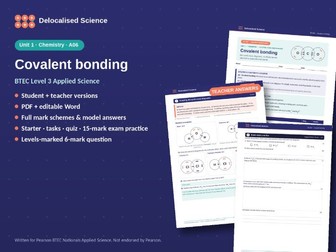
Covalent Bonding: Dot and Cross, Dative Bonds | BTEC Applied ScienceQuick View
rocheaji

Covalent Bonding: Dot and Cross, Dative Bonds | BTEC Applied Science

(0)
A complete, ready-to-teach lesson for Unit 1 (Principles and Applications of Science I), chemistry section: dot-and-cross diagrams, multiple bonds and dative (coordinate) bonds. Learning objectives: Explain what holds the atoms in a covalent bond together. Draw dot-and-cross diagrams for simple molecules, showing bonding pairs and lone pairs. Draw molecules that contain double and triple bonds. Explain how a dative covalent bond forms and draw ions such as NH₄⁺ and H₃O⁺. What’s included: Student worksheet (PDF and editable Word) Teacher version with model answers and mark schemes (PDF and editable Word) Teacher notes: lesson flow, common misconceptions and practical/safety notes Retrieval starter (5 marks) Structured tasks with key-idea boxes and clear diagrams Check for Understanding quiz (10 marks) with a confidence self-assessment Exam-style practice (15 marks), ending with a levels-marked 6-mark question with indicative content Specification coverage: A1 · Covalent bonding: the bond as an electrostatic attraction between two nuclei and the electron pair(s) they share. A1 · Covalent bonding: drawing dot-and-cross diagrams for simple molecules, including double, triple and dative (coordinate) bonds. About 60 minutes of teaching; the exam-style section works in class or as homework. All questions are original. Written for the Pearson BTEC Level 3 Nationals in Applied Science. Not endorsed by Pearson. Single-school licence.

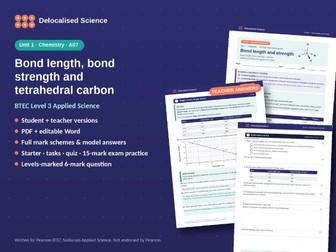
Bond Length, Bond Strength and Tetrahedral Carbon | BTEC Applied ScienceQuick View
rocheaji

Bond Length, Bond Strength and Tetrahedral Carbon | BTEC Applied Science

(0)
A complete, ready-to-teach lesson for Unit 1 (Principles and Applications of Science I), chemistry section: bond length, bond strength and the tetrahedral basis of organic chemistry. Learning objectives: Define bond length and bond enthalpy. Use data to describe the link between bond length and bond strength. Explain why multiple bonds are shorter and stronger, and why bonds get longer and weaker down a group. Draw methane in 3D and explain why carbon forms a tetrahedral arrangement with a 109.5° bond angle. What’s included: Student worksheet (PDF and editable Word) Teacher version with model answers and mark schemes (PDF and editable Word) Teacher notes: lesson flow, common misconceptions and practical/safety notes Retrieval starter (5 marks) Structured tasks with key-idea boxes and clear diagrams Check for Understanding quiz (10 marks) with a confidence self-assessment Exam-style practice (15 marks), ending with a levels-marked 6-mark question with indicative content Specification coverage: A1 · Covalent bonding: how the length of a covalent bond relates to its strength. A1 · Covalent bonding: the tetrahedral arrangement of bonds around carbon as the basis of organic chemistry. About 60 minutes of teaching; the exam-style section works in class or as homework. All questions are original. Written for the Pearson BTEC Level 3 Nationals in Applied Science. Not endorsed by Pearson. Single-school licence.

Metallic Bonding: Delocalised Electrons | BTEC Applied Science Unit 1Quick View
rocheaji

Metallic Bonding: Delocalised Electrons | BTEC Applied Science Unit 1

(0)
A complete, ready-to-teach lesson for Unit 1 (Principles and Applications of Science I), chemistry section: the metallic bonding model of positive ions, delocalised electrons and a regular layer structure. Learning objectives: Describe the structure of a metal: positive ions in regular layers and delocalised electrons. Define metallic bonding as an electrostatic attraction. Draw and label a model of a metal lattice, including metals with 2+ and 3+ ions. Explain how ion charge and ion size affect the strength of metallic bonding and melting point. What’s included: Student worksheet (PDF and editable Word) Teacher version with model answers and mark schemes (PDF and editable Word) Teacher notes: lesson flow, common misconceptions and practical/safety notes Retrieval starter (5 marks) Structured tasks with key-idea boxes and clear diagrams Check for Understanding quiz (10 marks) with a confidence self-assessment Exam-style practice (15 marks), ending with a levels-marked 6-mark question with indicative content Specification coverage: A1 · Metallic bonding: delocalised electrons, positive metal ions and a regular layer structure. About 60 minutes of teaching; the exam-style section works in class or as homework. All questions are original. Written for the Pearson BTEC Level 3 Nationals in Applied Science. Not endorsed by Pearson. Single-school licence.
Properties of Metals and Alloys | BTEC Applied Science Unit 1Quick View
rocheaji

Properties of Metals and Alloys | BTEC Applied Science Unit 1

(0)
A complete, ready-to-teach lesson for Unit 1 (Principles and Applications of Science I), chemistry section: conductivity, malleability, ductility, alloys and uses. Learning objectives: Explain why metals conduct electricity and heat. Explain why metals are malleable and ductile, using the layer structure. Explain why alloys are harder and stronger than pure metals. Link the properties of metals to their uses and evaluate a choice of metal using data. What’s included: Student worksheet (PDF and editable Word) Teacher version with model answers and mark schemes (PDF and editable Word) Teacher notes: lesson flow, common misconceptions and practical/safety notes Retrieval starter (5 marks) Structured tasks with key-idea boxes and clear diagrams Check for Understanding quiz (10 marks) with a confidence self-assessment Exam-style practice (15 marks), ending with a levels-marked 6-mark question with indicative content Specification coverage: A1 · Metallic bonding: using delocalised electrons, positive ions and the regular layer structure to explain properties. A2 · Uses of metals: linking the physical properties of metals and alloys to their uses. About 60 minutes of teaching; the exam-style section works in class or as homework. All questions are original. Written for the Pearson BTEC Level 3 Nationals in Applied Science. Not endorsed by Pearson. Single-school licence.
Intermolecular Forces: van der Waals and Dipole-Dipole | BTEC Applied ScienceQuick View
rocheaji

Intermolecular Forces: van der Waals and Dipole-Dipole | BTEC Applied Science

(0)
A complete, ready-to-teach lesson for Unit 1 (Principles and Applications of Science I), chemistry section: van der Waals forces and permanent dipole–dipole forces. Learning objectives: Distinguish between covalent bonds and intermolecular forces. Explain how van der Waals forces arise and why they increase with the number of electrons and surface contact. Use electronegativity to identify polar bonds and polar molecules. Explain boiling point data using van der Waals and dipole–dipole forces. What’s included: Student worksheet (PDF and editable Word) Teacher version with model answers and mark schemes (PDF and editable Word) Teacher notes: lesson flow, common misconceptions and practical/safety notes Retrieval starter (5 marks) Structured tasks with key-idea boxes and clear diagrams Check for Understanding quiz (10 marks) with a confidence self-assessment Exam-style practice (15 marks), ending with a levels-marked 6-mark question with indicative content Specification coverage: A1 · Intermolecular forces: van der Waals (induced dipole) forces. A1 · Intermolecular forces: permanent dipole–dipole forces. About 60 minutes of teaching; the exam-style section works in class or as homework. All questions are original. Written for the Pearson BTEC Level 3 Nationals in Applied Science. Not endorsed by Pearson. Single-school licence.

Hydrogen Bonding: Water and Ammonia | BTEC Applied Science Unit 1Quick View
rocheaji

Hydrogen Bonding: Water and Ammonia | BTEC Applied Science Unit 1

(0)
A complete, ready-to-teach lesson for Unit 1 (Principles and Applications of Science I), chemistry section: hydrogen bonding, the strongest intermolecular force, in water and ammonia, and the boiling point anomalies it causes. Learning objectives: Explain how a hydrogen bond forms and which molecules can form them. Draw hydrogen bonds between molecules of water and ammonia. Use hydrogen bonding to explain the anomalous boiling points of H₂O, HF and NH₃. Explain why ice is less dense than water, and compare all three types of intermolecular force. What’s included: Student worksheet (PDF and editable Word) Teacher version with model answers and mark schemes (PDF and editable Word) Teacher notes: lesson flow, common misconceptions and practical/safety notes Retrieval starter (5 marks) Structured tasks with key-idea boxes and clear diagrams Check for Understanding quiz (10 marks) with a confidence self-assessment Exam-style practice (15 marks), ending with a levels-marked 6-mark question with indicative content Specification coverage: A1 · Intermolecular forces: hydrogen bonding. About 60 minutes of teaching; the exam-style section works in class or as homework. All questions are original. Written for the Pearson BTEC Level 3 Nationals in Applied Science. Not endorsed by Pearson. Single-school licence.