Learning Who We Are – Creative Writing Lessons on Identity & Metaphor | KS3–KS4 English / Tutor TimeQuick View
gtiffin

Learning Who We Are – Creative Writing Lessons on Identity & Metaphor | KS3–KS4 English / Tutor Time

(0)
A complete creative writing unit that guides students to write with metaphor, restraint and structure — while exploring themes of identity, memory, habit and perception. Through calm, text-anchored lessons, students learn to show meaning through image and process, rather than explaining their thoughts or feelings. Students use each poem as a mentor text, notice the craft choices, then create short, focused writing pieces that practise control, subtlety and precision. What students learn • how metaphor and symbol communicate meaning • how beliefs and habits can be shown through process and pattern • how memory, time and perspective can shape a moment on the page • how writers create depth through contrast, suggestion and silence What students do • write short, crafted pieces (8–10 lines / 100 words) • practise “show, don’t tell” using process, character and image • build control over structure, sequencing and restraint • discuss ideas safely (no self-disclosure required) What’s included • 5-day curriculum map • 5 creative writing lessons (linked to the Learning Who We Are poems) • guided noticing tasks that lead directly into writing • clear prompts, scaffolds and optional models • reflection questions to support independent improvement Ideal for KS3–KS4 English, PSHE and Tutor Time. Minimal preparation. Print and teach. Companion to the Learning Who We Are Reading Bundle.
Learning Who We Are – Poetry Reading & Creative Writing Bundle | Identity & Wellbeing | KS3–KS4Quick View
gtiffin

Learning Who We Are – Poetry Reading & Creative Writing Bundle | Identity & Wellbeing | KS3–KS4

(0)
A complete poetry reading and creative writing bundle exploring identity, belief, memory, habit and perception — through calm, text-anchored lessons that help students notice meaning without turning discussion personal. Students read each poem closely, track how ideas develop, and discuss meaning through metaphor, image and structure. Then they use the poems as mentor texts to create short, crafted writing pieces that show understanding through control and restraint rather than over-explaining. Designed for KS3–KS4 English, PSHE and Tutor Time, these lessons support emotional literacy, empathy and thoughtful discussion — while staying rooted firmly in craft and analysis. What students learn • how poets use metaphor, symbolism and contrast to shape meaning • how beliefs form gradually through repetition, memory and attention • how identity shifts over time — and how poems communicate that change • how suggestion, silence and image can be more powerful than explanation What students do • analyse five original poems using inference and close reading • answer structured comprehension questions (retrieval → inference → analysis) • write short, focused creative responses (8–10 lines / ~100 words) • practise “show, don’t tell” using process, pattern, character and image • discuss ideas safely, with no personal disclosure required What’s included • Curriculum map • 5 creative writing lessons linked directly to each poem • comprehension worksheets for every poem (KS3–KS4 friendly) • teacher plans, scaffolds and suggested talking points • reflection questions that connect reading to writing • full curriculum map (Reading + Writing) for easy planning Poems included: Pottery • The Seamstress • John • Below the Surface • Whispers Each resource has been designed to be calm, structured and classroom-ready — supporting thoughtful thinking, careful reading and confident writing. Ideal for KS3–KS4 English, PSHE and Tutor Time. Minimal preparation. Print and teach. Part of the Learning Who We Are series.
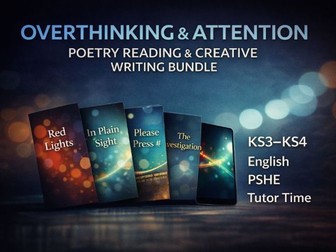
Overthinking & Attention – Poetry Reading & Creative Writing Bundle KS3–KS4 | English | PSHE & TutorQuick View
gtiffin

Overthinking & Attention – Poetry Reading & Creative Writing Bundle KS3–KS4 | English | PSHE & Tutor

(0)
A complete poetry unit that helps students understand focused attention, habitual attention, awareness and concentration — and how these shape communication, thinking and behaviour. Students read each poem to track where attention goes (and why), then use creative writing to show shifts in attention without over-explaining. Lessons are calm, structured and text-anchored. What students learn • the difference between focused and habitual attention • how attention is pulled by emotion, urgency and environment • how awareness can change understanding • how writers communicate meaning through structure, imagery and restraint What students do • analyse poems through attention and focus • discuss communication safely (no personal disclosure) • write short pieces using metaphor and control • build stamina, concentration and reflective thinking What’s included • 5 poetry reading lessons (original poems + comprehension/reflection) • 5 creative writing lessons with prompts and models • Reading + Writing curriculum map • clear teacher guidance and discussion scaffolds Ideal for KS3–KS4 English, PSHE and Tutor Time. Minimal preparation. Print and teach. Part of the Overthinking & Attention Series.
Overthinking & Attention – Creative Writing Lessons KS3–KS4 | English | PSHE | Tutor TimeQuick View
gtiffin

Overthinking & Attention – Creative Writing Lessons KS3–KS4 | English | PSHE | Tutor Time

(0)
A calm, structured set of creative writing lessons where students learn to show meaning without over-explaining. Ideal for English, PSHE and Tutor Time. This bundle helps students write about thought, awareness and attention using imagery, metaphor and precise detail. Instead of “trying harder to focus,” students learn to notice movement in the mind and reveal it clearly on the page. What students learn • use imagery and metaphor effectively • write in present tense without naming emotions • build tension through structure and pacing • recognise when language avoids meaning — and when it connects What’s included • 5-day curriculum map • 5 complete creative writing lessons • 5 original poems • teacher plans with models and prompts • student task sheets (clean, uncluttered) • optional discussion and reflection guidance Suitable for KS3–KS4 English, PSHE, Tutor Time and Creative Writing clubs. Minimal preparation. Print and teach. Part of the Overthinking & Attention Series by Grace Tiffin
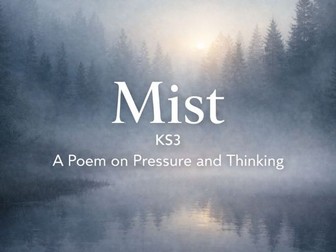
Mist – A Classroom Poem on Pressure, Thinking and Insight  KS3–KS4 | PSHE / English | Tutor TimeQuick View
gtiffin

Mist – A Classroom Poem on Pressure, Thinking and Insight KS3–KS4 | PSHE / English | Tutor Time

(0)
Many teachers recognise this moment. A student knows they know the answer — a word, a name, a solution — but the harder they try to retrieve it, the further it seems to slip away. Mist is a short reflective poem about that experience of thinking under pressure. The poem captures the familiar “tip-of-the-tongue” feeling: understanding feels close, maybe even present just moments ago, yet effort only produces fog. As the speaker searches — scanning the page, the room, their own thoughts — time ticks, breath tightens, and clarity dissolves into mist. Rather than offering strategies or solutions, the poem draws attention to something quieter: the way insight often returns after effort drops. When attention softens and the pressure to retrieve the answer fades, understanding reappears on its own. This makes the poem especially effective for students who: experience thinking blocks under pressure struggle during exams or timed tasks become anxious when trying to “force” answers know they understand but can’t always access it on demand And for teachers who recognise how easily pressure interferes with thinking. What’s included ✔ The full poem Mist ✔ Comprehension questions exploring metaphor and meaning ✔ Teacher discussion prompts suitable for whole-class or Tutor Time ✔ Optional reflective and creative response tasks ✔ Guidance for low-pressure, SEND-aware facilitation Classroom Use KS3–KS4 English – poetry analysis, metaphor, imagery, voice PSHE / Wellbeing – thinking under pressure, anxiety, mental overload Tutor Time / Form Time – short discussion starter on clarity and effort Suitable for mixed-ability groups and emotionally safe classrooms. Students are never required to share personal experiences. Why teachers value this resource Names a common but rarely discussed thinking experience Helps students understand why effort doesn’t always lead to clarity Normalises cognitive blocks without labelling them as failure Encourages awareness and understanding rather than self-criticism This poem works particularly well alongside other resources exploring pressure, attention, and performance, but is equally effective as a standalone Tutor Time or PSHE activity. Written by Grace Tiffin Teacher and TES Author
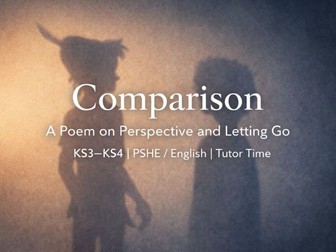
Comparison – A Poem on Perspective and Letting Go KS3–KS4 | PSHE / English | Tutor TimeQuick View
gtiffin

Comparison – A Poem on Perspective and Letting Go KS3–KS4 | PSHE / English | Tutor Time

(0)
Many teachers notice how easily students become caught in questions of right and wrong, ahead or behind, better or worse — even when the difference feels unclear. Shadows is a short reflective poem that gently explores this habit of comparison. Set in a quiet evening scene, the poem imagines Peter Pan in conversation with his shadow as light shifts and fades. As Peter asks questions about preference and position — night or day, young or old, ahead or behind — the shadow’s answers remain the same: it doesn’t matter. Rather than offering advice or instruction, the poem invites students to sit with uncertainty. The shadow responds without urgency, judgement, or explanation. And when the light is finally turned off, the shadow disappears — leaving behind a simple whisper that reframes all the questions that came before. This poem offers a calm way to explore: i) why we are drawn to opposites and comparisons ii) how some choices feel heavy even when there is no clear “right” answer iii) the possibility that perspective can soften pressure rather than resolve it What’s included ✔ The full poem Shadows ✔ Structured comprehension questions focused on meaning and metaphor ✔ Teacher discussion prompts suitable for whole-class or Tutor Time ✔ Optional creative and reflective response tasks ✔ Guidance for low-pressure, SEND-aware facilitation Classroom Use KS3–KS4 English – poetry analysis, symbolism, voice, imagery PSHE / Wellbeing – decision-making, perspective, comparison, uncertainty Tutor Time / Form Time – short discussion starter on choice and judgement The poem works well in mixed-ability groups and does not require students to share personal experiences unless they choose to. Why teachers value this resource Encourages thoughtful discussion without debate or right answers Reduces pressure around decision-making and comparison Uses metaphor to explore complex ideas in an accessible way Creates space for reflection rather than performance Shadows is particularly effective for students who feel overwhelmed by choices, worry about being “behind”, or struggle with black-and-white thinking. Written by Grace Tiffin Teacher and TES Author
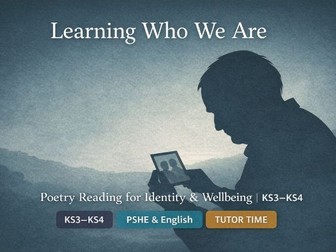
Learning Who We Are – Poetry Reading for Identity & Wellbeing | KS3–KS4 PSHE & English | Tutor TimeQuick View
gtiffin

Learning Who We Are – Poetry Reading for Identity & Wellbeing | KS3–KS4 PSHE & English | Tutor Time

(0)
A complete poetry reading unit and Tutor Time bundle helping students explore identity, belief, memory and wellbeing — and how these shape behaviour, self-image and understanding. Lessons are calm, structured and text-anchored, supporting KS3–KS4 English and PSHE without personal disclosure or therapy language. Students read each poem closely, track how ideas develop, and discuss meaning through image, metaphor and restraint. Creative tasks encourage precise, thoughtful writing rather than over-explaining. What students learn • how beliefs form, repeat and begin to “set” • how memory, family and habit influence identity • the difference between surface reactions and deeper steadiness • how poets communicate complexity through structure, silence and suggestion What students do • analyse poems using inference, symbolism and extended metaphor • discuss sensitive themes safely (no personal disclosure) • write short, crafted responses using image and control • practise reflective, text-based thinking What’s included • 5 poetry reading lessons (original poems + comprehension/reflection) • teacher discussion prompts for calm, structured dialogue • creative extension options (writing + visual) • clear guidance notes for PSHE-safe delivery Ideal for KS3–KS4 English, PSHE and Tutor Time. Minimal preparation. Print and teach. Part of the Learning Who We Are series.
Whispers – Poem, Reading & Creative Writing | Silence, Listening & Meaning | KS3–KS4Quick View
gtiffin

Whispers – Poem, Reading & Creative Writing | Silence, Listening & Meaning | KS3–KS4

(0)
A calm, ready-to-teach lesson exploring silence, listening and meaning — through poetry, guided discussion, comprehension and creative writing. Students read Whispers and notice how questions can rise quietly from the heart — and how simple, poetic replies can carry depth without explanation. They then write short, crafted pieces showing communication without words, using image, tone and restraint. Everything is text-anchored and fully classroom-safe. What students do • read the poem closely • analyse imagery, dialogue and symbolism • answer structured comprehension questions • choose from two linked creative writing tasks • practise “show, don’t tell” using silence and suggestion What’s included • original poem: Whispers • teacher notes, prompts and classroom activities • comprehension & reflection questions (retrieval → inference → meaning) • two creative writing tasks with guidance and examples • clear, printable layout — minimal prep Ideal for KS3–KS4 English, PSHE and Tutor Time. Minimal preparation. Print and teach. Part of the Learning Who We Are series.
Expectation – A Poetry Resource on Overthinking and Stress KS3–KS4 | PSHE | English| Tutor TimeQuick View
gtiffin

Expectation – A Poetry Resource on Overthinking and Stress KS3–KS4 | PSHE | English| Tutor Time

(0)
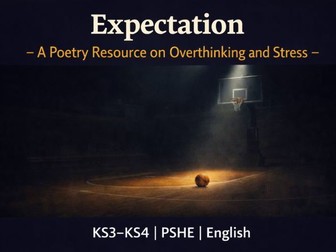
Many teachers notice this paradox. Some students perform best when no one is watching. When expectations fall away, pressure drops — and skill seems to surface on its own. When the Lights Go Out is a short poem about that state. Set on a basketball court after hours, the poem explores what happens when there is no audience, no scoreboard, no urgency to prove anything. In the darkness, movement becomes easier. Rhythm replaces effort. Performance turns into presence. Rather than focusing on technique or motivation, the poem draws attention to the conditions that allow creativity and skill to emerge — and why those conditions are often disrupted when the lights come back on. This makes it especially effective for students who: i) freeze under observation ii) struggle with performance anxiety iii)work well in private but falter under scrutiny And for teachers who recognise how quickly expectation can interfere with ability. What’s included ✔ The full poem When the Lights Go Out ✔ Comprehension questions exploring metaphor and meaning ✔ Discussion prompts suitable for whole-class or tutor time ✔ Optional creative responses (writing or reflection) ✔ Teacher guidance for low-pressure facilitation Classroom Use KS3–KS4 English – poetry analysis, metaphor, voice PSHE / Wellbeing – performance, pressure, confidence Tutor Time / Form Time – discussion starter on effort vs ease Suitable for mixed-ability groups and SEND-aware classrooms Why teachers value this resource Names a familiar but rarely discussed performance state Validates ability without forcing confidence Helps students understand why they work better in some conditions than others Encourages awareness rather than self-criticism This poem is part of the Performance Pressure series – Poems on Performance, Attention and Potential. Written by Grace Tiffin Teacher and TES Author
Feeling Stuck – A Poetry Resource About Pressure and Performance KS3–KS4 English | Tutor TimeQuick View
gtiffin

Feeling Stuck – A Poetry Resource About Pressure and Performance KS3–KS4 English | Tutor Time

(0)
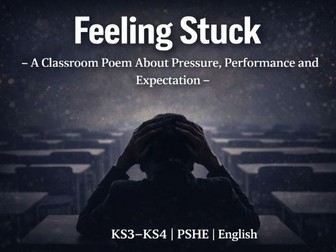
Most teachers recognise this moment. 15-20 minutes into a lesson, a student is still staring at a blank page. The clock is ticking. Everyone else has started. The pressure is rising — and yet nothing comes. For the student, it feels like being stuck, frozen in place while time moves on. For the teacher, it’s the quiet frustration of not knowing how to help without adding more pressure. The Blank Page is a short poem that puts this moment into words — without judgement, diagnosis, or forced solutions. Through the metaphor of two animals in the same alert field, the poem explores two intelligent responses to pressure: The deer, representing a survival response — stillness, vigilance, waiting The lion, representing awareness — readiness, presence, and timing Both animals experience the same environment. Both are are waiting for the right time to move. This resource helps students and teachers reframe the blank-page moment — not as failure or laziness, but as a state that can be understood, discussed, and approached with patience. What’s included ✔ The poem The Blank Page ✔ Comprehension questions focused on meaning and metaphor ✔ Carefully structured discussion prompts (no personal disclosure required) ✔ Optional creative responses (writing, metaphor, or visual) ✔ Clear teacher guidance for calm, low-pressure facilitation Classroom Use KS3–KS4 English – poetry, metaphor, interpretation PSHE / Wellbeing – pressure, freeze responses, awareness Tutor Time / Form Time – reflective discussion starter Suitable for mixed-ability groups and SEND-aware classrooms Why teachers value this resource Addresses a real classroom frustration Gives language to the freeze / blank-page experience Helps teachers support students without pushing or rescuing Encourages understanding rather than urgency Written by Grace Tiffin Teacher and TES Author This poem is part of the series Breaking the Pressure Loop- a collection of poems on performance, attention and potential.
Below the Surface – Poem, Reading & Creative Writing | Belief, Calm & Perspective | KS3–KS4/EnglishQuick View
gtiffin

Below the Surface – Poem, Reading & Creative Writing | Belief, Calm & Perspective | KS3–KS4/English

(0)
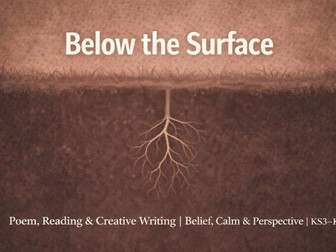
A ready-to-teach lesson exploring surface vs depth, belief and perspective — through poetry, guided discussion, comprehension and creative writing. Students read Below the Surface, track how wind shapes the ocean, and notice how thoughts, emotions and ideas can create movement without disturbing what lies underneath. Then they write short, crafted pieces showing contrast and perception — without over-explaining. Calm, text-anchored and fully classroom-safe. What students do • read the poem closely • analyse metaphor, contrast and structure • answer structured comprehension questions • choose from linked creative writing tasks • practise “show, don’t tell” using surface/depth imagery What’s included • original poem: Below the Surface • teacher notes, key discussion prompts and activities • comprehension worksheet (retrieval → inference → analysis) • two creative writing tasks with ideas and modelling • clear, printable layout — minimal preparation Ideal for KS3–KS4 English, PSHE and Tutor Time. Minimal preparation. Print and teach. Part of the Learning Who We Are series.
John – Poem, Reading & Creative Writing | Memory, Time & Identity | KS3–KS4| PHSE| English | TutorQuick View
gtiffin

John – Poem, Reading & Creative Writing | Memory, Time & Identity | KS3–KS4| PHSE| English | Tutor

(0)
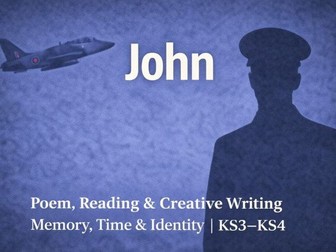
A calm, ready-to-teach lesson exploring memory, time and identity — through poetry, guided discussion, comprehension and creative writing. Students read John, follow the metaphor of “ghosts,” and notice how memories can return lovingly — inviting someone back to who they used to be. Then they create short, crafted pieces showing change, nostalgia and presence, without turning discussion personal. Everything is text-anchored, compassionate and classroom-safe. What students do • read the poem closely • analyse metaphor, symbolism and inference • answer structured comprehension questions • choose from two creative writing options linked to memory and change • practise “show, don’t tell” using image and restraint What’s included • original poem: John • comprehension worksheet (retrieval → inference → analysis) • creative writing tasks with prompts and models • teacher guidance, discussion prompts and activity ideas • clear, printable layout — minimal preparation Ideal for KS3–KS4 English, PSHE and Tutor Time. Minimal preparation. Print and teach. Part of the Learning Who We Are series.
The Seamstress – Poem, Reading & Creative Writing | Belief, Habit & Identity | KS3–KS4Quick View
gtiffin

The Seamstress – Poem, Reading & Creative Writing | Belief, Habit & Identity | KS3–KS4

(0)
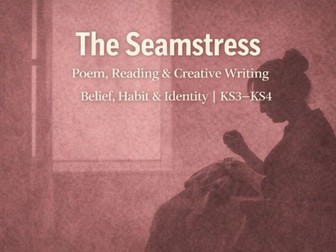
A calm, ready-to-teach lesson exploring belief, habit and identity — through poetry, guided discussion, comprehension and creative writing. Students read The Seamstress, follow the extended metaphor of inherited garments, and notice how beliefs are passed down, kept and cared for — even when they no longer quite fit. Then they create short, crafted writing that shows habit and repetition through character and symbol, without over-explaining. Everything is text-anchored and classroom-safe. What students do • read the poem closely • analyse extended metaphor, symbolism and inference • answer structured comprehension questions • choose from two creative writing tasks linked to habit and pattern • practise “show, don’t tell” through image and detail What’s included • original poem: The Seamstress • teacher notes, key questions and discussion prompts • comprehension worksheet (retrieval → inference → analysis) • two creative writing tasks with guidance and models • clear, printable layout — minimal preparation Ideal for KS3–KS4 English, PSHE and Tutor Time. Minimal preparation. Print and teach. Part of the Learning Who We Are series.
Pottery – Poem, Reading & Creative Writing | Belief, Identity & Change | KS3–KS4Quick View
gtiffin

Pottery – Poem, Reading & Creative Writing | Belief, Identity & Change | KS3–KS4

(0)
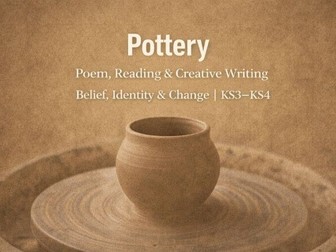
A complete, ready-to-teach lesson exploring belief, identity and change — through poetry, guided discussion, comprehension and creative writing. Students read Pottery, track how clay is shaped step-by-step, and notice how beliefs form, strengthen and eventually “set.” Then they write short, crafted pieces using process and metaphor to show meaning — without explaining it directly. Calm, text-anchored, and fully classroom-safe. What students do • read the poem closely • analyse extended metaphor and structure • answer structured comprehension questions • choose from two creative writing tasks linked to the poem • practise “show, don’t tell” using process and image What’s included • original poem: Pottery • teacher notes, prompts and discussion questions • comprehension worksheet (retrieval → inference → analysis) • two creative writing tasks with guidance and ideas • clear, printable layout — minimal prep Ideal for KS3–KS4 English, PSHE and Tutor Time. Minimal preparation. Print and teach. Part of the Learning Who We Are series.
Overthinking & Attention – Poetry Reading Lessons & Comprehension | KS3–KS4 English / PSHE | TutorQuick View
gtiffin

Overthinking & Attention – Poetry Reading Lessons & Comprehension | KS3–KS4 English / PSHE | Tutor

(0)
A complete set of structured poetry reading lessons exploring attention, focus and overthinking — designed for calm, text-anchored classroom discussion. Students read each poem, track what attention does, and use guided comprehension to think about systems, signals and expertise without personal disclosure. Every lesson includes teacher prompts, thoughtful questioning and flexible reflection tasks. Each poem approaches attention differently — crime scenes, signals, systems, standby mode and familiar stories — giving students multiple ways in. What students do • read each poem closely • analyse metaphor, structure and perspective • answer structured comprehension questions (literal → inference → interpretation) • discuss ideas safely, without self-disclosure • notice how attention can narrow, loop, drift or respond to signals What’s included • 5 original poems with full teacher prompts and discussion scaffolds – The Investigation – Red Lights – Screen Saver Mode – Please Press Hash – In Plain Sight • comprehension questions for every lesson – retrieval, deeper thinking and reflection – optional non-personal discussion prompts – KS3–KS4 friendly wording and pacing • clear teacher guidance — choose, adapt or extend as needed Ideal for KS3–KS4 English, PSHE and Tutor Time. Minimal preparation. Print and teach. Part of the Overthinking Series.
Red Lights – Poem, Reading & Creative Writing | Attention & Inner Safety | KS3–KS4 PSHE / EnglishQuick View
gtiffin

Red Lights – Poem, Reading & Creative Writing | Attention & Inner Safety | KS3–KS4 PSHE / English

(0)
A complete, ready-to-teach lesson exploring attention, danger signals and inner safety — through poetry, guided discussion, comprehension and creative writing. Students read Red Lights, notice how attention responds automatically to signals, and explore why thoughts sometimes escalate before we understand what’s happening. Then they write short, crafted pieces showing escalation and calm through image and process rather than personal disclosure. Designed to be thoughtful, calm and text-anchored. What students do • read the poem closely • explore metaphor, signal and response using teacher prompts • answer structured comprehension & reflection questions • choose from two creative writing tasks linked to the poem • discuss safely, without self-disclosure What’s included • original poem: Red Lights • teacher prompts for guided discussion • comprehension & reflection questions (KS3–KS4) • two creative writing tasks (escalation + stillness) • ready-to-print layout and clear guidance Suitable for KS3–KS4 English, PSHE and Tutor Time. Minimal preparation. Print and teach. Part of the Overthinking Series.
Screen Saver Mode – Poem, Reading & Creative Writing | Attention & Daydreaming | KS3–KS4 EnglishQuick View
gtiffin

Screen Saver Mode – Poem, Reading & Creative Writing | Attention & Daydreaming | KS3–KS4 English

(0)
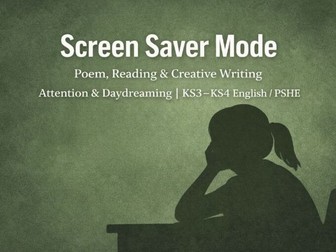
A calm, ready-to-teach lesson exploring attention, drifting and “standby mode” — through poetry, guided discussion, comprehension and creative writing. Students read Screen Saver Mode, notice how attention seems to drift without effort, and explore why systems sometimes “idle” rather than shut down. Then they create short, crafted writing that shows wandering attention without naming or explaining it. Everything is text-anchored and classroom-safe — no personal disclosure. What students do • read the poem closely • explore metaphor and function using guided prompts • answer structured comprehension questions • choose from two creative writing tasks linked to the poem • practise “show, don’t tell” through image, process and restraint What’s included • original poem: Screen Saver Mode • teacher prompts and discussion scaffolds • comprehension questions (literal → structure → inference) • creative writing options with models and guidance • clear, ready-to-print formatting Ideal for KS3–KS4 English, PSHE and Tutor Time. Minimal preparation. Print and teach. Part of the Overthinking Series.
Please Press # – Poem, Reading & Creative Writing | Communication | KS3–KS4| PHSE | English | TutorQuick View
gtiffin

Please Press # – Poem, Reading & Creative Writing | Communication | KS3–KS4| PHSE | English | Tutor

(0)
A ready-to-use lesson exploring systems, frustration and communication — through poetry, discussion, comprehension and creative writing. Students read Please Press Hash, track the automated loop step-by-step, and notice how attention is redirected away from what the caller really wants. Then they write short, crafted pieces showing breakdown, delay and avoidance — without turning discussion personal. Everything stays text-anchored and safe for KS3–KS4. What students do • read the poem closely • analyse repetition, loops and redirection • answer structured comprehension questions • choose from two creative writing options linked to the poem • discuss systems without self-disclosure What’s included • original poem: Please Press Hash • teacher prompts for guided, calm discussion • comprehension questions (literal → structure → interpretation) • two creative writing tasks (communication & obstacles) • clear, printable formatting — minimal prep Ideal for KS3–KS4 English, PSHE and Tutor Time. Minimal preparation. Print and teach. Part of the Overthinking Series.
The World Behind the Wind- A Poetry Unit on Inner Storms, Perception and Transformation KS3–KS4Quick View
gtiffin

The World Behind the Wind- A Poetry Unit on Inner Storms, Perception and Transformation KS3–KS4

(0)
Some stories stay with students because they explain the world. Others stay with them because they help explain themselves. The World Behind the Wind is a poetry unit about a young firefly who has not yet found his light. While his siblings illuminate the night sky, he remains in darkness, wondering if he’s broken. Confused, he turns to his grandfather who explains that to receive his light, he must uncover an ancient truth. To this end, he’s given a scroll of unanswered questions and one line stirs something deep within him: How are super storms really created? This question begins a journey into the inner landscape of the mind. Across eight chapters, the firefly travels through symbolic realms of fear, memory, desire, perception, and awareness — where storms become a metaphor for repeated thoughts, unprocessed emotions, and inherited patterns of belief. The poem invites students to interpret meaning through story and image, rather than being given conclusions. Why teachers choose this resource A complete, extended narrative poem for sustained reading At chapters, 27 pages, the poem is perfect for full unit study Explores identity, emotions, perception, and transformation through metaphors Ideal for students who feel “stuck”, behind, or unsure of themselves Encourages reflection without requiring personal disclosure What’s included ✔ Full narrative poem ✔ Comprehension questions ✔ Discussion prompts for ✔ Optional creative and reflective tasks ✔ Teacher guidance for low-pressure facilitation Classroom Use KS3–KS4 English – narrative poetry, symbolism, allegory PSHE / Wellbeing – emotions, inner states, awareness Tutor Time – extended reading and discussion Written by Grace Tiffin Teacher and TES Author
The Nature of Emotions – Short Poem on Unnamed Feelings (KS3–KS4 PSHE / English)Quick View
gtiffin

The Nature of Emotions – Short Poem on Unnamed Feelings (KS3–KS4 PSHE / English)

(0)
This short classroom poem with teacher prompts is designed for KS3–KS4 students and explores unnamed or difficult-to-label emotions. It supports lessons in PSHE, English, tutor time, or wellbeing sessions, helping students reflect on emotional awareness and inner experience. How teachers use this resource: i) As a lesson starter or tutor time reflection ii)To support PSHE, English, or wellbeing conversations iii) As a grounding activity during emotionally charged lessons iv) With no expectation of sharing What’s included: A short, accessible poem exploring the nature of emotions A one-page reflection worksheet Clear prompts suitable for KS3–KS4 Language that is emotionally safe and classroom-appropriate This poem forms part of a wider collection called Understanding Attention which exploring attention, emotions, and the inner landscape, and can be used as a standalone piece or alongside longer narrative poetry resources.
The Investigation – Poem, Reading & Creative Writing | Attention & Focus | Habits | KS3–KS4Quick View
gtiffin

The Investigation – Poem, Reading & Creative Writing | Attention & Focus | Habits | KS3–KS4

(0)
A complete, ready-to-use classroom resource exploring attention, expertise and distraction — through poetry, discussion, comprehension and creative writing. Students read the poem, notice how focus shapes what different people see, and then write from different perspectives to show how trained attention can reveal — and sometimes limit — understanding. Designed to be calm, structured and text-anchored, this lesson helps students think deeply without personal disclosure. What students do • read the poem closely • discuss metaphor, attention and roles using guided prompts • answer structured comprehension questions • write a short creative piece from a chosen viewpoint What’s included • original poem: The Investigation • teacher prompts for whole-class discussion • differentiated comprehension questions (KS3–KS4) • two creative writing options (perspective + trained attention) • clear, ready-to-teach formatting Suitable for KS3–KS4 English, PSHE and Tutor Time. Minimal preparation. Print and teach. Part of the Overthinking Series.