OCR Chemistry 6.1.1 PhenolsQuick View
t-leman

OCR Chemistry 6.1.1 Phenols

(8)
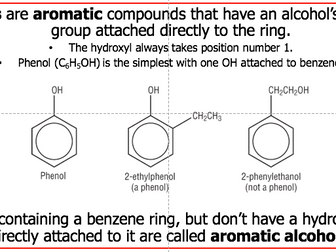
A complete lesson covering the phenols section of OCR A level chemistry 6.1.1. The powerpoint covers all the learning objectives listed on the OCR spec with a bit of further information included to help students understanding. After each section there are a small number of questions built into the powerpoint with answers included. Reviews and feedback always welcome. Cheers
OCR Chemistry 6.1.2 Carbonyl Compounds (Pt. 1)Quick View
t-leman

OCR Chemistry 6.1.2 Carbonyl Compounds (Pt. 1)

(5)
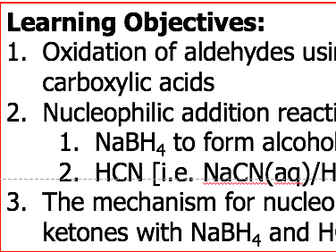
The first lesson in a two part series looking at carbonyl compound chemistry. The lesson powerpoint contains everything you need for a lesson, with a molecule identifcation starter and exam style questions contained within the powerpoint. It covers the specification points of oxidation of aldehydes, nucleophilic addition reactions of carbonyl compounds and the mechanisms associated with that. There is also a set of questions on the mechanisms taken from OCR exam builder and attached mark scheme, can be used within the lesson or as homework. As always any feedback or reviews welcome. Thanks, Tom
OCR 6.2.4 Extending Carbon Chain LengthQuick View
t-leman

OCR 6.2.4 Extending Carbon Chain Length

(3)
A lesson powerpoint going over OCR chemistry 6.2.4 Extending Carbon Chain Length. This is very much a recap lesson as all the content is included in other parts of the specification, but it’s a useful grouping of all the reactions that allow the increase of a carbon chain length. The powerpoint contains exam questions and answers within it, I have also uploaded a set of past exam questions and answers taken from the OCR exam builder site. As always feedback and reviews welcome, Hope it’s helpful, Tom
OCR 6.1.3 Carboxylic AcidsQuick View
t-leman

OCR 6.1.3 Carboxylic Acids

(1)
A complete lesson powerpoint covering the OCR specification point on Carboxylic Acids. Includes starter on writing general acid equations, then questions with differentiation on the reactions of carboxylic acids with carbonates, metal oxides, metals and alkalis. Note, I haven’t taught this yet, so the lesson may be a little shorter than an hour. Could be well combined with a naming exercise on carboxylic acids. As always, hope it’s helpful and any reviews/feedback greatly appreciated. With Thanks Tom
OCR 6.1.1 Benzene Pt.2Quick View
t-leman

OCR 6.1.1 Benzene Pt.2

(1)
A powerpoint covering the second section of OCR unit 6.1.1 looking at benzene. The lesson covers electrophilic substitution and the relative resistance of benzene to bromination. Please note, while the slides contains some questions on electrophilic substitution, the last part of the syllabus; “The interpretation of unfamiliar electrophilic substitution reactions of aromatic compounds including prediction of mechanisms” isn’t addressed as I’m still thinking of a way to cover this. Contains a nice starter from the RSC based on benzene chemicals found in cherries. As always all feedback appreaciated. With Thanks, Tom
OCR 6.1.3 EstersQuick View
t-leman

OCR 6.1.3 Esters

(1)
A full lesson powerpoint looking at esters, covering the specification points in the OCR A-Level specification 6.1.3 Esters. The lesson contains some questions built in, but I use this in conjuction with the worksheet available here https://www.tes.com/teaching-resource/ester-worksheet-6440005 As always feedback and reviews welcome. Cheers, Tom
OCR 6.1.2 Carbonyl Compounds (Pt. 2)Quick View
t-leman

OCR 6.1.2 Carbonyl Compounds (Pt. 2)

(1)
The second lesson in a two part series looking at carbonyl compound chemistry. The lesson powerpoint contains the explanation of tollens reagent and 2,4-DNP, with all the details the students need for the specification. There is also a demonstration sheet for Tollens Reagent, taken from STEM learning and a practical for students to use 2,4-DNP. Note, that requires the use of melting point apparatus if they are to identify the indivdual carbonyls. There is also an exam style question at the end for a final activity, with the mark scheme included on the powerpoint. As always any feedback or reviews welcome. Thanks, Tom
OCR 4.1.1 Naming Organic Compounds Pt. 1Quick View
t-leman

OCR 4.1.1 Naming Organic Compounds Pt. 1

(0)
A powerpoint and worksheets covering the naming of straight and branch chained alkanes. I use the powerpoint to go through the explaination of the stem, suffix and prefix rules. This is followed by two worked examples to be done as a class and then the first worksheet. I use the second worksheet for homework but can be used in any way you see fit. Answers for the worksheets are included. As always any feedback or reviews greatly appreciated. With Thanks, Tom
Communicable Diseases (Foundation AQA)Quick View
t-leman

Communicable Diseases (Foundation AQA)

(0)
A lesson on communicable diseases, all contained within one powerpoint. Covers the four different pathogens, with a more detailed look at bacteria and viruses. Also covers how pathogens are spread and how we can stop their spread. Contains a brief overview of the bodies natural defenses as well. Has a lesson plan, with suggested timings, LOs and Key questions.
OCR Chemistry 2.1.2 Compounds, Formulae and EquationsQuick View
t-leman

OCR Chemistry 2.1.2 Compounds, Formulae and Equations

(0)
A lesson powerpoint covering all the learning objectives in section 2.1.2 of the OCR chemistry a-level specification. Again mostly revision from KS4, quite a short lesson so can be easily combined with lesson from section 2.1.1. Contains lots of balancing equations practice, answers not included but are good to work through on the board as you go through them. As always feel free to leave feedback, all great fully received. Cheers, Tom
OCR Chemistry 6.1.1 Benzene (Pt. 1)Quick View
t-leman

OCR Chemistry 6.1.1 Benzene (Pt. 1)

(0)
The first part of the OCR Chemistry topic 6.1.1 Benzene. This lesson covers: the structure of benzene, in terms of kekule and delocalised models. The three key pieces of evidence for delocalised over kekule models. Then a deep look into naming aromatic compounds. Ends with series of naming questions, with increasing difficulty. Also includes set of questions on the key pieces of evidence when discussing Kekule vs. delocalised, can be used in class or set as homework. (Mark Scheme included) As always any reviews and feedback greatly appreaciated. Cheers, Tom
OCR 2.1.3 Amount of Substance Pt. 1Quick View
t-leman

OCR 2.1.3 Amount of Substance Pt. 1

(0)
Powerpoint covering part one of the OCR a level chemistry topic “2.1.3 Amount of Substance”. Includes starter of balancing equations, then moles, moles from a solid, empirical and molecular formula calculations and water of crystallisation calculations. Lots of practice questions included on the slides, note answers not included as I tend to work them out with the class.
OCR Chemistry 2.1.1 Atomic Structure and IsotopesQuick View
t-leman

OCR Chemistry 2.1.1 Atomic Structure and Isotopes

(0)
Powerpoint going through all of section 2.1.1 from the OCR A-Level syllabus, questions built into the powerpoint with table to be filled in by students as starter. Generally a revision lesson from GCSE but important to get locked in early. Contains lots of key word definitions. Feel free to leave feedback, always looking to improve.
Fertilisation and Sexual ReproductionQuick View
t-leman

Fertilisation and Sexual Reproduction

(0)
A quick year 7 lesson on fertilisation and sexual reproduction. Contains a link to a very good BBC video on the process of fertilisation. Also has a good literacy excercise, where students have to write a story about fertilisation.
OCR 2.1.3 Amount of Substance Pt. 2Quick View
t-leman

OCR 2.1.3 Amount of Substance Pt. 2

(0)
Powerpoint covering part two of the OCR A-level specification topic “2.1.3 Amount of substance” Includes starter sheet taken from RSC starter for ten, then information, example questions and test questions on molar calculations involving gas and liquids. Please note, answers to questions are not included as I tend to work through them on the board. Cheers and leave and feedback below.