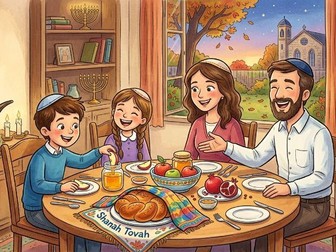
Rosh Hashanah reading comprehensions suited to be used in KS1, LKS2 or UKS2. These can also be used for differentiation.
Each text contains relevant questions and progress in difficulty over the 3 texts.
KS1 - 4 Retrieval Questions
LKS2 - 4 Retrieval and 1 Inference Question
UKS2 - 7 different questions.
These are suited to a one off lesson or guided read task for Jewish New Year.
3 reading comprehensions for Upper KS2, Lower KS2 and KS1 (differentiation can be applied). Each text is roughly 1 page long with questions on following page (KS1 text and questions appear on a single page)
UKS2 has 8 questions including answers.
LKS2 has 6 questions including answers.
KS1 has 4 questions including answers.
These can be used for a stand alone guided reading activity or as part of a larger English lesson.
3 reading comprehensions for Upper KS2, Lower KS2 and KS1 (differentiation can be applied). Each text is roughly 1 page long with questions on following page (KS1 text and questions appear on a single page)
UKS2 has 8 questions including answers.
LKS2 has 6 questions including answers.
KS1 has 4 questions including answers.
These can be used for a stand alone guided reading activity or as part of a larger English lesson.
3 reading comprehensions for Upper KS2, Lower KS2 and KS1 (differentiation can be applied). Each text is roughly 1 page long with questions on following page (KS1 text and questions appear on a single page)
UKS2 has 8 questions including answers.
LKS2 has 6 questions including answers.
KS1 has 4 questions including answers.
These can be used for a stand alone guided reading activity or as part of a larger English lesson.
3 reading comprehensions for Upper KS2, Lower KS2 and KS1 (differentiation can be applied). Each text is roughly 1 page long with questions on following page (KS1 text and questions appear on a single page)
UKS2 has 8 questions including answers.
LKS2 has 6 questions including answers.
KS1 has 4 questions including answers.
These can be used for a stand alone guided reading activity or as part of a larger English lesson.
Bundle include 5 WW1 and 5 WW2 fictional letters or diaries. Each includes a series of different comprehension questions. These texts are more suited to upper KS2.
These could be used as part of a History topic, English unit or stand alone Guided Reading activity.
3 reading comprehensions for Upper KS2, Lower KS2 and KS1 (differentiation can be applied). Each text is roughly 1 page long with questions on following page (KS1 text and questions appear on a single page)
UKS2 has 8 questions including answers.
LKS2 has 6 questions including answers.
KS1 has 4 questions including answers.
These can be used for a stand alone guided reading activity or as part of a larger English lesson.
WW1 Fictional reading texts based on 5 key moments of the war.
Contained here are a master copy of the texts (Diary entries / letters) and the comprehensions to go with them. (These are purely fictional and should not in any way relate to a real-life person or people.)
WW1 significant dates - including two English, one French, one German, and one American. Fictional texts will be from various points of view and nationalities during the war.
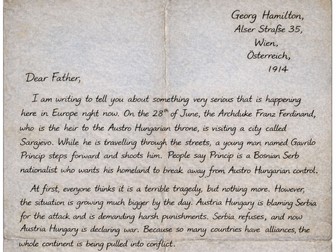
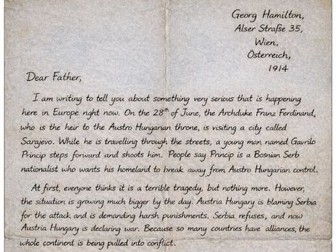
The Assassination of Archduke Franz Ferdinand (Austria Hungary / Trigger for Britain’s involvement)
Date: 28 June 1914 - The heir to the Austro Hungarian throne was assassinated in Sarajevo by Gavrilo Princip, a Bosnian Serb nationalist.
The First Battle of the Marne (France)
Date: 6–12 September 1914 - French and British forces launched a decisive counter offensive to halt the German advance toward Paris.
The Sinking of the Lusitania (United States)
Date: 7 May 1915 - A German U boat torpedoed the British passenger liner Lusitania, killing nearly 1,200 people, including 128 Americans.
The Battle of the Somme (United Kingdom)
Date: 1 July – 18 November 1916 - A major Allied offensive launched to relieve pressure on Verdun and break the stalemate on the Western Front.
The Fall of Berlin (Germany)
Date: 9 November 1918 - As Germany faced military collapse and widespread revolution, workers and soldiers rose up across the country. In Berlin, the Kaiser’s authority crumbled, and he fled into exile.
Following each image is a typed version to be used however suitable to meet the needs. Included afterwards are reading comprehension questions; 3 retrieval, 3 inference, 3 vocabulary, 2 explanation (writers reasoning), 1 prediction, and 1 summary question suitable for upper key stage 2 (UK). Following the questions are example answers for a teacher.
WW2 Fictional reading texts based on 5 key moments of the war.
Contained here are a master copy of the texts (Diary entries / letters) and the comprehensions to go with them. (These are purely fictional and should not in any way relate to a real-life person or people.)
WW2 significant dates - including two English, one German, one Japanese, and one American. Fictional texts will be from various points of view and nationalities during the war.
The Miracle of Dunkirk (United Kingdom)
Date: May 26 – June 4, 1940
Known as Operation Dynamo, this was the massive evacuation of over 338,000 Allied soldiers from the beaches of France.
The Attack on Pearl Harbor (United States)
Date: December 7, 1941
The Imperial Japanese Navy launched a surprise military strike against the U.S. naval base at Pearl Harbor, Hawaii.
The Surrender at Stalingrad (Germany)
Date: February 2, 1943
While the battle lasted months, the surrender of the German 6th Army marked the first time Hitler’s forces were decisively defeated and forced to retreat in a major campaign.
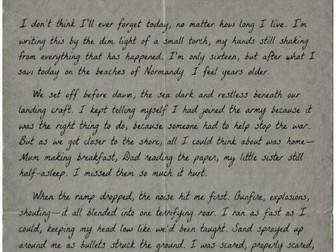
D-Day: Operation Overlord (United Kingdom / Allied)
Date: June 6, 1944
The largest seaborne invasion in history saw Allied forces landing on the beaches of Normandy, France. While a multi-national effort, the UK served as the vital “unsinkable aircraft carrier” and staging ground for the operation.
The Atomic Bombing of Hiroshima (Japan)
Date: August 6, 1945
The U.S. B-29 bomber Enola Gay dropped the first atomic weapon used in warfare on the city of Hiroshima.
Following each image is a types version to be used however suitable to meet the needs. Included afterwards are reading comprehension questions; 3 retrieval, 3 inference, 3 vocabulary, 2 explanation (writers reasoning), 1 prediction, and 1 summary question suitable for upper key stage 2 (UK). Following the questions are example answers for a teacher.
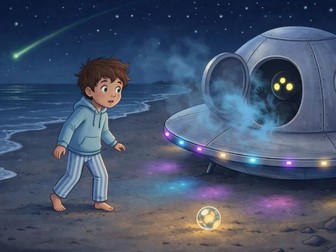
A 5‑part sci‑fi story: The Glowing Star of Sandy Cove
Suitable for Key Stage 2.
These texts can be used as part of an English topic or guided reading sequence. Each extract is designed to fit on one side of A4 and includes five retrieval questions at the bottom of the page.
This document provides a variety of additional questions to support different lesson objectives or target areas. They can be used to focus on specific reading domains (VIPERS) or as extension tasks following the texts.
Across the full set, there are three vocabulary questions, five inference questions, two prediction questions, two explanation questions, five retrieval questions and two summarising questions.
The texts and questions are simple to use, and differentiation or extension opportunities are straightforward to implement.
(An example answer key is included afterwards — note that the answers are suggestions only, and teacher judgement should always be applied.)
David Attenborough Reading comprehensions for Primary.
Information about the life and careers of Sir David Attenborough. Suitable for an activity based around his 100th birthday.
3 different reading comprehensions suitable for KS1, Lower KS2 and Upper KS2. (Can be used to differentiate at various age levels).
Questions are predominantly focused of retrieval style questions with some inference in KS2 texts.
KS1 includes 4 questions and KS2 includes 5 questions.
Texts are designed to fit on one side of A4. (With answers for a teacher on the following page).


 Quick View