Editable Pupil Passports & One-Page Profiles | Secondary SEND SupportQuick View
angiekhorne

Editable Pupil Passports & One-Page Profiles | Secondary SEND Support

(0)
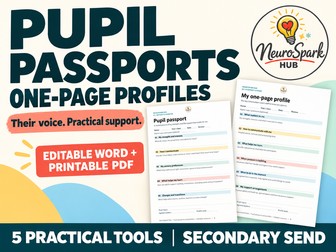
What does this pupil need the next adult to understand? A useful pupil profile makes that answer easier to find. This NeuroSpark Hub pack helps you capture strengths, communication preferences and practical support in clear, age-respectful templates for secondary settings. Save time creating the layout. Spend that time listening to the pupil. FIVE TOOLS, SIX TEMPLATE PAGES Two-page pupil passport: a fuller picture of strengths and everyday support. Everyday one-page profile: the key information staff need at a glance. Communication profile: preferred methods, processing time and help signals. Transition profile: plan changes, name responsibilities and review together. My voice and choices: an optional pupil preparation sheet. ALSO INCLUDED All six template pages in editable Word and printable PDF formats. The same six pages in versions that use less ink. Three pages of completed examples for a fictional secondary pupil. A four-page staff guide covering completion, editing, sharing and review. Three short, attributed quotations from Navigating the Storm, reproduced at the author’s request in the staff guide. Designed for secondary teachers, SENCOs, teaching assistants, pastoral staff and transition teams. The templates can record support for neurodivergent pupils, including autistic pupils and pupils with a demand-avoidant profile. They do not require a diagnosis or assume the same strategies suit every pupil. All template headings, prompts and response areas are editable in Microsoft Word. PDFs are for printing and are not interactive forms. Pages are US Letter size; use fit-to-page when printing on A4. Detailed entries may add pages in Word. Keep the one-page summary concise or use the two-page passport for detail. This is a planning and communication resource, not a diagnostic tool. Use alongside existing provision, individual plans, school safeguarding procedures and specialist advice as appropriate.
PDA and Autism in Secondary Schools | Staff Training Presentation, Workbook & Classroom StrategiesQuick View
angiekhorne

PDA and Autism in Secondary Schools | Staff Training Presentation, Workbook & Classroom Strategies

(0)
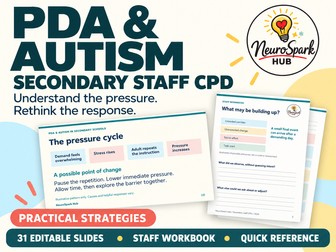
**When repeating the instruction increases the pressure, what could you try next? PDA & Autism in Secondary Schools | Practical Staff CPD Pack Build staff confidence in the moments that matter: a task refused, a difficult transition or a pupil becoming overwhelmed. This NeuroSpark Hub pack helps your team explore what may sit behind demand avoidance—and consider what to say, what to adjust and how to respond while protecting pupil dignity and maintaining appropriate boundaries. Save preparation time. Turn understanding into classroom action. 31 editable PowerPoint slides with presenter notes — a structured session for approximately 45 minutes of core CPD. 9-page printable staff workbook — take reflection beyond the training room. Realistic secondary-school scenarios and example scripts — explore responses to situations staff recognise. Practical strategies — support transitions, task engagement and collaborative problem-solving. Action-planning template and printable quick-reference guide — keep useful prompts close when staff need them. Designed for secondary teachers, teaching assistants, SENCOs and inclusion teams, with flexible use across whole-school CPD, departmental training and staff induction. Leave your next staff meeting with more than awareness. Leave with a plan for what to try next. General educational guidance. Not a diagnostic tool or a substitute for individualised support, safeguarding procedures or specialist advice.**
Teen Planning Toolkit | Secondary Executive Function and Homework Support | Editable and FillableQuick View
angiekhorne

Teen Planning Toolkit | Secondary Executive Function and Homework Support | Editable and Fillable

(0)
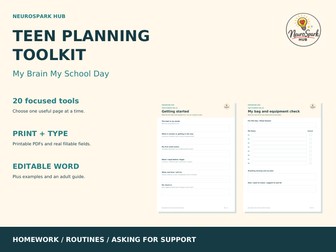
When a task feels too big, make the next step easier to see. My Brain My School Day is a NeuroSpark Hub planning toolkit for teenagers aged approximately 11-18. Choose practical pages for homework, routines, deadlines and asking for support, without committing to a full daily planner. WHAT IS INCLUDED 20 focused planning tools in A4 printable, fillable and less-ink PDF editions. An editable Word edition of the same 20 tools. 154 form fields, including clickable bag-check boxes, in the fillable PDF. Three fictional completed examples. A four-page parent/staff guide in PDF and editable Word. Short, accurately attributed quotations from Navigating the Storm in the guide. THE 20 TOOLS 01 My week at a glance 02 My school day 03 Getting started 04 Break down my homework 05 My deadline map 06 Time estimate and reality 07 One homework session 08 My bag and equipment check 09 Before I leave 10 My energy and capacity 11 My workspace preferences 12 Brain dump and choose 13 Revision without overload 14 A change of plan 15 Asking for support 16 Reminders that work for me 17 End of day reset 18 Preparing for tomorrow 19 Plan a project or assessment 20 What worked for me Designed for use at home or school, including support for autistic and ADHD teenagers. Different teenagers will prefer different tools. There is no requirement to fill in every section, and there is no promise that planning will remove every barrier. DIGITAL DOWNLOAD ONLY No printed item is supplied. A PDF reader with form support is needed to save typing and checkbox entries. Browser and phone previews vary. Save, close and reopen a completed copy to check it. Keep entries concise because text that scrolls may not print in full. Microsoft Word is recommended for the editable files. Long edits can add pages. The PDF editions and Word edition repeat the same 20 tools. These are different formats, not 80 different tools. The examples are illustrative. This is general educational support, not a diagnostic tool or treatment.