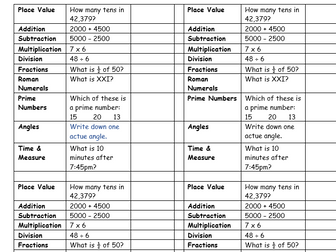
A selection of mental arithmetic suitable for Year 6.
There are enough for 1 a day from Autumn one right up to SATs.
There are 4 mini tests on each page with a question on each of the key topics for arithmetic. As the year goes on, the topics change to reflect coverage.
A set of reading comprehension exercises designed for Year 6 to commemorate VE Day.
Texts:
A diary entry from a VE Day celebrator
How to Set up a VE Day Party
A fictional story set in a futuristic war.
50 marks in total to match SATs style.
Mark scheme included.
A selection of quick SATs style questions focussing on two aspects that children often struggle with:
Vocabulary style questions - what does ___ mean in this context?
Inference style questions (3 mark questions):
What impression do you get of…
How does the author…
Each question links to a short text (one or two paragraphs) focussing on quick skills practice.
A comprehension exercise designed for Year 6 SATs practice featuring questions that have been answered wrongly or in not enough detail.
Useful for children practising checking answers.
A mark scheme with full correct answers has also been included.
A SATs style paper for Year 6.
Three texts included: one fiction, one non-fiction and one poem, all centred around the theme of magic.
Questions and mark scheme included up to a total of 50 marks.
A variety of comprehension exercises suited to Year 6 SATs practice.
On a range of non-fiction topics:
Rodents
Sport
UK Government
All complete with questions and mark schemes.
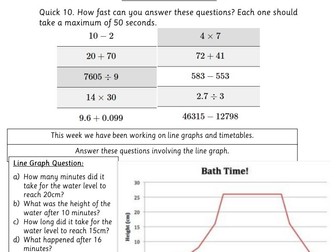
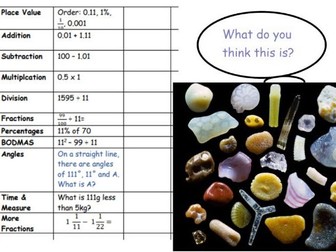
A mental arithmetic (and sometimes grammar) starter for the morning when Year 6 first come into the classroom. Alongside the mental maths, there is a question or image to consider and discuss which enhances other areas of the curriculum.
There are enough for 1 per day from for the whole year.
A reading comprehension based on the final chapter of the original text of A Christmas Carol.
Suitable for upper Key Stage 2 or higher with SATs style questions.
Questions are differentiated for two groups.
Two half terms of Maths booster booklets to be used as part of an intervention. It covers some key topics including arithmetic, multiplication and division, fractions percentages and a mix of reasoning questions from past papers.
AN ENTIRE YEAR OF MATHS HOMEWORK!
Maths Homework sheets, designed for a Year 5 class. One sheet per week for each half term.
Following the Power Maths/White Rose order of the curriculum. Some sheets may need editing to match your topics.
Each sheet will have a starter (arithmetic) which can be accessed by children of all abilities. Further tasks range in difficulty with problem solving/reasoning included where appropriate.
A full list of all of the Phase 5A and Phase 5B Phonics sounds, complete with a list of games/activities to play.
Designed to be part of an intervention for Years 3 and up.
Lists of suffixes with rules on how to add them from Year 2 to 6 also included on the document.
A guide and set of resources for the whole year for Year 2 Maths.
Features range of problems and problem solving activities and 2 end of year tests.
Designed for children working towards the end of Key Stage 1 SATs.
Problems for all aspects of Year 2 Maths curriculum including place value, addition and subtraction, multiplication and division, shape, time, fractions.
Problem solving for Maths Mastery.
Teaching guide pages included.
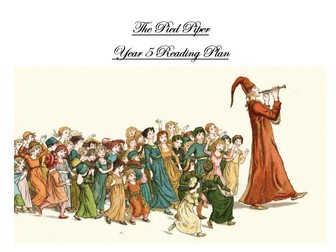
A week’s worth of planning and resources for Guided or Whole Class Reading sessions based on the Pied Piper aimed at Year 5 but could easily be adapted for any Key Stage 2 year group.
The first two lessons are based on Michael Morpurgo’s version of the book with the final lessons being based on a shortened version.
A bundle of various reading plans and resources aimed at upper KS2.
These include plans and resources for:
A Christmas Carol
The Pied Piper
War of the Worlds
Various types of poem
Books by Elizabeth Laird
Enough for at least 4 weeks of planning and lessons
A selection of reading resources based on work by Elizabeth Laird - author of Kiss the Dust and Oranges in No Man’s Land.
Resources include weekly plans which follow a set format.
Vocabulary Task
Anchor Question
Main Task (with supplementary differentiated resources)
Fluency
Text not included with the Kiss the Dust resources.
A one week (4 lessons) reading plan based on HG Wells’ War of the Worlds.
Resources & notebook provided following the format of:
Objective
Vocabulary
Anchor Question
Suitable for KS2 or higher.
A week’s worth of whole class reading based on various types of poem.
The poem types are:
Calligram
Haiku
Villanelle
Poems written in accents
Vocabulary task followed by main task to answer anchor question.
Plan & resources included.