A simple revision Powerpoint containing 40 theories, studies or concepts related to Families and Households and covering a range of topics including theories of the role of the family, diversity and conjugal roles. It is intended as a revision resource so students can learn a bulk of studies and theories relevant to the unit. It was designed for the Cambridge AS syllabus but is also relevant to the Edexcel and OCR sociology syllabuses.
A simple essay plan, about the topic of Family and housholds. The question is taken from the Cambridge syllabus and is an evaluative essay so worth 26 marks. It could also be used for the Edexcel or OCR syllabus.
The resource was created for Education A level revision (Cambridge Syllabus). It is meant to be a revision resource. It contains a range of theories and studies that would be useful for AS level or A level sociology revision. It is not comprehensive, but contains a decent range of theories and studies including some trends and statistics for DEA.
This is an essay plan for IGCSE sociology students. This is a plan for a 15 mark essay question. The plan could be stuck into the student’s book or just used as guidance for the essay. The student could use the Blundell textbook to assist.
This is an essay question in the Culture, socialisation and identity unit chapter 2 of IGCSE sociology.
A sheet which has been prepared as a guidance sheet to assist with individual revision. If students get stuck, they can look at it and get an idea about where to begin. This is a general resource, I use it as a starter to get students talking about revision strategies.
This is an essay plan activity to help igcse students plan a 15 mark essay: To what extent are gender roles shaped by nature rather than nurture. There is brief essay plan guidance here. This is a task intended to be used with the Blundell IGCSE textbook.
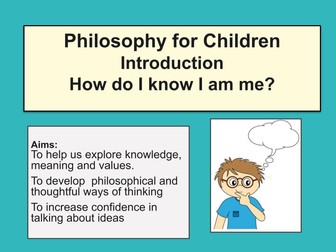
These are developed for KS2 / KS3 children and should last between 30 minutes to 45 minutes depending on developing the discussion work, and how many children are in the class. These were developed for online sessions with one nine year old, but should work fine with a larger class, but may need some tweaking.
They are to develop children’s interest in philosophical ideas and concepts, and they focus on posing questions to develop and extend children’s curiosity, and logical thinking, through short scenarios, and problems.
Each one contains a link to a clip- I mainly used the BBC KS2 philosophy short clips. https://www.bbc.co.uk/teach/class-clips-video/articles/zjbft39
Some of them include brief introductions to philosophy concepts at a fairly basic level. These are designed to be light, fun and engaging. Most appropriate for 9-11 and may not be suitable for children under 9 years old.
The topics are:
How do I know I am me? - ship of theseus
why should I be good?
Free will and determinism
The Mystery of the Other world
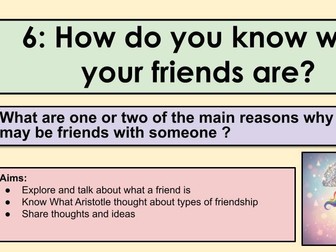
How do you know who your friend are?
Soduku Dectectives- logical puzzles
How do you know when you are dreaming?