DensityQuick View
beckiejade_pickersgill

Density

(0)
By the end of this lesson pupils will be able to: Define the word density and predict if materials will float/sink Explain why some materials are denser than others in terms of particles Explain the difference between the oil and ice cubes in water This lesson targets the misconception that air makes objects float, assess the pupils understanding throughout the lesson and provides the pupils with a challenging activity towards the end.
Cost of Electricity and Energy UseQuick View
beckiejade_pickersgill

Cost of Electricity and Energy Use

(0)
By the end of the lesson, you will be able to: can compare the energy usage and cost of running different home devices I can suggest ways to reduce costs, by examining data on a home energy bill I know we pay for our domestic electricity usage based on the amount of energy transferred and can calculate it using the formula: cost = power (kW) x time (hours) x price (per kWh)
Cells, Tissues, Organs and SystemsQuick View
beckiejade_pickersgill

Cells, Tissues, Organs and Systems

(1)
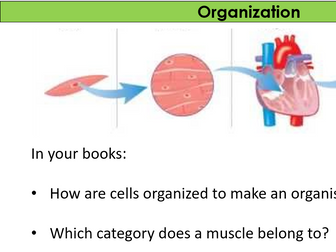
In this lesson pupils will be able to; Describe how the body is organised into cells, tissues, organs, organ systems and organisms. Describe the various functions of the organ systems Explain why multicellular organisms need organ systems to keep them alive. This lesson included a video - with questions, a pop quiz, starter, plenary and exam style questions as well as activities.
Cells Bundle LessonQuick View
beckiejade_pickersgill

Cells Bundle Lesson

5 Resources
This bundle includes 6 lessons covering the introduction of cells all the way to how they are organised in order to create an organism. The lessons were designed and targeted towards KS3. By buying these lessons as a bundle you would be saving 17%
Energy BundleQuick View
beckiejade_pickersgill

Energy Bundle

7 Resources
These lessons cover the introduction of energy. How energy is transferred and what the future holds for energy resources. These lessons were targeted at KS3. By buying this bundle - you save 38%.
Cooling CurveQuick View
beckiejade_pickersgill

Cooling Curve

(0)
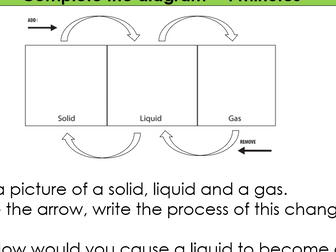
By the end of this lesson, pupils will be able to: Understand that substances can change state when heated or cooled. Describe how changes to the arrangement and motion of their particles can cause substances to change state Explain changes in state in terms of energy and particles Recognize melting and boiling point on a cooling curve Explain the shape of a cooling curve at a substances melting and boiling point This lesson stretches pupils understanding of the states of matter and the links between them. It is also a great opportunity for pupils to practice their graph reading skills.
States of MatterQuick View
beckiejade_pickersgill

States of Matter

(0)
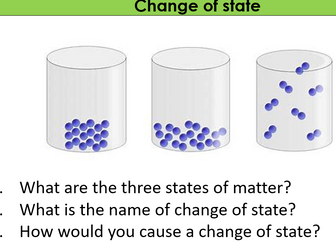
By the end of this lesson pupils will be able to: Describe the differences between the motion and arrangement of particles in solids, liquids and gases Describe the arrangement of particles in solids, liquids and gases Understand the relationship between the kinetic energy of particles of solids, liquids and gases Lesson includes a video with hook questions to introduce the abstract topic, a definition with words to un-jumble, an AfL quiz and an exention piece of work at the end to challenge the pupils.
MusclesQuick View
beckiejade_pickersgill

Muscles

(0)
In this lessons, pupils will be able to; Describe what a muscle is Describe the interaction between muscle and skeleton Explain why a person with weakened tendons would struggle to walk. This lesson comes with starter, plenary, AfL. Using the pupils prior knowledge of skeletons and cells organisation to help them.
Renewable and Non-renewableQuick View
beckiejade_pickersgill

Renewable and Non-renewable

(0)
By the end of this lesson, you will be able to; Recall the names of the non-renewable and renewable sources of energy. Describe the energy transfers from energy resources to electricity in the home Evaluate the social, economic and environmental consequence of using a resource to generate electricity
Reducing Thermal Energy LossQuick View
beckiejade_pickersgill

Reducing Thermal Energy Loss

(0)
By the end of this lesson, you will be able to: Identify a thermal insulator as a material that allows heat to travel slowly through it Explain patterns in data and draw conclusions about methods of reducing energy loss. Evaluate different materials and their properties. Make links to reducing energy loss.
RadiationQuick View
beckiejade_pickersgill

Radiation

(0)
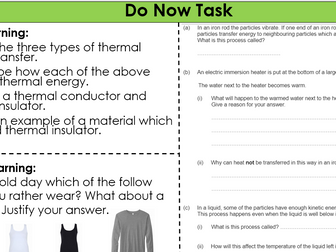
By the end of this lesson, you will be able to; Know radiation is the transfer of thermal energy as a wave Identify examples of where evidence of radiation can be seen Compare and contrast the 3 ways that thermal energy can be moved from one place to another by heating
ConvectionQuick View
beckiejade_pickersgill

Convection

(0)
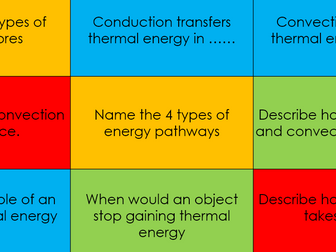
By the end of this lesson, you will be able to; Know convection is the transfer of thermal energy involved when particles in a heated fluid rise Sketch diagrams to show convection currents in unfamiliar situations Describe and explain convection in term of thermal energy transfer
Energy StoresQuick View
beckiejade_pickersgill

Energy Stores

(0)
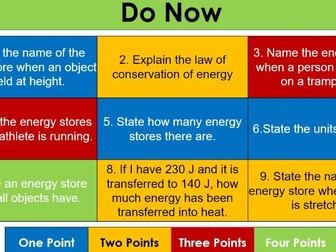
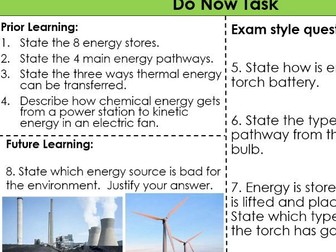
By the end of this lesson pupils will be able to ; Recall the different stores of energy Identify the different stores of energy in different situations. Explain what is meant by the conservation of energy. Activities, AfL, starter, plenary and exam style questions are all included.
Energy PathwaysQuick View
beckiejade_pickersgill

Energy Pathways

(0)
By the end of this lesson pupils will be able to; Identify the energy pathway involved when energy is shifted from store to store in a range of real-life examples Describe how energy is dissipated in a range of situations Explain why processes such as swinging pendulums or bouncing balls cannot go on forever, in terms of energy. Activities included.
Plant CellsQuick View
beckiejade_pickersgill

Plant Cells

(0)
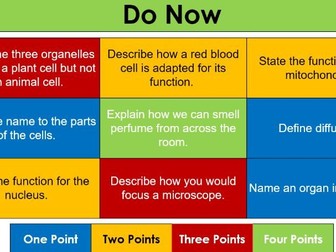
In this lesson the pupils will be able to; name the organelles within a plant cell. describe the functions of the organelles within the cell. Compare and contract a plant and animal cell. This lesson is full of starter, learning objectives, plenary and exam style questions.
Animal CellsQuick View
beckiejade_pickersgill

Animal Cells

(0)
Powerpoint designed to introduce an animal cell to a mixed ability class - targeted towards KS3. Includes activities for pupil to be able to identify the parts of an animal cell and their functions. Starter and plenary included.