In a world where young people are overwhelmed with information and content, it is really challenging to get students to form opinions in a subject such as (English) Literature This is a very short lesson or part of a lesson that uses music to help learners to understand how to form opinions about Literature (or anything) using music.
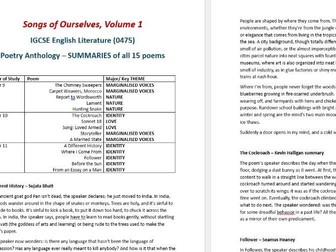
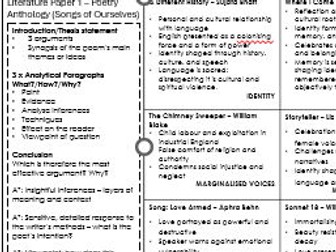
This resource is a collation of all 15 poems in the Songs of Ourselves Volume1 IGCSE Eng Lit (0475).
I compiled the summaries when I gleaned that my students could explain quotation by quotation what was happening, but did not understand or follow the ‘storyline’ of the poems. Getting students to think of the poems as stories has really helped both their learning and revision.
The Chimney Sweepers
Carpet Weavers, Morocco
Report to Wordsworth
Lament
Hunting Snake
The Cockroach
Sonnet 18
Song: Loved Armed
Storyteller
A Married State
A Different History
Where I Come From
Follower
Before the Sun
From an Essay on a Man
This is a revision mat that goes over:
A brief summary of all 15 poems
Outlines how to write a strong essay
Gives the Themes, Key Character analysis and overview of Susan Hill’s*** I’m the King of the Castle*** and A Streetcar Named Desire for IGCSE - Cambridge.
My students were requesting ‘short form’ revision materials - hence I made this. They have found this to be particularly helpful.
I recommend that you print it double sided in A3 or A4.
Songs of Ourselves Volume 1:
The Chimney Sweepers
Carpet Weavers, Morocco
Report to Wordsworth
Lament
Hunting Snake
The Cockroach
Sonnet 18
Song: Loved Armed
Storyteller
A Married State
A Different History
Where I Come From
Follower
Before the Sun
From an Essay on a Man
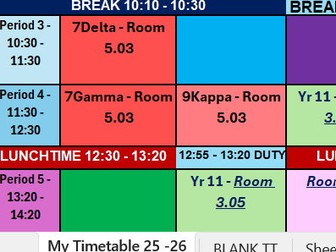
This is a really useful Timetable Template and Example Timetable that can be adapted for the timings of your school or workplace. You can print it pretty easily and shrink it to fit to a handy postcard size too!
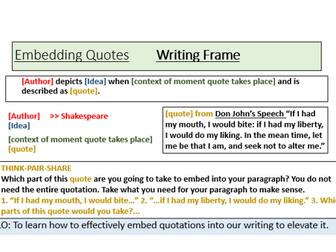
This lesson takes students through how they can embed a quotation into a sentence when writing an essay paragraph. The lesson includes a Do Now activity, a link to a 5 min Embedding Quotes Youtube video to help students understand the importance of this skill, lesson activities, and more.
These 2 lessons include a range of activities.
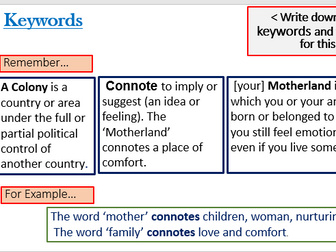
Lesson 1 is about students engaging with their ‘first impressions’ of the poem, and helping them gain a good understanding of what the Motherland was/is, and how West Indian people being asked to come to Britain would have had the Motherland presented to them.
Lesson 2 supports students to analyse the poem in more detail and write an essay paragraph responding to the question: Q - How does the narrator feel in the poem ‘Call to the Motherland’?
Windrush Poems are important in the UK in 2023 and beyond to help students and people of all races and ethnicities on their journey to understand the ofiten harsh experiences, tiumph, and remarkable contributions arcoss British society.
Hopefully, more teachers can incorporate these engaging & educational lessons that focus on poetry analysis, literacy, history, empathy and more.
These 2 lessons include a range of activities. It would be helpful for students to have completed the poems: Kamikaze by Beatrice Garland and Not My Business by Niyi Osundare. This is not essential.
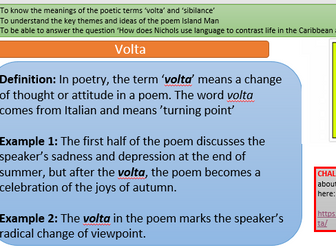
Lesson 1 is about students understanding the broad ideas in the poem Island Man in terms of imagery. Students will be introduced to the language device sibilance and the structural device volta. Students will be supported to write an essay paragraph before the end of the lesson.
Lesson 2 Students will explore the idea of the poet’s* intention* behind writing the poem. This exposes them to one of the GCSE Assessment Objectives (AQA) - AO3: Show understanding of the relationships between texts and the contexts in which they were written.
Again, students will be supported to analyse the poem in more detail and write an essay paragraph responding to the question
Windrush Poems are important in the UK in 2023 and beyond to help students and people of all races and ethnicities on their journey to understand the ofiten harsh experiences, tiumph, and remarkable contributions arcoss British society.
Hopefully, more teachers can incorporate these engaging & educational lessons that focus on poetry analysis, literacy, history, empathy and more.
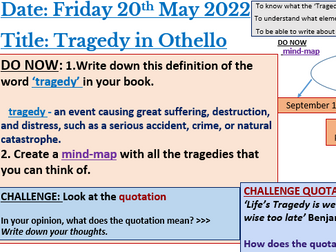
A contextual/background information lesson that focuses on helping students to understand Tragedy and Hamartia in Shakespeare’s Othello. Students are supported to write a short paragraph in the lesson about what the *Tragedy *genre is.
TIP: Teachers should use the notes sections on slides to get more information.
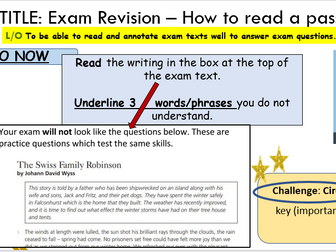
This lesson has been created to help English students of ages 11-16 to understand how to properly read an English literature passage in an exam in order to answer challenging, and tricky (often in terms of wording) questions.
The text used for this lesson is ‘The Swiss Family Robinson’ – taken from a GL Assessment Paper.
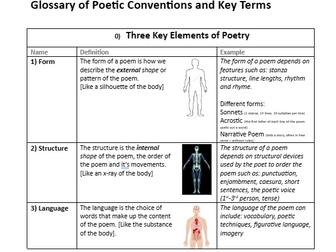
This is a 6-page resource with lots of poetic terms, their meanings and clear examples aimed at supporting your students with poetry study.
Form: Key Terms
Structure: Key Terms
Language: Key Terms
Useful terms to use when analysing poetry
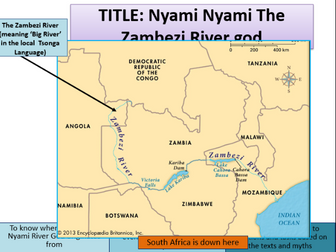
This lesson was created to add some diversity to a scheme of work entitled ‘Myths & Legends’ which mostly included Western Mythology.
I wanted students to be exposed to ideas from other parts of the globe, so I created these fun, educational lesson. It has elements of Geography, History & Literature.
Please enjoy.


 Quick View