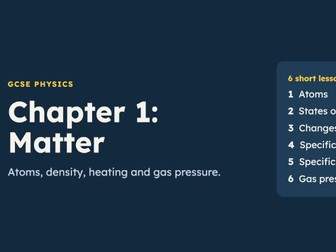
Slides and worksheets for P1.1 to P1.3.1
Atoms, matter and density, specific heat capacity, specific latent heat and gas pressure.
This is aimed at lower ability students.
This worksheet is an excellent resource for Year 9 Chemistry students to practice identifying elements within a chemical formula and understanding the composition of various chemical compounds. The activity involves analyzing a series of chemical formulas and determining the number of atoms, the number of different elements, and naming the elements present in each formula.
The worksheet contains 15 questions covering a wide range of chemical compounds, from simple molecules like water (H2O) to more complex ones like sugar (C12H22O11). An answer key version of the worksheet is also available, providing detailed solutions for each question.
This exercise is designed to support the understanding of molecular structures, improve chemical literacy, and offer students a hands-on approach to learning how different atoms combine to form compounds. It can be used as a classroom activity, homework assignment, or as a formative assessment to gauge student understanding of chemical formulas.
“The 30” is a set of questions that cover C1-C3 in the OCR specification, broadly assessing the particle model, atomic structure, mixtures, bonding, properties of materials, chemical reactions and energetics.
I use one lesson for students to complete as many of the questions as possible and then release the solutions. In the following lesson I pick 10 questions at random for the students to sit as a test.
This has been a great way to engage all students
*Solutions do not currently include graphs or diagrams but I hope to update this soon.
“The 30” is a set of questions that cover P1-P3 in the OCR specification, broadly assessing the particle model, changes of state, pressure, motion, Newton’s laws, forces, electric fields and simple circuits.
I use one lesson for students to complete as many of the questions as possible and then release the solutions. In the following lesson I pick 10 questions at random for the students to sit as a test.
This has been a great way to engage all students
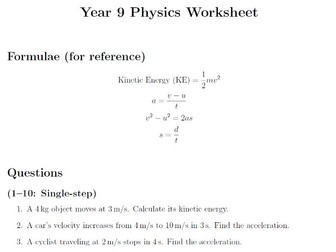
Selection of questions based on Chapter 7 of the OCR specification, Energy.
Numerical and qualitative questions that test understanding of energy transfers.
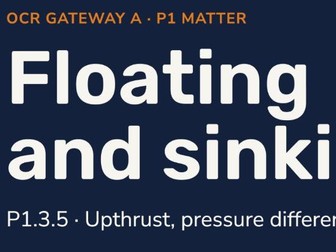
Lesson slides for the last topic in P1. They cover maybe a bit more than is necessary but hopefully help students to understand upthrust and how to calculate it.
I also have an accompanying jupyter notebook for this lesson which works really well. I can’t upload it here but if interested please email me and I’ll send it over.
william.finney@mybiddeham.com
 Quick View


 Quick View
 Quick View
 Quick View
 Quick View
 Quick View
 Quick View
 Quick View
 Quick View
 Quick View
 Quick View
 Quick View
 Quick View
 Quick View
 Quick View