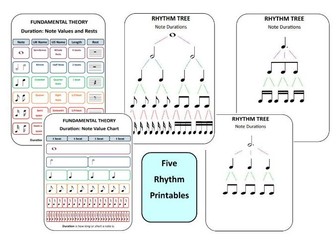
This download includes 5 colourful and informative rhythm crib sheets, including rhythm trees. Just download and print to help student learn note values.
Note values & rests (US and UK note value definitions)
Note value chart
3 rhythm trees starting from different note values
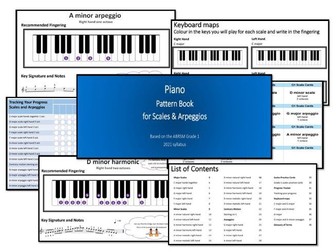
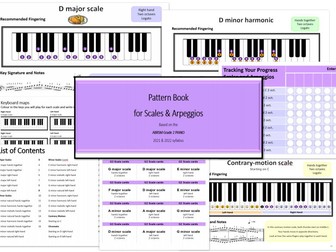
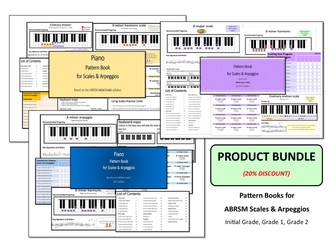
This bundle includes pattern books for scales and arpeggios for Initial Grade, Grade 1 and Grade 2. All are based on the ABRSM 2021 & 2022 syllabus for piano.
These e-books are full of easy to follow keyboard diagrams and staves with notes and fingering, scales cards, a weekly progress tracker, keyboard maps and a glossary of terms.
The content of this scales pattern e-book is listed below:
Keyboard diagrams
Key signatures
Grade 1 scales and arpeggio practice cards
Progress tracker
Keyboard maps
Glossary of terms
Print out or screen share with your pupils in lessons.
The book includes scales cards which are great for encouraging pupils to practice all scales assigned to them. Just cut out and give to pupils to take home.
In addition, you can use the progress tracker to help both teachers and pupils monitor their progress on a weekly basis.
This e-book is full of questions, helpful tips and keyboard maps to help pupils really understand and learn scales patterns, recommended fingering, key signatures and differences between the harmonic and melodic minor scales.
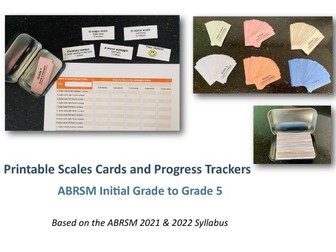
Scales cards and Progress Trackers are a great way to track which scales and arpeggios you / your students are learning.
This pack includes Scales Cards and Progress Trackers for all scales and arpeggios included in the 2021 & 2022 ABRSM syllabuses for Initial Grade to Grade 5.
Once purchased, you will get access to 6 individual pdf files (one per grade) which include:
Instructions on how to use the scales cards and progress trackers.
Double sided scales cards to print and cut out.
A progress tracker.
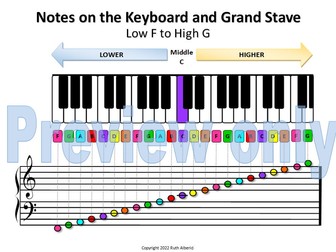
Help your students to learn their Landmark Notes using this bumper 41 page pack. It includes definitions of Landmark Notes and how to use and remember them, handy crib sheets to show where notes sit on the Grand Stave and on the Keyboard and activity sheets to reinforce learning. These Landmark Notes have symmetry on the grand stave and link to the F (bass) clef and G (treble) clef.
Levels of Difficulty
The pack includes five separate pdf downloads covering levels of progressing difficulty and an information sheet. By separating each Level, the most appropriate one can be chosen for each of your pupils.
Introduction (3 pages)
Level 1 – Bass F, Middle C and Treble G (8 pages)
Level 2 – Bass C to Treble C (9 pages)
Level 3 – Low F to High G (10 pages)
Level 4 – Low C to High C (11 pages)
With the studio license, your students can print out the crib sheets and keep near their instrument as a handy reference document
Each Level includes
Tips on how to identify the Landmark Notes
2 cribs sheets showing where landmark notes are on the grand stave and keyboard
4 activity sheets to complete in lessons or at home.
This Grade 3 scales pattern e-book comes with a Studio Licence so you can print it out, or screen share, for any number of pupils that you teach in your studio!
This 55 page e-book covers all scales and arpeggio patterns and fingering for the new ABRSM Grade 3 Piano syllabus (from 2021). It includes visual keyboard diagrams and notes on the stave to cater for different learning styles.
The content of this scales pattern e-book is listed below:
Keyboard diagrams for all ABRSM Grade 3 scales and arpeggios (2021 syllabus)
Written notes and key signatures for all ABRSM Grade 3 scales and arpeggios (2021 syllabus)
Key signatures
Grade 3 scales and arpeggio practice cards
Progress tracker
Keyboard maps
Glossary of terms
Print out or screen share with your pupils in lessons.
Voice leading refers to the smooth and logical movement of individual musical lines or “voices” from one chord to another in a piece of music. It involves the way each note (or “voice”) moves to the next note in a progression of chords, with the goal of creating smooth transitions that are musically satisfying. Voice leading is a foundational concept in harmony and counterpoint, especially in classical and traditional Western music.
These worksheets include easy to follow steps and clear, simple worksheets to help you craft good voice leading.
The download includes:
An introduction to voice leading;
Instructions on how to craft good voice leading;
2 blank, fillable worksheets to work out chords in root position, 1st inversion and 2nd inversion; and
1 blank, fillable voice leading worksheet.
Music is a universal language—and so are emojis! In today’s digital world, students use emojis every day to express feelings, ideas, and actions. Why not use them to spark some creativity in your music lessons. Use these cards and game ideas to develop emotional awareness, enhance listening skills, build expression in playing.
This resource includes 30 Unicode emoji cards and 5 ideas for using emojis in music lessons
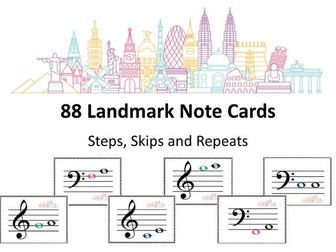
A selection of 88 cards showing steps (2nds), skips (3rds) and repeated notes (unisons) off landmark notes low F, bass C, bass F, middle C, treble G, treble C and high G. Includes an extra pack with low G and high F for those using the Piano Adventures method book, low C and high C and 8 text cards with step, skip, repeat, up, down, C, G, and F for students to place the cards in piles.
The pack includes:
An introduction to Landmark Notes.
How to use Landmark Notes for note reading.
10 single landmark note cards
70 directional movement cards
8 text cards (step, skip, repeat, up, down, C, G, F)
These cards are excellent for helping students improve their note-reading skills!
This 38 page e-book covers all scales and arpeggio patterns and fingering for the new ABRSM Grade 1 Piano syllabus (from 2021). It includes visual keyboard diagrams and notes on the stave to cater for different learning styles.
The content of this scales pattern e-book is listed below:
Keyboard diagrams for all ABRSM Grade 1 scales and arpeggios (2021 syllabus)
Written notes and key signatures for all ABRSM Grade 1 scales and arpeggios (2021 syllabus)
Key signatures
Grade 1 scales and arpeggio practice cards
Progress tracker
Keyboard maps
Glossary of terms
Print out or screen share with your pupils in lessons.
The book includes scales cards which are great for encouraging pupils to practice all scales assigned to them. Just cut out and give to pupils to take home.
In addition, you can use the progress tracker to help both teachers and pupils monitor their progress on a weekly basis.
This e-book is full of questions, helpful tips and keyboard maps to help pupils really understand and learn scales patterns, recommended fingering, key signatures and differences between the harmonic and melodic minor scales.
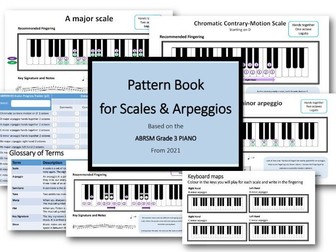
This 55 page e-book covers all scales and arpeggio patterns and fingering for the new ABRSM Grade 2 Piano syllabus (from 2021). It includes visual keyboard diagrams and notes on the stave to cater for different learning styles.
The content of this scales pattern e-book is listed below:
Keyboard diagrams for all ABRSM Grade 2 scales and arpeggios (2021 syllabus)
Written notes and key signatures for all ABRSM Grade 2 scales and arpeggios (2021 syllabus)
Key signatures
Grade 2 scales and arpeggio practice cards
Progress tracker
Keyboard maps
Glossary of terms
Print out or screen share with your pupils in lessons.
The book includes scales cards which are great for encouraging pupils to practice all scales assigned to them. Just cut out and give to pupils to take home.
In addition, you can use the progress tracker to help both teachers and pupils monitor their progress on a weekly basis.
This e-book is full of questions, helpful tips and keyboard maps to help pupils really understand and learn scales patterns, recommended fingering, key signatures and differences between the harmonic and melodic minor scales.
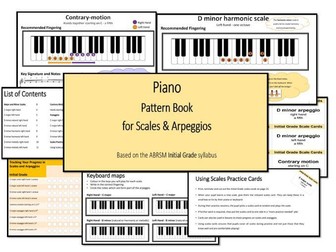
This e-book covers all scales and arpeggio patterns and fingering for the new ABRSM Initial Grade Piano syllabus (from 2021). It includes visual keyboard diagrams and notes on the stave to cater for different learning styles.
The content of this scales pattern e-book is listed below:
Keyboard diagrams for all ABRSM Initial Grade scales and arpeggios (2021 syllabus)
Written notes and key signatures for all ABRSM Initial Grade scales and arpeggios (2021 syllabus)
Key signatures
Initial Grade scales and arpeggio practice cards
Progress tracker
Keyboard maps
Glossary of terms
Print out or screen share with your pupils in lessons.
The book includes scales cards which are great for encouraging pupils to practice all scales assigned to them. Just cut out and give to pupils to take home.
In addition, you can use the progress tracker to help both teachers and pupils monitor their progress on a weekly basis.
This e-book is full of questions, helpful tips and keyboard maps to help pupils really understand and learn scales patterns, recommended fingering, key signatures and differences between the harmonic and melodic minor scales.
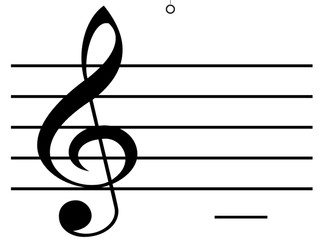
These A4 sized treble and bass clef templates are perfect for getting students to learn notes. Pin the sheets onto a whiteboard and place magnetic counters on specific notes.
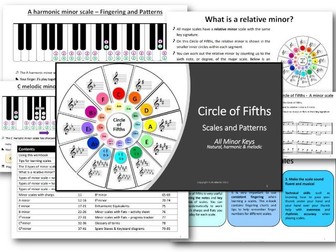
This 86 page workbook takes students through ALL minor scale patterns for piano with reference to the Circle of Fifths. It provides a clear structure, with scales ordered by the number of sharps then the number of flats in the key signature. Furthermore, scales are linked to the relative major and the book covers natural, harmonic and melodic minor patterns.
It is the ideal accompaniment to my major scales pattern book.
Also included in this minor scale pattern for piano workbook:
All relative minor scales on the stave with their key signatures;
Keyboard diagrams showing the shapes and recommended finger patterns of all minor scales (natural, harmonic and melodic);
Activity sheets for each scale;
Progress trackers; and
Helpful tips.
Print out the crib sheets and use them regularly to help with understanding of the structure of scales, their key signatures and the link to the circle of fifths.
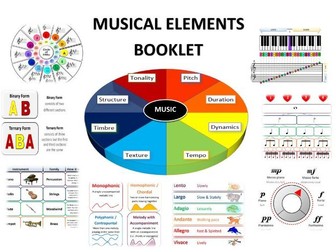
This 22 page booklet is perfect for teaching students about the 8 key elements of music – pitch, duration, dynamics, tempo, texture, timbre, structure and tonality.
It includes:
Notes on the stave;
Note and rest values;
Rhythm Trees;
Time signatures;
Dynamic and tempo markings;
Binary, ternary and rondo form;
The circle of fifths;
The order of sharps & flats; and
Music signs & symbols.**
Full of helpful diagrams, tips and explanations, this is a must have for any musician!
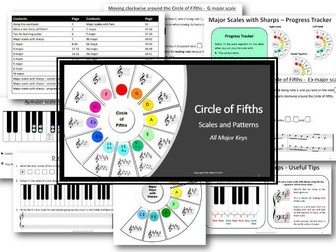
This workbook takes students through scale patterns for all major scales on the piano with reference to the Circle of Fifths. It provides a clear structure, with scales ordered by the number of sharps then the number of flats.
This workbook includes:
Written scales with their key signatures;
Keyboard diagrams showing the shapes of all major scales;
Recommended finger patterns;
Activity sheets for each scale;
Progress trackers; and
Helpful tips
How to use
Print out the crib sheets and use them regularly to help with understanding of the structure of scales, their key signatures and the link to the circle of fifths.
Tailor the progress trackers so that they focus on specific scales. They are a great tool if you / your students are working towards an exam.
Print out the scale pattern sheets that you need for each student – you’ll be amazed at how quickly they progress with the help of these tools!
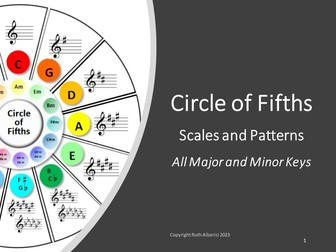
This bundle pack contains two bumper pdf files:
Circle of Fifths: Scales and Patterns in all major keys (67 pages)
Circle of Fifths: Scales and Patterns in all minor keys (86 pages)
Together, all major and minor (natural, harmonic and melodic scales) are covered, with scales ordered by the number of sharps then the number of flats in the key signature.
The keyboard diagrams are particularly helpful for students to see the patterns and recommended fingering for each hand. Also included are activity sheets, progress trackers and tips.
Included in these workbooks
Scale patterns for piano in all major and minor (natural, harmonic and melodic) scales, ordered by the number of sharps then the number of flats in the key signature;
All major and relative minor scales on the stave with their key signatures;
Keyboard diagrams showing the shapes and recommended finger patterns of all major and minor scales (natural, harmonic and melodic);
Activity sheets for each scale;
Progress trackers; and
Helpful tips.
Print out the crib sheets and use them regularly to help with understanding of the structure of scales, their key signatures and the link to the circle of fifths.
Tailor the progress trackers so that they focus on specific scales. They are a great tool if you / your students are working towards an exam.
Print out the scale pattern sheets that you need for each student – you’ll be amazed at how quickly they progress with the help of these tools!
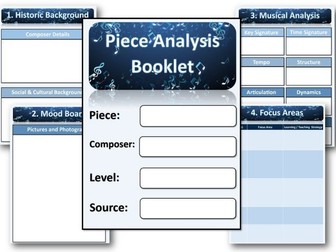
Before you dive into learning a piece, or start teaching it to students, a bit of preliminary research and analysis can help you navigate your way through it more easily.
This workbook is designed to help you by providing a space to gather this information in one place, including:
Social, cultural and composer background;
A mood board space for photos and pictures;
Musical analysis – key signature, time signature, tempo, structure, articulation, dynamics, rhythm, melodic and harmonic features and stylistic performance.
Potential ‘problem areas’ which may require specific learning/teaching strategies.
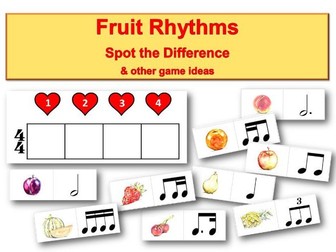
You can use this fun fruit rhythms game board and cards in many different ways! It’s a great way to get students of all levels to listen intently to, and recognise, different rhythms.
Game ideas include:
Spot the difference;
Secret code breaking;
Making a rhythm fruit salad; and
Incorporating fruit rhythms into composition & improvisation.
This pdf download includes:
Instructions
Game ideas and tips
2 game boards with different time signatures
Fruit rhythm cards
A fruit rhythm crib sheet
Note values include dotted minims (dotted half notes), minims (half notes), crotchets (quarter notes), dotted crotchets (dotted quarter notes) and quavers (eighth notes).
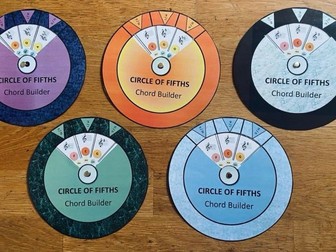
This interactive Circle of Fifths helps you to quickly identify primary and secondary chords in any key. It is ideal for working out great sounding chord progressions and to help with composition and improvisation.
The pack includes:
Instructions
A printable circle of fifths
Five colourful covers
How to use the circle of fifths to identify primary and secondary chords in any key
How to create chord progressions that work
How to quickly work out major and minor chords
Just download, print, cut out and assemble.
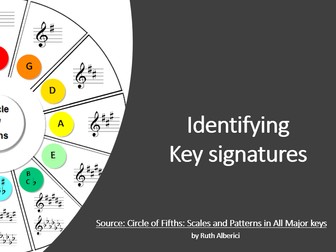
These crib sheets give handy tips for identifying key signatures, including:
The structure of a major scale;
How to identify a major scale from the key signature; and
How to work out the order of sharps or flats in a key signature.
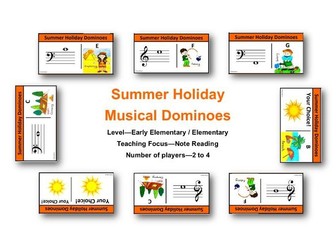
Based on the classic dominoes game, but with a Summer twist, these cards include musical notes instead of numbers.
This game is an instant hit with students and makes learning notes fun and enjoyable. It can be played in face-to-face music lessons, in groups of up to 4 players or at home with family members.
The download includes:
Step-by-step instructions on How to Play
24 Summer holiday-themed musical domino cards