 Quick View
Pokémon Crate Transport Challenge – STEM Game Using Volume, Mass & Profit
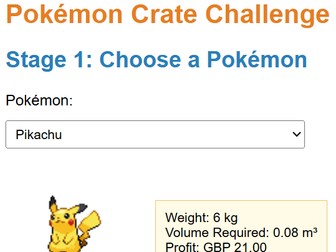
Engage your students with this fun and challenging logistics-themed maths activity! In this interactive HTML game, students take on the role of engineers tasked with transporting Pokémon. They must design crates, select materials, and choose safe transport speeds — all while working out if their decisions will result in profit or loss.
All Pokémon data (weight, size, etc.) is taken directly from the official Pokédex, adding an extra level of authenticity for fans.
Perfect for KS3 and KS4 maths, this task reinforces real-world problem solving and applied numeracy.
How to Use:
Best used by downloading and opening the HTML file on a PC or Mac.
The file runs entirely offline — no internet or installation required.
Avoid opening it within Microsoft Teams or OneDrive preview, as features may not work properly.
Lesson Structure:
Students should complete workings in their books as they progress through the stages:
Choose a Pokémon
Note down its volume, weight, and base profit (all from the Pokédex).
Design a Crate
Pick a crate shape (cuboid, triangular prism, or cylinder) and calculate its volume. Ensure it fits the Pokémon and stays under the material’s max load.
Set a Transport Speed
Understand how the speed affects cost. Use the formula provided to calculate transport cost based on chosen speed.
Calculate Final Profit
Use their crate and transport costs to work out a final profit or loss — then test their solution in the game and compare!
Differentiation Tip:
Scaffold the task by having students calculate each part on paper before checking in the app.
Use easier Pokémon and crates for support, or push advanced students to experiment for maximum profit.
Curriculum Links:
Volume of 3D shapes
Density, mass, and material strength
Speed-distance-time and conversions
Budgeting, cost modelling, and profit/loss
Real-world application of multiple mathematical strands
Bonus Features:
Real Pokémon data from the official Pokédex
Currency options (AED, USD, GBP, EUR, JPY)
Audio feedback with Pokémon cries
Replayable with different crate and transport combinations