
The Truman Show: Reality, Freedom & Truth | Complete RMPS / Philosophy Unit (S2-S4)Quick View
jenthomson25

The Truman Show: Reality, Freedom & Truth | Complete RMPS / Philosophy Unit (S2-S4)

(0)
A complete, engaging and thought-provoking resource based on The Truman Show exploring philosophy, ethics, free will, media influence and human rights. This resource encourages pupils to move beyond simply watching a film and instead investigate some of life’s biggest questions: What is reality? Do we truly have free will? Is it better to live a comfortable lie or a difficult truth? Is freedom more important than happiness? How much control do social media and algorithms have over us? Perfect for RMPS, Philosophy, PSE or cover lessons. Included: Fully editable PowerPoint lesson sequence A3 pupil worksheet Teacher notes and guidance Plato’s Cave activities Ethical thinking tasks (Utilitarianism & Kant) Modern links to social media, algorithms and influencers Debate and discussion activities Hinge questions throughout Assessment / extension tasks UNCRC links included Learning Themes Reality vs illusion Free will and control Plato’s Cave Human rights Ethics Media influence Algorithms and social media Critical thinking ** Skills Developed** Analysis Evaluation Critical thinking Oracy Empathy Learner independence Real-life application Suitable for: S2-S4 RMPS Philosophy Citizenship PSE Cross-curricular learning Cover lessons The Truman Show is an excellent stimulus for exploring complex philosophical ideas in an accessible and engaging way, helping pupils connect big questions about freedom, truth and identity to their own lives. Approximate teaching time: 3-4 lessons No specialist Philosophy knowledge required.
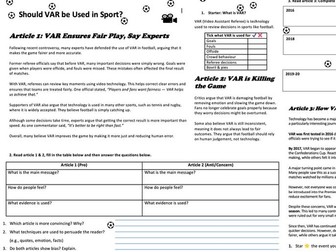
Football  Ethics: Should VAR Be Used in Sport?Quick View
jenthomson25

Football Ethics: Should VAR Be Used in Sport?

(0)
A fully resourced and engaging lesson exploring one of the biggest debates in modern sport: does VAR make football fairer? Designed for lower school Citizenship, RMPS, PSE or Modern Studies, this lesson encourages pupils to think critically about fairness, technology, justice and enjoyment in sport. Using real-life examples, QR-code video clips and ethical viewpoints, pupils develop their ability to analyse evidence, consider different perspectives and justify their own conclusions. Included Editable Resources 2-page A3 pupil worksheet Teacher answer booklet PowerPoint starter and plenary activities QR code video analysis tasks Literacy-based article activities Timeline activity on the development of VAR Ethical viewpoints: Christianity Utilitarianism Sporting Ethics Final evaluative extended response task Learning Intentions Pupils will: Understand what VAR is and how it is used Explore arguments for and against VAR Analyse different viewpoints about fairness in sport Evaluate evidence from real-life examples Justify their own opinion using evidence Skills Developed Critical thinking Analysis Evaluation Literacy Source analysis Justification Discussion and debate Ethical reasoning Curriculum Links This resource is ideal for: RMPS Citizenship PSE Modern Studies Interdisciplinary Learning It also supports discussion of: Fairness Justice Rules Honesty Responsibility Technology in society UNCRC Links Article 12 – Respect for children’s views Article 13 – Freedom of expression Article 29 – Developing critical thinking and respect for different viewpoints Perfect as a standalone lesson, World Cup themed activity, cover lesson or enrichment task.
Save the Ugly Animals! P7 Transition / S1 Citizenship LessonQuick View
jenthomson25

Save the Ugly Animals! P7 Transition / S1 Citizenship Lesson

(0)
A fun and creative P7 transition or S1 Citizenship/RMPS/RE lesson exploring whether animals should be judged by appearance. Pupils discuss why cute animals often receive more attention, then work in groups to create a campaign to protect an “ugly” or misunderstood animal. The lesson encourages teamwork, communication, creativity, empathy and critical thinking. It also links to UNCRC Articles 12, 13 and 29. Includes teacher notes, suggested timings, learning intention and success criteria, discussion prompts, campaign task, 30-second pitch activity, exit ticket, campaign planning sheet and printable animal information cards.