Primary to Secondary: It provides a section for students to demonstrate how blending two primary colors creates a secondary color.
Tertiary Colors: It includes a column for tertiary colors, which are defined as the results of blending a primary color with a secondary color.
Practical Application: The worksheet concludes with a blank color wheel for the student to fill in, along with a “Scribble Test colour Zone” for testing colors.
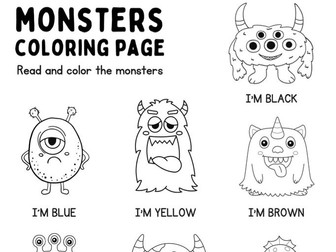
This image displays an educational “Monsters Coloring Page” activity designed for children. The activity combines literacy and artistic skills by asking learners to read simple color-based prompts and then color the corresponding monster illustrations accordingly.
Each monster is paired with a short, descriptive sentence, such as:
“I’M BLACK”
“I’M BLUE”
“I’M YELLOW”
“I’M BROWN”
This exercise is an effective way to help young students practice reading color words and following instructional tasks while engaging in creative play.
A structured tool designed to help individuals manage household cleaning through flexible, manageable routines and compassionate self-guidance.
The planner is organized into the following key sections:
Daily Routine Framework: Provides a “simple plan” divided into three segments:
Morning Focus: Includes tasks like making the bed, opening windows, and putting away visible clutter.
Midday Check-In: Focuses on small resets, such as clearing surfaces, washing dishes, and returning misplaced items.
Evening Wind-Down: A calming routine involving tidying the living area, preparing essential items for the next day, and resetting one small area.
Strategy & Pacing: Offers guidance on making tasks less overwhelming:
Task Breakdown: Recommends focusing on one area at a time and using short bursts of effort.
Flexible Timing: Encourages working in 5–10 minute sessions, taking breaks, and stopping when focus decreases.
Tracking & Motivation:
Visual Progress Tracker: A weekly table to mark the completion of daily routines and extra tasks.
Quick Boost Ideas: Suggestions for increasing motivation, such as playing music, setting a timer, or taking a deep breath.
Support & Personalization:
Notes & Reminders: Dedicated space for personal adjustments.
Kind Reminders: Affirmations emphasizing that small steps count, progress varies daily, and perfection is not required.
Make science fun and easy! This vibrant, interactive concept map breaks down the water cycle into bite-sized, engaging sections — from the “Big Four” stages to the surprising secret of how dinosaurs drank the same water we use today.
Bring the science of the water cycle to life — download your study guide today!
Row 1 (Top)
Jack Will: Spiky hair, Auggie’s close friend.
Summer Dawson: Curly hair with the blue headband.
Julian Albans: Neatly parted hair, the main antagonist.
Row 2
Olivia “Via” Pullman: Auggie’s older sister, with straight hair and bangs.
Miranda Navas: Via’s friend, shown with curly hair.
Charlotte Cody: Straight hair tucked behind her ears, recruited to welcome Auggie.
Row 3
Isabel Pullman (Mom): Classic bob haircut with bangs.
Savanna / Maya: Popular classmate with high pigtails and blue hair ties.
Mr. Browne: The English teacher, now featuring distinctive blue glasses frames.
Row 4 (Bottom)
Nate Pullman (Dad): The newly designed adult male portrait with textured, salt-and-pepper hair.
Via / Miranda (Alternate Version): Styled with a modern asymmetrical haircut, a blue streak, and a hoop earring.
August “Auggie” Pullman: The new character added at the bottom right. He is depicted in the book’s signature minimalist style, with shaggy hair and noticeably asymmetrical ears to subtly represent his craniofacial differences
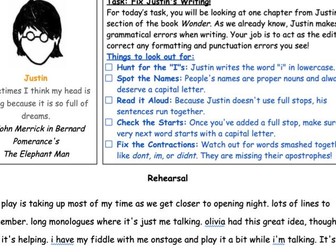
Task: Fix Justin’s Writing!
For today’s task, you will be looking at one chapter from Justin’s section of the book Wonder. As we already know, Justin makes grammatical errors when writing. Your job is to act as the editor and correct any formatting and punctuation errors you see!
Things to look out for:
Hunt for the "I"s: Justin writes the word “i” in lowercase.
Spot the Names: People’s names are proper nouns and always deserve a capital letter.
Read it Aloud: Because Justin doesn’t use full stops, his sentences run together.
Check the Starts: Once you’ve added a full stop, make sure the very next word starts with a capital letter.
Fix the Contractions: Watch out for words smashed together like dont, im, or didnt. They are missing their apostrophes!
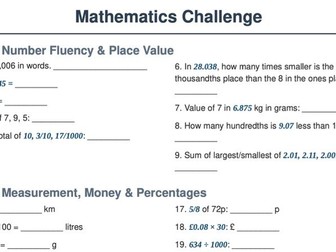
Boost student confidence and mathematical fluency with this comprehensive, structured series of daily challenges. Designed to build essential skills systematically, these 26 unique, single-page challenges (A–Z) provide a consistent routine that keeps learners engaged and progressing.
The Journey of Life: 8-Stage Visual Sequencing Cards
Help visual learners master the concepts of time, growth, and chronological order with this illustrated Journey of Life sequencing set. Designed specifically for young learners, neurodivergent students, and visual thinkers, this educational tool breaks down the human lifecycle into eight relatable, easy-to-understand stages.