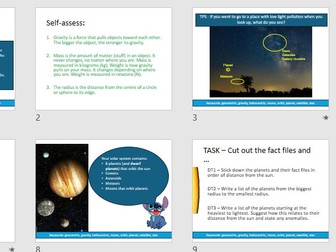
Topics covered:
objects in our solar system
scale of our solar system
heliocentric and geocentric models of our solar system
working scientifically to analyse models
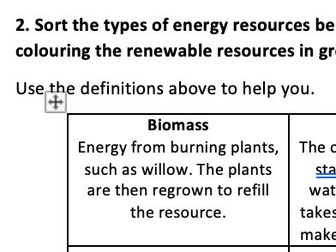
Accessible worksheet where students use word fills to complete the definitions of renewable and non-renewable energy sources, and then apply these to categorise the different sources of energy specified by the national curriculum, based on information provided. Suitable for KS3 and KS4. Answers included.
This worksheet can be attached to the front of exam questions to scaffold students applying a technique for understanding what a question is actually asking them.
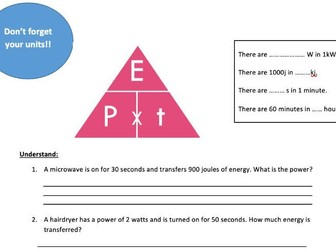
Practise applying E=P/t to worded calculation questions that are increasingly difficult with conversions. Includes answers and conversion activity. Suitable for KS3 and KS4 physics
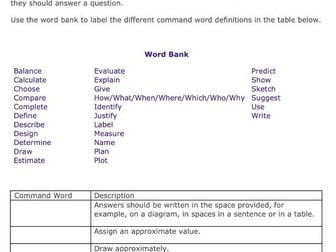
AQA GCSE Science (inc. Biology, Chemistry, Physics, Combined Science Synergy and Trilogy) command word activity to learn the definitions from the exam board. Students match the word from the word bank to the definition in the table.
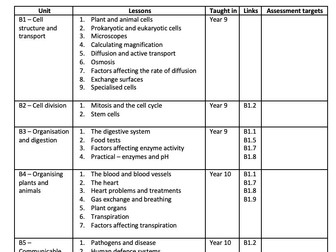
AQA Combined Science Trilogy lesson topic checklist (structured using Kerboodle units) with space to add assessment tasks. Ideal for putting in the front of folders/books or giving out for structuring revision. Each topic has links to prior learning, making it easy for students to recall relevant content for new learning.
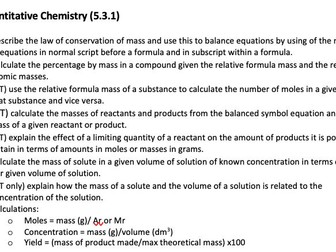
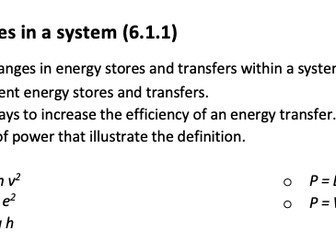
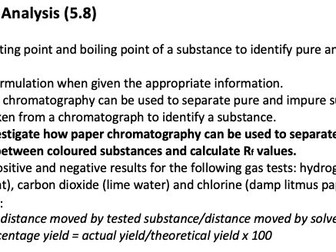
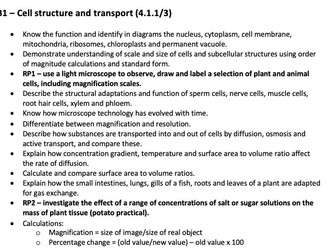
These documents simplify the AQA Combined Science Trilogy specification into student-friendly concepts, so that students know explicitly what the exam board expects them to know and do without being confused by the additional information for teachers.
The document includes references to the original specification and is organised by the Kerboodle units.
Can I explain the structure of the brain, different brain areas (e.g. pre-frontal cortex) and brain functioning as an explanation of aggression as a human behaviour?
These documents simplify the AQA Combined Science Trilogy specification into student-friendly concepts, so that students know explicitly what the exam board expects them to know and do without being confused by the additional information for teachers.
The document includes references to the original specification and is organised by the Kerboodle units.
Designed for AQA GCSE Combined Science Trilogy. Guides students to accumulate all knowledge relevant to specification section “Atomic Structure and the Periodic Table”. Differentiation is to accomodate different comprehension abilities. Also included is an enlarged sheet of the foundation version with font size 18.
These documents simplify the AQA Combined Science Trilogy specification into student-friendly concepts, so that students know explicitly what the exam board expects them to know and do without being confused by the additional information for teachers.
The document includes references to the original specification and is organised by the Kerboodle units.
Can I relate the structure of monosaccharides to their functions?
Can I explain how disaccharides are made and broken down by hydrolysis and condensation reactions?
Question: Describe how the structure of glycogen allows it to perform its function and explain the advantage to animals of using glycogen as an energy store.
Markscheme and feedback grid provided.
These documents simplify the AQA Combined Science Trilogy specification into student-friendly concepts, so that students know explicitly what the exam board expects them to know and do without being confused by the additional information for teachers.
The document includes references to the original specification and is organised by the Kerboodle units.
Can I explain the role of the central nervous system (CNS) and neurotransmitters and synaptic transmission in human behaviour?
Can I explain the effect of recreational drugs on the transmission process in the central nervous system?