Group 7 lesson (A level chemistry)Quick View
eilish2136

Group 7 lesson (A level chemistry)

(1)
Complete lesson for the group 7 elements including the halogens as oxidising agents, halide ions as reducing agents and the uses of chlorate. Designed for AQA A level chemistry but suitable for other exam boards.
Energetics (AS) (A level chemistry)Quick View
eilish2136

Energetics (AS) (A level chemistry)

(1)
Complete lesson for energetics including endo- and exothermic reactions/graphs, calorimetry calculations and Hess’s law (using enthalpies of formation, combustion as well as mean bond enthalpies). Designed for AQA A level chemistry but suitable for other exam boards.
Transition metals lesson (A level chemistry)Quick View
eilish2136

Transition metals lesson (A level chemistry)

(0)
Complete lesson on transition metals including complex formation introduction, shapes of complexes, isomerism in complexes. ligand substitution (including chelate effect), energy calculations (with Planck’s constant), colorimetry, reduction of vanadium using zinc, redox titrations and catalysts. Designed for AQA A Level chemistry but suitable for other exam boards
Electrode potentials and electrochemical cells (A level chemistry)Quick View
eilish2136

Electrode potentials and electrochemical cells (A level chemistry)

(0)
Powerpoint for the topic of electrode potentials and electrochemical cells including; oxidising/reducing agents, half cells/electrodes, measuring electrode electron potential, standard hydrogen electrode, calculating Emf, interpresting the electrochemical series and conventional way of representing cells. Does NOT include commercial applications. Designed for AQA A level chemistry but suitable for other exam boards.
Group 2 lesson (A level chemistry)Quick View
eilish2136

Group 2 lesson (A level chemistry)

(0)
Complete lesson for the group 2 elements including solubility of group 2 compounds and uses of group 2 elements/compounds. Designed for AQA A level chemistry but suitable for other exam boards.
Hormonal communication (A level biology)Quick View
eilish2136

Hormonal communication (A level biology)

(0)
Complete powerpoint for hormonal communication including; endocrine and exocrine glands, comparing hormonal and nervous communication, adrenal glands, the pancreas, regulation of blood glucose (insulin and glucagon), diabetes type 1 and 2 and insulin production. Designed for A level biology OCR A but suitable for other exam boards.
Classification and evolution lesson (A level biology)Quick View
eilish2136

Classification and evolution lesson (A level biology)

(0)
Complete lesson for classification and evolution including the five kingdoms, classification and phylogeny, evolution and natural selection, variation types and causes, standard deviation and adaptations. Designed for A level biology OCR A but suitable for other exam boards.
Photosynthesis (A level biology)Quick View
eilish2136

Photosynthesis (A level biology)

(0)
Complete lesson for photosynthesis including; photosystems, two stages of photosynthesis: light dependent (light harvesting, water photolysis and cyclic and non-cyclic photophosphorylation(with diagrams)) and the light independent stage (the calvin cycle, with diagram) as well as limiting factors. Designed for A level biology OCR A but suitable for other exam boards.
Biological membranes lesson (A level biology)Quick View
eilish2136

Biological membranes lesson (A level biology)

(0)
Complete lesson for biological membranes including the fluid mosaic model, factors affecting membrane permeability and transport across membranes. Designed for A level biology OCR A but suitable for other exam boards.
Amount of substance lesson (A level chemistry)Quick View
eilish2136

Amount of substance lesson (A level chemistry)

(0)
Complete lesson for amount of substance including key equations, a basic titration calculation example and a hydration exam question. Designed for AQA A Level chemistry but suitable for other exam boards.
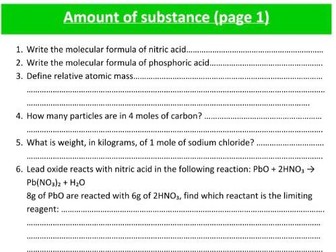
Amount of substance quiz (A level chemistry)Quick View
eilish2136

Amount of substance quiz (A level chemistry)

(0)
Quiz for the amount of substance topic, to accompany the amount of substance lesson, including a titration and hydration calculation along with answers and methods to calculation questions. Designed for AQA A level chemistry but suitable for other exam boards.
Excretion as an example of homeostatic control (A level biology)Quick View
eilish2136

Excretion as an example of homeostatic control (A level biology)

(0)
Complete topic of excretion including; the liver (histology, functions, disease, protein breakdown process), the kidneys (histology, nephron structure, ultrafiltration, selective reabsorption, osmoregulation (ADH), kidney failure (transplants, haemodialysis, peritoneal dialysis) and urine sampling (pregnancy tests). Designed for A level biology OCR A but suitable for other exam boards.
Neuronal communication (A Level biology)Quick View
eilish2136

Neuronal communication (A Level biology)

(0)
Complete lesson for neuronal communication including; structure pf neurones, myelination, resting potential, action potential generation, saltatory conduction, synpases, neurotransmitter (acetylcholine), summation and effect of drugs on synapses. Designed for A level biology OCR A but suitable for other exam boards.
Biodiversity (A level biology)Quick View
eilish2136

Biodiversity (A level biology)

(0)
Complete lesson for biodiversity including sampling, Simpson’s index of biodiversity and maintaining biodiversity. Designed for A level biology OCR A but suitable for other exam boards.
Animal transport lesson (A level biology)Quick View
eilish2136

Animal transport lesson (A level biology)

(0)
Complete lesson for animal transport including types of circulatory systems, tissue fluid formation, the oxygen dissociation curve, carbon dioxide transport, cardiac cycle and electrocardiograms. Designed for A level biology OCR A but suitable for other exam boards.
Bonding lesson (A level chemistry)Quick View
eilish2136

Bonding lesson (A level chemistry)

(1)
Complete lesson for bonding including ionic, covalent (with dative covalent bonds), metallic bonding, intermolecular forces (van der Waals, dipole-dipole and hydrogen bonds), bonding with physical properties and crystals (including molecular and macromolecular crystals). Does not include shapes of molecules, resource on shapes of molecules can be found in ‘A Level chemistry shapes of molecules table’ resource. Designed for AQA A Level chemistry but suitable for other exam boards