Edexcel A Level Business Theme 3 workbooksQuick View
JESReeves

Edexcel A Level Business Theme 3 workbooks

(0)
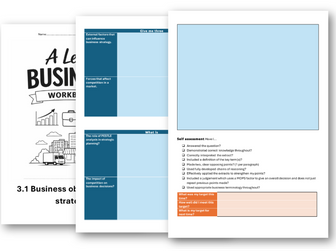
These Theme 3 workbooks provide structured activities for A Level Business students, covering 3.1 Business Objectives and Strategy, 3.2 Business Growth, 3.3 Decision-Making Techniques, 3.4 Influences on Business Decisions, 3.5 Assessing Competitiveness, and 3.6 Managing Change. Aligned to the Edexcel A Level Business specification, each workbook includes: RAG‑rating grid for confidence tracking “Define” keyword lists – Students record definitions of key terms such as Ansoff’s Matrix, Porter’s Five Forces, SWOT analysis, critical path analysis, decision trees, net present value, gearing, ROCE and organisational culture “Give me three…” questions – Recall‑focused prompts asking for examples, reasons, impacts, features or benefits “What is…?” questions – Short conceptual checks clarifying differences, relationships and key ideas within the theme (e.g. the difference between strategic and tactical decisions; strengths and limitations of decision-making models; the relationship between competitiveness and financial performance) “How might…?” analytical tasks – Prompts encouraging students to apply knowledge and develop chains of reasoning, such as: How strategic decisions influence business growth, How investment appraisal supports decision-making, How changes in the external environment affect competitiveness, How organisational culture influences successful change management Exam practice sections – Several pages of extended-answer space, including self-assessment checklists and target-setting boxes. The activities are structured to benefit learners at every level, combining straightforward knowledge-building questions with more demanding analytical tasks that extend higher-level students. Consistent format across all topics The layout and activity structure are identical across 3.1, 3.2, 3.3, 3.4, 3.5 and 3.6, making the set straightforward to use for: Classroom lessons Independent study Homework Revision sessions Resources are supplied as PDFs for ease of access but are best printed for student use.
Edexcel A Level Business Theme 1 workbooksQuick View
JESReeves

Edexcel A Level Business Theme 1 workbooks

(0)
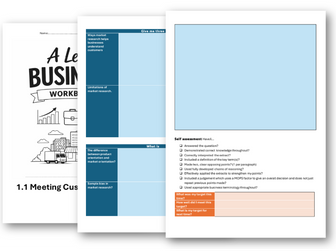
These Theme 1 workbooks provide structured activities for A Level Business students, covering 1.1 Meeting Customer Needs, 1.2 The Market, 1.3 Marketing Mix and Strategy, 1.4 Managing People, and 1.5 Entrepreneurs and Leaders. Aligned to the Edexcel A Level Business specification, each workbook includes: RAG‑rating grid for confidence tracking “Define” keyword lists – Students record definitions of key terms such as market segmentation, market mapping, price elasticity of demand, branding, market research, leadership styles, motivation theories and organisational structures “Give me three…” questions – Recall‑focused prompts asking for examples, reasons, impacts, features or benefits “What is…?” questions – Short conceptual checks clarifying differences, relationships and key ideas within the theme (e.g. the difference between niche and mass markets; distinctions between leadership and management; differences between financial and non-financial motivation) “How might…?” analytical tasks – Prompts encouraging students to apply knowledge and develop chains of reasoning, such as: How market research influences business decision-making How pricing decisions affect sales and revenue How organisational structures influence communication and efficiency How leadership style can affect employee motivation and business performance Exam practice sections – Several pages of extended-answer space, including self-assessment checklists and target-setting boxes. The activities are structured to benefit learners at every level, combining straightforward knowledge-building questions with more demanding analytical tasks that extend higher-level students. Consistent format across all topics The layout and activity structure are identical across 1.1, 1.2, 1.3, 1.4 and 1.5, making the set straightforward to use for: Classroom lessons Independent study Homework Revision sessions Resources are supplied as PDFs for ease of access but are best printed for student use.
Edexcel A Level Business workbooks Theme 1-4Quick View
JESReeves

Edexcel A Level Business workbooks Theme 1-4

4 Resources
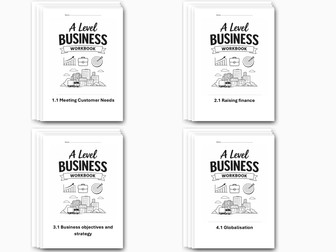
These workbooks provide structured activities for A Level Business students, covering all themes in the Edexcel A level Business specification. Specifically aligned to the Edexcel A Level Business specification, each workbook includes: RAG‑rating grid for confidence tracking “Define” keyword lists – Students record definitions of key terms “Give me three…” questions – Recall‑focused prompts asking for examples, reasons, impacts, features or benefits “What is…?” questions – Short conceptual checks clarifying differences, relationships and key ideas within the theme “How might…?” analytical tasks – Prompts encouraging students to apply knowledge and develop chains of reasoning Exam practice sections – Several pages of extended-answer space, including self-assessment checklists and target-setting boxes. The activities are structured to benefit learners at every level, combining straightforward knowledge-building questions with more demanding analytical tasks that extend higher-level students. Consistent format across all topics The layout and activity structure are identical across all themes and sub themes, making the sets straightforward to use for: Classroom lessons Independent study Homework Revision sessions Resources are supplied as PDFs for ease of access but are best printed for student use. You will receive 20 PDF workbooks in total.
Edexcel A Level Business Theme 2 workbooksQuick View
JESReeves

Edexcel A Level Business Theme 2 workbooks

(0)
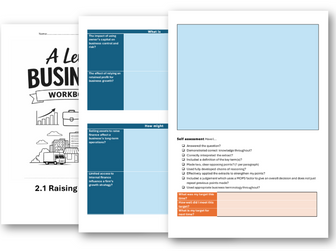
These Theme 2 workbooks provide structured activities for A Level Business students, covering 2.1 Raising Finance, 2.2 Financial Planning, 2.3 Managing Finance, 2.4 Resource Management, and 2.5 External Influences. Aligned to the Edexcel A Level Business specification, each workbook includes: RAG‑rating grid for confidence tracking “Define” keyword lists – Students record definitions of key terms such as retained profit, venture capital, break-even, contribution, capacity utilisation, lean production, quality management, liquidity and cash flow forecasting “Give me three…” questions – Recall‑focused prompts asking for examples, reasons, impacts, features or benefits “What is…?” questions – Short conceptual checks clarifying differences, relationships and key ideas within the theme (e.g. the difference between debt and equity finance; differences between fixed and variable costs; distinctions between quality control and quality assurance) “How might…?” analytical tasks – Prompts encouraging students to apply knowledge and develop chains of reasoning, such as: How businesses choose appropriate sources of finance, How break-even analysis supports decision-making, How capacity utilisation affects profitability, How external economic changes affect business performance Exam practice sections – Several pages of extended-answer space, including self-assessment checklists and target-setting boxes. The activities are structured to benefit learners at every level, combining straightforward knowledge-building questions with more demanding analytical tasks that extend higher-level students. Consistent format across all topics The layout and activity structure are identical across 2.1, 2.2, 2.3, 2.4 and 2.5, making the set straightforward to use for: Classroom lessons Independent study Homework Revision sessions Resources are supplied as PDFs for ease of access but are best printed for student use.
Edexcel ALevel Business Theme 4 workbooksQuick View
JESReeves

Edexcel ALevel Business Theme 4 workbooks

(0)
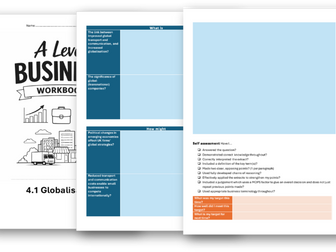
These Theme 4 workbooks provide structured activities for A Level Business students, covering 4.1 Globalisation, 4.2 Global Markets & Business Expansion, 4.3 Global Marketing, and 4.4 Global Industries & MNCs. Aligned to the Edexcel A Level Business specification, each workbook includes: RAG‑rating grid for confidence tracking “Define” keyword lists – Students record definitions of key terms such as GDP, emerging economies, push/pull factors, outsourcing, exchange rates, and ethnocentric/geocentric/polycentric marketing approaches “Give me three…” questions – Recall‑focused prompts asking for examples, reasons, impacts, features or benefits “What is…?” questions – Short conceptual checks clarifying differences, relationships and key ideas within the theme (e.g. the link between FDI and business growth; differences between global marketing approaches) “How might…?” analytical tasks – Prompts encouraging students to apply knowledge and develop chains of reasoning, such as: * How economic growth shapes business opportunities * How exchange rate movements affect competitiveness * How cultural differences influence global marketing decisions Exam practice sections – Several pages of extended‑answer space, including self‑assessment checklists and target‑setting boxes. The activities are structured to benefit learners at every level, combining straightforward knowledge‑building questions with more demanding analytical tasks that extend higher‑level students. Consistent format across all themes The layout and activity structure are identical across 4.1, 4.2, 4.3 and 4.4, making the set straightforward to use for: Classroom lessons Independent study Homework Revision sessions Resources are supplied as PDFs for ease of access but are best printed for student use.