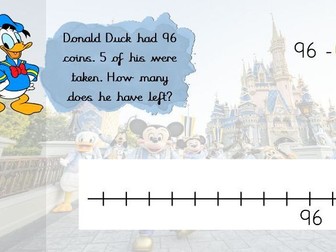
This is a Y3 lesson for them to develop their knowledge of subtracting multiples of 10 from 2 and 3 digit numbers. It is based around the theme Disney where Maleficent steals golden coins from the disney characters. Each coin represents 10. The lesson focusses on using 100 squares and numberlines to support counting back in 10s.
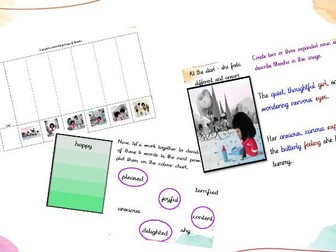
This is a complete unit of lessons: consisting of three lessons to build up to the children creating their own character description of Meesha from the PSHE story ‘Meesha makes friends’.
Lesson 1 - A reading lesson based around the story and plotting how Meesha feels on a graph to show the change in her emotions.
Lesson 2 - Grammar focus, developing sentences using expanded noun phrases.
Lesson 3 - Writing a character descroption - there is a WAGOLL to support.
All lessons have scaffolds for lower ability pupils.
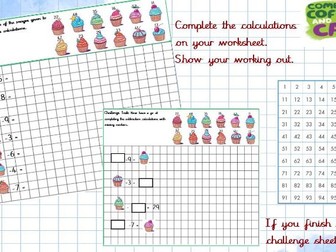
This lesson focusses on subtracting 1-digit numbers from 2-digit numbers.
It is in the theme of Macmillan coffee morning and is a perfect lesson to engage the pupils with their maths learning as it is based around cake!!
The lesson requires 100 squares and numberlines for some children.
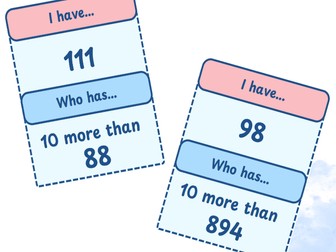
This is a great way to assess pupils knowledge and understanding of the skill 10/100 more than a given number.
The resource follows the pattern of ‘I have, who has’ to get the children to apply their knowledge of what 10 or 100 more would be than the number which has been mentioned.
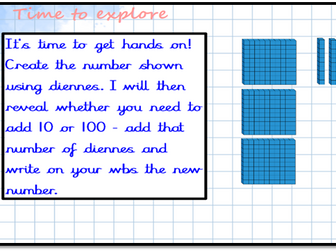
This lesson teaches the children how to calculate 10 or 100 more than a given number. The resources are all included, the lesson is in the form of ActiveInspire and has been replicated in PPT for those who don’t have access to ActiveInspire. All support sheets/challenges are attached too.
The starter begins with adding 10 more through a machine input activity. The It starts off easy with multiples of 10 and gradually gets trickier. This is differentiated with a more accessible version for the SEN/lower ability pupils to access too.
The children then need diennes/base 10 to show a given number and when told to show 10 or 100 more they need to add to their equipment and write the new answer on their whiteboards. Once the children have had practice with the manipulatives they then move onto applying this in their books by identifying the number shown through the base 10/diennes and writing 10 or 100 more. There is a sheet created for the SEN/lower ability to support them with this. The rest of the children just need to cut out the images and stick in their books and write the calculations around it.
The children then move onto independent work where they make a 3-digit number rolling 3 die. They then write what that number would be if it had 10 or 100 more. There are challenge questions where children have to exchange to deepen their understanding.
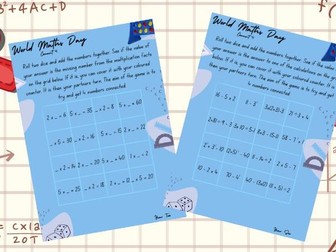
This resource is the perfect activity/game for the pupils in your school to launch World Maths Day.
The resource is a fun activity which involves all pupils from Reception all the way up to Y6, gradually challenging the pupils understanding of number.
The only thing you need to teach this fun activity is a dice per pupil and two different coloured counters. The pupils will need to work in pairs to complete this challenge.
Each year group focuses on teaching a particular skill linked to number as follows:
Reception - Number recognition
Year One - Addition
Year Two - Addition and times tables (focussing on the 2s and 5s)
Year Three - Addition and times tables (focussing on the 3s and 4s)
Year Four -Addition and times tables (focussing on the 6s and 7s)
Year Five - Multiplication and Division Missing Number Facts
Year Six - Order of operations
You are guaranteed to create a buzz across the school with this fun, interactive maths activity for all pupils to take part in, so what are you waiting for - download and enjoy!
Also, if you do love this activity please could you leave me a review if you have time!
This resource is a great activity for the whole school to get involved with, developing pupils arithmetic skills whilst having fun!
It is the perfect resource to download if you are whole school Maths Lead to create a buzz around Maths on World Maths Day.
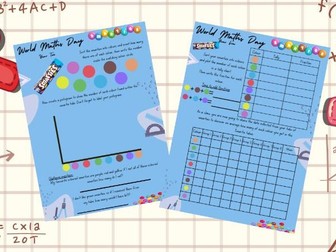
The resource is a fun activity which involves all pupils from Reception all the way up to Y6, gradually challenging the pupils understanding of number.
The only thing you need to teach this fun activity is a few packets of smarties. If you have a class of 30 pupils, it might be worth purchasing 10 packets and getting the children to work in 3’s to complete it.
Each year group focuses on teaching a particular skill linked to number as follows:
Reception - counting
Year One - Counting and adding
Year Two - Counting, adding and subtracting and plotting on a pictogram
Year Three - Counting, adding, multiplication and tally and bar chart
Year Four - Counting, adding, multiplication, fractions and tally and bar chart
Year Five - Counting, fractions and calculating the mean
Year Six - Fractions, decimals, percentages and ratio
You are guaranteed to create a buzz across the school with this fun, interactive maths activity for all pupils to take part in, so what are you waiting for - download and enjoy!
Also, if you love the product, please take some time to leave me a review.
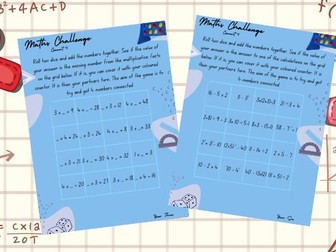
This resource can be used to launch a maths incentive at your school, e.g. a maths morning or World Maths Day.
The resource is a fun activity which involves all pupils from Reception all the way up to Y6, gradually challenging the pupils understanding of number.
The only thing you need to teach this fun activity is a dice per pupil and two different coloured counters. The pupils will need to work in pairs to complete this challenge.
Each year group focuses on teaching a particular skill linked to number as follows:
Reception - Number recognition
Year One - Addition
Year Two - Addition and times tables (focussing on the 2s and 5s)
Year Three - Addition and times tables (focussing on the 3s and 4s)
Year Four -Addition and times tables (focussing on the 6s and 7s)
Year Five - Multiplication and Division Missing Number Facts
Year Six - Order of operations
You are guaranteed to create a buzz across the school with this fun, interactive maths activity for all pupils to take part in, so what are you waiting for - download and enjoy!
Also, if you do love this activity please could you leave me a review if you have time!
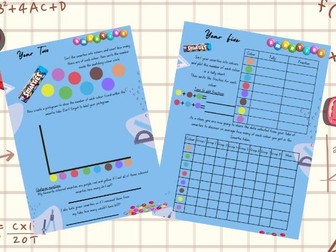
This resource can be used to launch a maths incentive at your school, e.g. a maths morning or World Maths Day.
The resource is a fun activity which involves all pupils from Reception all the way up to Y6, gradually challenging the pupils understanding of number.
The only thing you need to teach this fun activity is a few packets of smarties. If you have a class of 30 pupils, it might be worth purchasing 10 packets and getting the children to work in 3’s to complete it.
Each year group focuses on teaching a particular skill linked to number as follows:
Reception - counting
Year One - Counting and adding
Year Two - Counting, adding and subtracting and plotting on a pictogram
Year Three - Counting, adding, multiplication and tally and bar chart
Year Four - Counting, adding, multiplication, fractions and tally and bar chart
Year Five - Counting, fractions and calculating the mean
Year Six - Fractions, decimals, percentages and ratio
You are guaranteed to create a buzz across the school with this fun, interactive maths activity for all pupils to take part in, so what are you waiting for - download and enjoy!
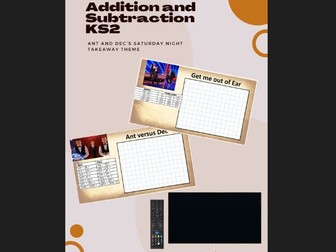
This lesson can be used to support the revision of addition and subtraction in KS2. It is mainly aimes at Y5 but can be used for Y4 and Y6 too depending upon your cohort.
The lesson begins with a vocabulary discussion followed by revision of number knowledge, e.g place value , rounding of numbers and 1000 more and 1000 less.
This then leads the lesson onto the main skill of addition and subtraction and there is an Ant v Dec round with slides to model how to tackle the calculations. It then leads into a round of get out of me ear, where the pupils are given 3 different possible answers and have to solve the calculations to find the correct solution. The final task is win the ads, where the pupils can earn house points etc for completing the calculations, these become more challenging as they involve mistakes/missing numbers.
The resource provided includes a PowerPoint and resources for each round which are ready-made.
I specialise in KS2, therefore, please check out my other resources, mainly linked to the core subjects Maths and English as well as RE - focusing on the Catholic faith.
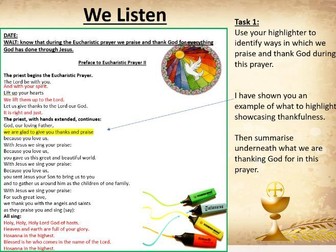
This lesson supports the teaching of the Sacrament of the Eucharist. It goes into depth about the meaning behind the Eucharistic Prayer as part of the Catholic Mass.
It also enables pupils to showcase their creative flare by creating a piece of artwork inside a Chalice template.
The resource provided includes a PowerPoint and ready-made word documents to support.
The resources are differentiated throughout using a star system. 1* (blue) is the heavily supported task. 2** (green) is the independent main task which the majority of the class should be able to complete. 3*** (pink) is the challenge task for the more able pupils.
I specialise in KS2. Therefore, please check out my other resources, mainly linked to the core subjects Maths and English as well as RE - focussing on the Catholic faith.
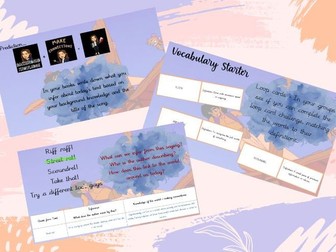
This is a creative lesson which supports with teaching the key reading skills - inference and making connections. This is a fun lesson to support the pupils in preparing for their SATs through text analysis.
It is based around the film Aladdin - focusing on the song ‘One Jump Ahead’.
The lesson begins with the pupils making predictions about what the song might mean based on the title. The children then work in groups to complete a loop card vocabulary activity to understand the meaning of words within the lyrics.
They then analyse these lyrics further and annotate around the lyrics the meaning.
The pupils then are supported with understanding how to use specific phrases to infer the meaning and then making connections with the world around them.
It is a really fun lesson which holds the pupils interests.
The lesson was originally planned on ActivPrimary Flipchart but I have copied it over to a PPT for those who do not have access to flipchart.
I specialise in KS2. Please take a look at my other resources.
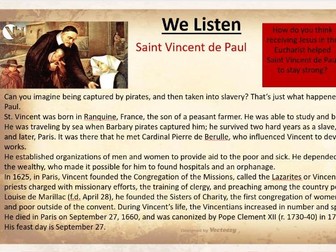
This lesson supports the teaching of the Sacrament of the Eucharist. It discusses ways in which receiving the Eucharist has changed peoples lives and enables the pupils to reflect on how it can help to change their lives.
It then focuses on the final stage of the mass - the dismissal; the children are given the opportunity to reflect on the words and create their own versions with similar meanings.
I specialise in KS2. Therefore, please check out my other resources.
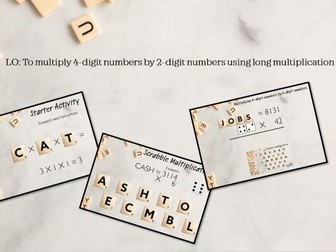
This is a fun, creative, engaging lesson to teach multiplication to Y6 pupils.
It starts off with quick recall of times tables where the pupils have the multiply the value of the scrabble tiles.
They then create 4 letter words and use the values of these letters to create 4 digit numbers and roll a die to multiply by a 1 digit number to continue confidence building with multiplying.
They then continue to progress with this by rolling two die and multplying the 4 digit value y a 2-digit value. There are slides throughout for the teacher to model how to complete these calculations with exchanges.
The resources uploaded are in the form of a PPT and a PDF just incase the font does not load properly for you in the PPT. The word document is a page with the value of the tiles for the children to use. The only other thing you need is dice!
Please download and share, and if you like the resource, leave a review.
I also have lots of other creative, fun lessons so check them out too!
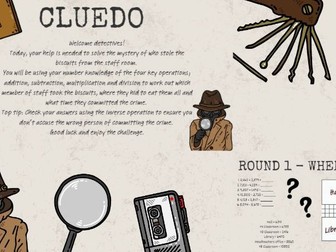
This lesson, enables Y6 pupils to consolidate their knowledge of the four key operations: addition, subtraction, multiplication and division.
The lesson is based around the board game Cluedo.
The children have to solve calculations during the starter activity to reveal the name of the board game, when they solve the calculations correctly, they are given the letters to spell Cluedo, they are in the wrong order so the children need to rearrange them.
Round 1 of the lesson, the children complete + and - calculations to work out where in the school the crime was committed. This crime is a member of staff eating all of the biscuits from the staffroom.
Round 2, the children complete multiplication questions to work out what time the crime was committed.
Round 3, the children complete division questions to work out who it was.
The answers are in the notes section as to where it was, what time and who it was.
The resources are in a word document ready to be printed and trimmed down for the children to show their working out underneath each section.
If you like this resource, please download and use, the children in your class will love playing the game. I have lots of other engaging creative resources too, please check them out and give them a download. If you find the resource useful, please give me a review.
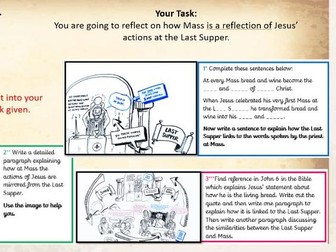
This lesson supports the teaching of the Sacrament of the Eucharist. It is linked to my other Eucharist lessons which I have uploaded.
The lesson focuses on the role of the priest and how he replicates and celebrates the Last Supper during Mass. The lesson begins with a vocabulary focus based on the word Sacrifice. There is then a link to an animated video to describe the Last Supper at Mass and the children then reflect on this video as their main task.
The resource provided includes a PowerPoint and ready-made resources to support.
The resources are differentiated throughout using a star system, 1* (blue) is the heavily supported tasks. 2** (green) is the independent main task which the majority of the class should be able to complete. 3*** (pink) is the challenge task for the more able pupils.
I specialise in KS2. Therefore, please check out my other resources, mainly linked to the core subjects; Maths, English as well as RE - focussing on the Catholic faith.
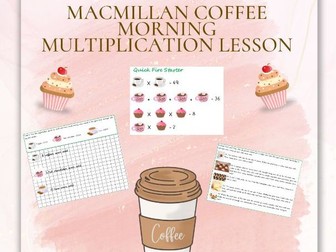
This lesson supports the teaching of multiplication. It is mainly aimed at UKS2 but can be adapted for LKS2.
At the start of the lesson the children have to use their times table knowledge to work out the value of the images related to a coffee morning.
The children then are set the challenge of solving real-life multiplications involving money. The teacher can model how to calculate these using the squared paper on the teaching resource.
The challenge comes next where the children have to solve word problems involving multiplication.
This is the perfect resource to make Macmillan coffee morning even more engaging for the pupils.
The resources provided include a PowerPoint and an ActivInspire flipchart as well as a publisher document with the tasks on ready to print.
I specialise in KS2. Therefore, please check out my other resources linked to the core subjects Maths and English as well as RE - focusing on the Catholic faith.
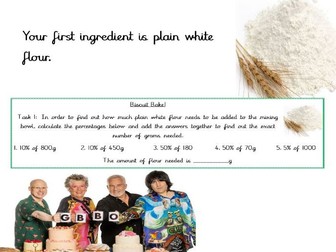
This is a fun, engaging lesson to support the teaching of finding the percentage of an amount. It is based around the theme ‘Bake off’ and the end result is that the children will have worked out the amount needed for each ingredient to make biscuits.
At the start of the lesson the pupils see how quickly they can divide numbers by 10. There is a scaffolded version of these to support the lower ability pupils.
The children are then guided by the teacher with methods for how to teach finding 10%, then 50%, 1% and 5% before allowing the pupils to apply this knowledge. The lesson then gradually gets trickier, allowing pupils to apply their knowledge of how to use the percentages discussed to solve harder ones.
The activity sheets are scaffolded so there is a main activity sheet and an easier one for the lower attaining pupils.
The lesson has been uploaded as a flipchart using ActivInspire Primary but has also been copied onto a PPT and the activity sheets have all been uploaded to support with the teaching of the lesson.
If you want to engage your Year Six pupils with their arithmetic skills then teach this lesson.
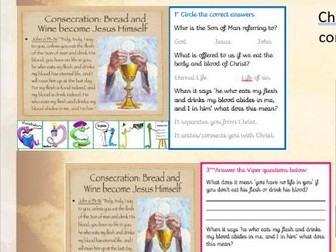
This resource supports the teaching of the Eucharist. The children reflect on the words from the Bible according to John about the bread and wine becoming Jesus himself. The children then explore ways in which they can bring Christ into the world today through their chosen actions.
The resources provided include a teaching powerpoint and ready-made word document activity sheets.
The resources are differentiated through a star system. 1* (blue) is the heavily supported task. 2** (green) is the independent main task which the majority of the class should be able to complete. 3*** (pink) is the challenge task for the more able pupils.
I specialise in KS2. Therefore, please check out my other resources, mainly linked to the core subjects; Maths and English, as well as RE - focusing on the Catholic faith.
This lesson supports the teaching of the Sacrament of the Eucharist. It is linked to my other Eucharist lessons which I have uploaded.
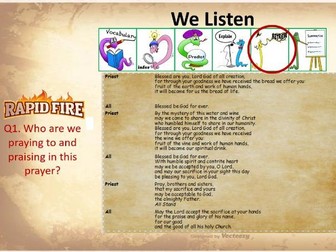
This lesson teaches in depth about the meaning behind the Eucharistic prayer using a reading technique - VIPERS. The children annotate around the prayer the meaning behind the words to showcase their understanding. They then end the lesson with creating some beautiful chalice artwork.
The resource provided includes a PowerPoint and ready-made resources to support, these are in the form of PDF, word document and publisher.
The resources are differentiated throughout using a star system, 1* (blue) is the heavily supported tasks. 2** (green) is the independent main task which the majority of the class should be able to complete. 3*** (pink) is the challenge task for the more able pupils.
I specialise in KS2. Therefore, please check out my other resources, mainly linked to the core subjects; Maths, English as well as RE - focussing on the Catholic faith.
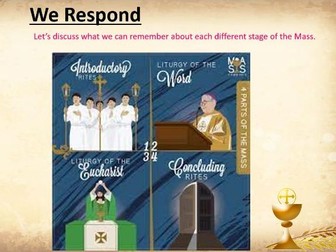
This lesson supports the teaching of the Sacrament of the Eucharist. It describes the four key stages of the Catholic Mass and in detail discusses the purpose of each.
At the start of the lesson PpwerPoint there is an opportunity for the children to self-reflect and describe what they already know about the mass. This then allows the children to share their own experiences whilst exploring the key aspects of each stage later in the lesson.
The resource provided includes a PowerPoint and ready - made word documents to support.
The resources are differentiated throughout using a star system. 1* (blue) is the heavily supported task. 2** (green) is the independent main task which the majority of the class should be able to complete. 3*** (pink) is the challenge task for the more able pupils.
I specialise in KS2. Therefore, please check out my other resources, mainly linked to the core subjects Maths and English as well as RE - focussing on the Catholic faith.


 Quick View