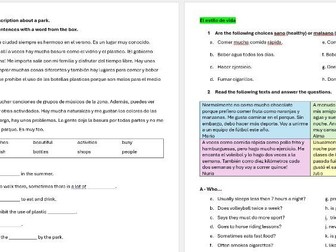
This is a booklet that’s ideal for assessment revision. It covers some key topics:
family
towns/cities
lifestyle/health
school
work
free time
verb practice
There are a range of tasks, such as:
match-ups
gap fills
translations
reading tasks
short writing practice
verb tables
A sheet that could be printed out for pupils or displayed in a classroom.
Has recommendations of ways in which pupils can extend their Spanish learning outside the classroom:
TikTok accounts
Musicians
Netflix recommendations
Duolingo
10 Minute Spanish
YouTube accounts
Websites/apps
Probably more appropriate for KS4/5. Can be easily adapted.
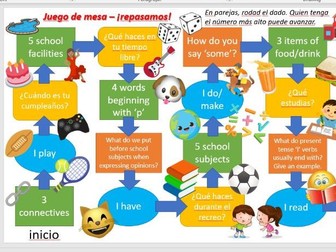
Revision board game with a focus on basics (e.g. birthdays), free time and school.
Visual aids added around the board game to scaffold the game.
Can be adapted accordingly to different topics/abilities of students.
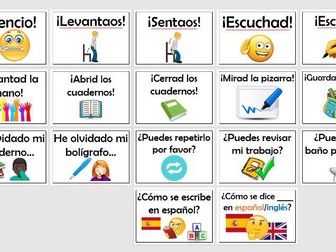
A series of 20 Spanish commands and questions (e.g. silence / stand up / can you repeat it please / how do you say ___ in Spanish) with accompanying images.
I printed and laminated these and put them around my whiteboard, which was very effective as all students could see them!
A zip file comprising of:
a document with Spanish flag-themed letters which spell out ‘¿donde se habla el español?’
a document with other capitalised Spanish flag-themed letters
a powerpoint comprising of fact files and images related to each Spanish-speaking country in the world
a powerpoint with questions/phrases to print out such as ‘where would you like to visit?’ and ‘I would like to visit…’ to encourage students to think about which Hispanic countries they would like to go to.
I cut and laminated everything and had a world map as the focal point of my display, with pins and string connecting the fact files to different countries. Slightly time-consuming to do it this way, but it really did engage students and got them thinking about the wider world (i.e. Spain is NOT the only place where Spanish is spoken!). You could do it this way, or more simply you could print out the fact files and images on their own.
This could also be a good segue into a research task, particularly at KS3.
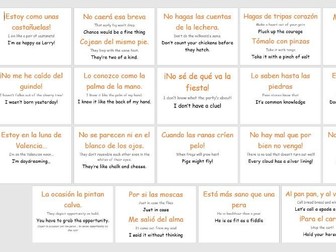
A set of Spanish and French idiomatic expressions with their literal and English translations, as well as a background that they could be stuck on each week. Does not take too long to print and laminate them, and encourages conversations with pupils!
This lesson is aimed for high-ability KS4 Spanish students. I used this for a formal observation during my ECT year and I received excellent feedback so thought I would share.
LO: To understand the main ideas of a Spanish news article about technology.
Starter: Students write the Spanish for key words on the board.
Extension: Write a sentence including at least 3 of the words.
Students to then write as many Spanish words as possible about technology.
Students then presented with an adapted article from El Pais about WhatsApp and then work together (or could work independently depending on group) on a ‘challenge sheet’.
Post-it plenary about confidence with reading in Spanish and why, as well as three new words/phrases learned in the lesson.
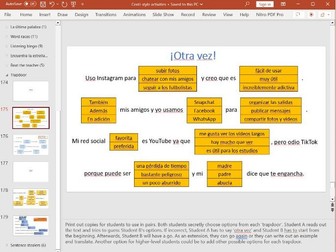
Range of KS3 and KS4 activities based on the Gianfranco Conti approach. These activities are for Spanish but can be adapted for any language. The powerpoint includes:
sentence builders
rock climbing translations
pyramid translations
tangled translations
bad translations
correct the sentences
find in the text (translations)
identify in the text (categories)
write in the correct order
finish the sentence
unscramble
gap fills
word snakes
one pen one dice
paired gap dictation
the last word
word races
listening bingo
find the star
beat the teacher
trapdoor
sentence stealers
Explanations on how to present and complete each activity can be found in the speaker notes in each section.
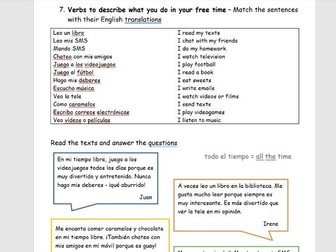
A booklet focusing on present tense verbs, adverbs of frequency and free time activities.
The booklet is split up as follows:
The infinitive
Verbs with the infinitive
Present tense -ar verbs
Stem-changing verbs
Irregular verbs (hacer)
Adverbs of frequency
Verbs to describe what you do in your free time
Activities include filling in verb tables, gap fills, reading comprehensions, translations and a short writing task about what you do in your free time. This could be used as an independent learning task or cover.
Appropriate for KS3 or as foundation GCSE revision. Could also be used as assessment.
A short powerpoint showing the different ways in which students can revise vocabulary, with examples and some activities. Appropriate for both KS3 and can be made more challenging for KS4.


 Quick View