Nine print-ready AQA GCSE Physics Atomic Structure worksheets with exam-style practice and a complete teacher answer booklet.
A complete AQA GCSE Physics Atomic Structure resource pack containing nine print-ready student worksheets and a separate teacher answer booklet. The worksheets cover the full Atomic Structure topic, including atoms and isotopes, development of the atomic model, radioactive decay, nuclear radiation, nuclear equations, half-life, background radiation, irradiation and contamination, radiation hazards and uses, nuclear fission and nuclear fusion.
Each worksheet uses clear, student-friendly language, structured progression, exam-style questions, calculation practice, misconception checks and appropriately sized answer spaces. Questions are informed by recurring issues identified in AQA examiner reports, including confusion between mass number and atomic number, weak explanations of alpha scattering, errors in nuclear equations, insecure half-life definitions, confusion between irradiation and contamination, incomplete radiation-risk explanations and misunderstanding of fission and fusion.
The teacher booklet includes complete answers, acceptable alternatives, marking guidance, specification references and notes on common misconceptions. The pack is suitable for classroom teaching, homework, revision, intervention and independent study.
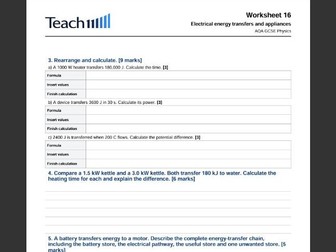
A complete AQA GCSE Physics Electricity resource pack containing ten print-ready student worksheets and a separate teacher answer booklet. The worksheets cover the full Electricity topic, including circuit symbols, charge and current, potential difference and resistance, component characteristics, series and parallel circuits, mains electricity and safety, electrical power, appliance energy transfers, the National Grid, static electricity and electric fields.
Each worksheet uses clear, student-friendly language, structured progression, exam-style questions, calculation practice, misconception checks, required-practical skills and appropriately sized answer spaces. Questions are informed by recurring issues identified in AQA examiner reports, including inaccurate circuit symbols, confusion between current and potential difference, incorrect meter placement, failure to square current in power calculations, weak explanations of parallel circuits and incomplete National Grid reasoning.
The teacher booklet includes complete answers, acceptable alternatives, marking guidance, specification references and notes on common misconceptions. The pack is suitable for classroom teaching, homework, revision, intervention and independent study.
Eight print-ready AQA GCSE Physics Energy worksheets with exam-style practice, required practicals and a complete teacher answer booklet.
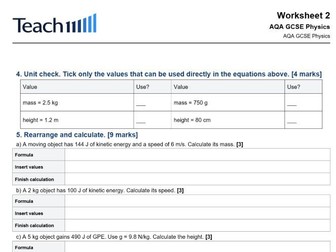
A complete AQA GCSE Physics Energy resource pack containing eight print-ready student worksheets and a separate teacher answer booklet. The worksheets cover the full Energy topic, including energy stores and transfers, kinetic and potential energy, elastic energy, specific heat capacity, power, conservation and dissipation, efficiency, thermal insulation, and national and global energy resources.
Each worksheet uses clear, student-friendly language, structured progression, exam-style questions, calculation practice, misconception checks, required-practical skills and appropriately sized answer spaces. Questions are informed by recurring issues identified in AQA examiner reports, including imprecise scientific language, incomplete explanations, unit errors, poor equation selection and weak practical reasoning.
The teacher booklet includes complete answers, acceptable alternatives, marking guidance, specification references and notes on common misconceptions. The pack is suitable for classroom teaching, homework, revision, intervention and independent study.
Five print-ready AQA GCSE Chemistry of the Atmosphere worksheets with exam-style practice and a complete teacher answer booklet.
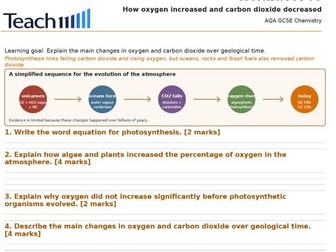
A complete AQA GCSE Chemistry of the Atmosphere resource pack containing five print-ready student worksheets and a separate teacher answer booklet. The worksheets cover the present atmosphere, the Earth’s early atmosphere, changes in oxygen and carbon dioxide, greenhouse gases, climate change, carbon footprints and atmospheric pollutants produced by burning fuels.
Each worksheet uses clear, student-friendly language, structured progression, exam-style questions, calculations, diagrams, data interpretation, evidence evaluation, misconception checks and appropriately sized answer spaces. Questions address recurring issues identified in AQA examiner reports, including incorrect early-atmosphere gases, introducing photosynthesis at the wrong stage, failing to name carbon dioxide, confusing sulfur with sulfur dioxide and mixing up global dimming and global warming.
The teacher booklet includes complete answers, acceptable alternatives, marking guidance, specification references and notes on common misconceptions. The pack is suitable for classroom teaching, homework, revision, intervention and independent study.
Eighty print-ready AQA GCSE Chemistry worksheets covering all ten specification topics, with exam-style practice, all required practicals and complete teacher answer booklets.
A complete AQA GCSE Chemistry resource package containing 80 print-ready student worksheets and accompanying teacher answer booklets. The collection covers all ten topics in the AQA GCSE Chemistry specification: Atomic Structure and the Periodic Table; Bonding, Structure and the Properties of Matter; Quantitative Chemistry; Chemical Changes; Energy Changes; The Rate and Extent of Chemical Change; Organic Chemistry; Chemical Analysis; Chemistry of the Atmosphere; and Using Resources.
The worksheets provide comprehensive coverage of the knowledge, calculations and practical skills required for Paper 1 and Paper 2. Students practise balancing equations, formulae, mole calculations, reacting masses, concentration, electrolysis, energy changes, reaction rates, organic structures, chemical tests, data analysis and extended explanations. All eight required practical activities are integrated into the relevant topics, with questions developing understanding of apparatus, variables, risk assessment, observations, measurements, evaluation and experimental improvements.
Each worksheet uses clear, student-friendly language, structured progression, exam-style questions, misconception checks and answer spaces appropriate to the available marks. Questions are informed by recurring issues identified in AQA examiner reports, including imprecise use of atoms, ions and molecules, incorrect formulae and charges, unit-conversion errors, weak calculation working, misuse of intermolecular forces, inaccurate practical methods and incomplete particle-level explanations.
The accompanying teacher booklets include complete answers, acceptable alternatives, full calculation working, marking guidance, specification references and notes on common misconceptions. Higher Tier and Chemistry-only content is clearly identified where appropriate.
The complete bundle is suitable for classroom teaching, homework, revision, intervention, cover lessons, tutoring and independent study. Worksheets can be taught sequentially as a complete GCSE Chemistry course or selected individually to support particular topics, required practicals and areas of weakness.
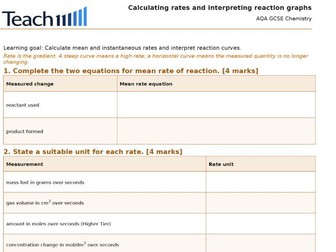
Six print-ready AQA GCSE Chemistry Rate and Extent worksheets with exam-style practice, required practicals and a complete teacher answer booklet.
A complete AQA GCSE Chemistry resource pack containing six print-ready student worksheets and a separate teacher answer booklet. The worksheets cover calculating rates, reaction graphs, tangent gradients, collision theory, concentration, pressure, surface area, temperature, catalysts, reversible reactions, dynamic equilibrium and Le Chatelier’s principle.
Each worksheet uses clear, student-friendly language, structured progression, exam-style questions, graph and tangent work, calculations, practical planning, misconception checks and appropriately sized answer spaces. Questions address recurring issues identified in AQA examiner reports, including calculating a mean instead of an instantaneous rate, misreading graph scales, omitting control variables, weak collision-theory explanations and believing that catalysts alter equilibrium yield.
The teacher booklet includes complete answers, acceptable alternatives, full calculation working, marking guidance, specification references and notes on common misconceptions. The pack is suitable for classroom teaching, homework, revision, intervention and independent study.
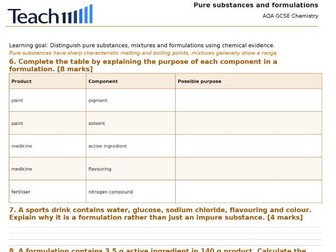
Seven print-ready AQA GCSE Chemistry Chemical Analysis worksheets with exam-style practice, required practicals and a complete teacher answer booklet.
A complete AQA GCSE Chemistry Chemical Analysis resource pack containing seven print-ready student worksheets and a separate teacher answer booklet. The worksheets cover pure substances, mixtures, formulations, melting and boiling points, chromatography, Rf calculations, gas tests, flame tests, hydroxide precipitates, tests for negative ions and flame emission spectroscopy.
Each worksheet uses clear, student-friendly language, structured progression, exam-style questions, practical planning, chromatograms, calculations, test-result tables, misconception checks and appropriately sized answer spaces. Questions address recurring issues identified in AQA examiner reports, including placing chromatography start lines below the solvent, measuring spots incorrectly, confusing chlorine with chloride, mixing up test reagents and describing precipitates as solutions.
The teacher booklet includes complete answers, acceptable alternatives, marking guidance, specification references and notes on common misconceptions. The pack is suitable for classroom teaching, homework, revision, intervention and independent study.
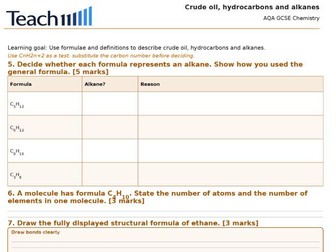
Nine print-ready AQA GCSE Chemistry Organic Chemistry worksheets with exam-style practice and a complete teacher answer booklet.
A complete AQA GCSE Chemistry Organic Chemistry resource pack containing nine print-ready student worksheets and a separate teacher answer booklet. The worksheets cover crude oil, hydrocarbons, alkanes, fractional distillation, combustion, cracking, alkenes, bromine water, alcohols, fermentation, carboxylic acids, esters, addition polymers, condensation polymers, amino acids and naturally occurring polymers.
Each worksheet uses clear, student-friendly language, structured progression, exam-style questions, molecular and displayed formulae, balanced equations, reaction diagrams, calculations, misconception checks and appropriately sized answer spaces. Questions address recurring issues identified in AQA examiner reports, including confusing fractional distillation with cracking, inaccurate organic formulae, insecure alkane and alkene naming, poor knowledge of the bromine-water test and confusion about polymers and monomers.
The teacher booklet includes complete answers, acceptable alternatives, marking guidance, specification references and notes on common misconceptions. The pack is suitable for classroom teaching, homework, revision, intervention and independent study.
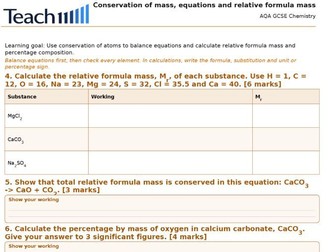
Nine print-ready AQA GCSE Chemistry Quantitative Chemistry worksheets with structured calculation practice and a complete teacher answer booklet.
A complete AQA GCSE Chemistry Quantitative Chemistry resource pack containing nine print-ready student worksheets and a separate teacher answer booklet. The worksheets cover conservation of mass, balancing equations, relative formula mass, percentage by mass, uncertainty, moles, reacting masses, limiting reactants, concentration, titration calculations, percentage yield, atom economy and molar gas volumes.
Each worksheet uses clear, student-friendly language, structured progression, exam-style calculations, equation practice, practical reasoning, misconception checks and appropriately sized working spaces. Questions address recurring issues identified in AQA examiner reports, including changing subscripts when balancing equations, applying mole ratios incorrectly, failing to convert between cm³ and dm³, confusing percentage yield with atom economy and omitting calculation working or units.
The teacher booklet includes complete answers, acceptable alternatives, full calculation working, marking guidance, specification references and notes on common misconceptions. The pack is suitable for classroom teaching, homework, revision, intervention and independent study.
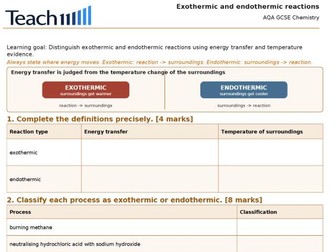
Six print-ready AQA GCSE Chemistry Energy Changes worksheets with exam-style practice, required practicals and a complete teacher answer booklet.
A complete AQA GCSE Chemistry Energy Changes resource pack containing six print-ready student worksheets and a separate teacher answer booklet. The worksheets cover exothermic and endothermic reactions, investigating temperature changes, reaction profiles, activation energy, bond-energy calculations, chemical cells, batteries and hydrogen fuel cells.
Each worksheet uses clear, student-friendly language, structured progression, exam-style questions, calculation practice, reaction-profile diagrams, practical planning, misconception checks and appropriately sized answer spaces. Questions address recurring issues identified in AQA examiner reports, including confusing exothermic and endothermic reactions, inaccurate activation-energy arrows, confusing energy levels with temperature, omitting bonds from calculations and treating fuel cells as single-use devices.
The teacher booklet includes complete answers, acceptable alternatives, full calculation working, marking guidance, specification references and notes on common misconceptions. The pack is suitable for classroom teaching, homework, revision, intervention and independent study.
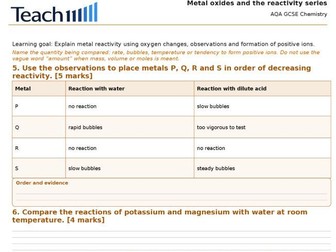
Eleven print-ready AQA GCSE Chemistry Chemical Changes worksheets with exam-style practice, required practicals and a complete teacher answer booklet.
A complete AQA GCSE Chemistry Chemical Changes resource pack containing eleven print-ready student worksheets and a separate teacher answer booklet. The worksheets cover the reactivity series, displacement reactions, metal extraction, reduction and oxidation, electron transfer, ionic equations, acids, bases, carbonates, salts, pH, strong and weak acids, titrations and electrolysis.
Each worksheet uses clear, student-friendly language, structured progression, exam-style questions, equation practice, calculations, practical methods, misconception checks, required-practical skills and appropriately sized answer spaces. Questions address recurring issues identified in AQA examiner reports, including confusing ions with electrons, reversing the anode and cathode, weak half equations, inaccurate titration methods and incomplete explanations of metal extraction and electrolysis.
The teacher booklet includes complete answers, acceptable alternatives, marking guidance, specification references and notes on common misconceptions. The pack is suitable for classroom teaching, homework, revision, intervention and independent study.
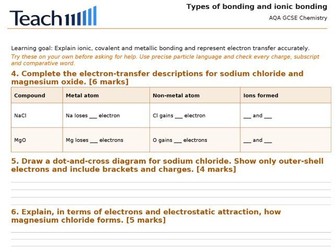
Nine print-ready AQA GCSE Chemistry Bonding, Structure and Properties worksheets with exam-style practice and a complete teacher answer booklet.
A complete AQA GCSE Chemistry resource pack containing nine print-ready student worksheets and a separate teacher answer booklet. The worksheets cover ionic, covalent and metallic bonding, ionic lattices, simple molecules, polymers, giant covalent structures, metals, alloys, diamond, graphite, graphene, fullerenes, carbon nanotubes and nanoparticles.
Each worksheet uses clear, student-friendly language, structured progression, exam-style questions, bonding diagrams, formula practice, calculations, misconception checks and appropriately sized answer spaces. Questions address recurring issues identified in AQA examiner reports, including confusion between atoms, ions and molecules, describing ionic bonding as electron sharing, misuse of the term intermolecular forces, incorrect ionic formulae and the misconception that covalent bonds are weak.
The teacher booklet includes complete answers, acceptable alternatives, marking guidance, specification references and notes on common misconceptions. The pack is suitable for classroom teaching, homework, revision, intervention and independent study.
Seventy-two print-ready AQA GCSE Biology worksheets covering all seven specification topics, with exam-style practice, all required practicals and complete teacher answer booklets.
A complete AQA GCSE Biology resource package containing 72 print-ready student worksheets and accompanying teacher answer booklets. The collection covers all seven main topics in the AQA GCSE Biology specification: Cell Biology, Organisation, Infection and Response, Bioenergetics, Homeostasis and Response, Inheritance, Variation and Evolution, and Ecology.
The worksheets provide comprehensive coverage of the knowledge and skills required for Paper 1 and Paper 2. Students practise calculations, biological diagrams, graph interpretation, data analysis, practical methods, comparisons, evaluation and extended explanations. All ten required practical activities are integrated into the relevant topics, with questions developing understanding of apparatus, variables, risk assessment, data collection, uncertainty, evaluation and experimental improvements.
Each worksheet uses clear, student-friendly language, structured progression, exam-style questions, misconception checks and answer spaces appropriate to the available marks. Questions are informed by recurring issues identified in AQA examiner reports, including imprecise biological terminology, incomplete explanations, weak application to unfamiliar contexts, calculation and unit-conversion errors, poor graph interpretation and insecure practical reasoning.
The accompanying teacher booklets include complete answers, acceptable alternatives, calculation working, marking guidance, specification references and notes on common misconceptions. Higher Tier and Biology-only content is clearly identified where appropriate.
The complete bundle is suitable for classroom teaching, homework, revision, intervention, cover lessons, tutoring and independent study. Worksheets can be taught sequentially as a complete GCSE Biology course or selected individually to support particular topics, required practicals and areas of weakness.
Topic 1: Cell Biology, Worksheets 1 to 9
Eukaryotic and prokaryotic cells, 4.1.1.1 to 4.1.1.2
Microscopy, magnification and cell drawings, 4.1.1.5, Required Practical 1
Specialised cells and cell differentiation, 4.1.1.3 to 4.1.1.4
Culturing microorganisms and aseptic technique, 4.1.1.6, Required Practical 2, Biology only
Chromosomes, mitosis and the cell cycle, 4.1.2.1 to 4.1.2.2
Stem cells and their uses, 4.1.2.3
Diffusion and exchange surfaces, 4.1.3.1
Osmosis and changes in plant tissue, 4.1.3.2, Required Practical 3
Active transport and comparing transport processes, 4.1.3.3
Topic 2: Organisation, Worksheets 10 to 19
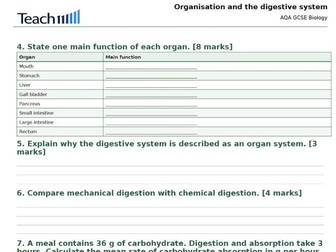
Levels of organisation and the digestive system, 4.2.1 and 4.2.2.1
Digestive enzymes and bile, 4.2.2.1
Food tests, 4.2.2.1, Required Practical 4
The effect of pH on amylase activity, 4.2.2.1, Required Practical 5
The heart and blood vessels, 4.2.2.2
Blood and its components, 4.2.2.3
Coronary heart disease and treatments, 4.2.2.4
Health, lifestyle and non communicable diseases, 4.2.2.5 to 4.2.2.6
Cancer, risk factors and tumour growth, 4.2.2.7
Plant tissues, transport and transpiration, 4.2.3.1 to 4.2.3.2
Topic 3: Infection and Response, Worksheets 20 to 28
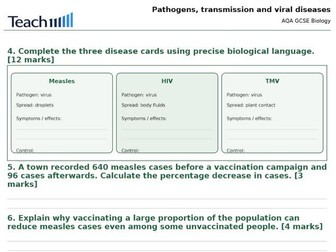
Pathogens, transmission and viral diseases, 4.3.1.1 to 4.3.1.2
Bacterial diseases, 4.3.1.3
Fungal and protist diseases, 4.3.1.4 to 4.3.1.5
Human defence systems, 4.3.1.6
Vaccination and immunity, 4.3.1.7
Antibiotics, painkillers and resistant bacteria, 4.3.1.8
Discovery, testing and development of drugs, 4.3.1.9
Monoclonal antibodies and their uses, 4.3.2, Biology only, Higher Tier
Plant diseases and plant defence responses, 4.3.3, Biology only
Topic 4: Bioenergetics, Worksheets 29 to 34
The photosynthesis reaction and leaf adaptations, 4.4.1.1
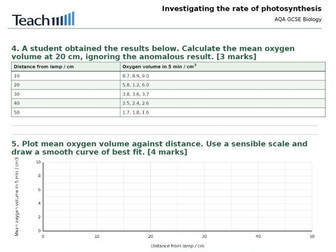
Investigating the rate of photosynthesis, 4.4.1.2, Required Practical 6
Limiting factors and photosynthesis graphs, 4.4.1.2, Higher Tier elements
Uses of glucose produced by photosynthesis, 4.4.1.3
Aerobic and anaerobic respiration, 4.4.2.1
Exercise, oxygen debt and metabolism, 4.4.2.2 to 4.4.2.3
Topic 5: Homeostasis and Response, Worksheets 35 to 47
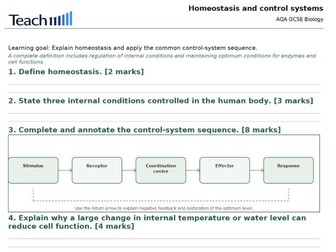
Homeostasis and control systems, 4.5.1
The nervous system, reflexes and reaction time, 4.5.2.1, Required Practical 7
The brain and methods of investigation, 4.5.2.2, Biology only
The eye, accommodation and vision defects, 4.5.2.3, Biology only
Control of body temperature, 4.5.2.4, Biology only
The human endocrine system, 4.5.3.1
Blood glucose, insulin and diabetes, 4.5.3.2
Kidneys, water balance and nitrogen balance, 4.5.3.3, Biology only
Hormones and the menstrual cycle, 4.5.3.4
Hormonal and non hormonal contraception, 4.5.3.5
Fertility treatment and negative feedback, 4.5.3.6 to 4.5.3.7, Higher Tier
Plant hormones and tropisms, 4.5.4.1, Required Practical 8, Biology only
Commercial uses of plant hormones, 4.5.4.2, Biology only, Higher Tier
Topic 6: Inheritance, Variation and Evolution, Worksheets 48 to 63
Sexual and asexual reproduction, 4.6.1.1
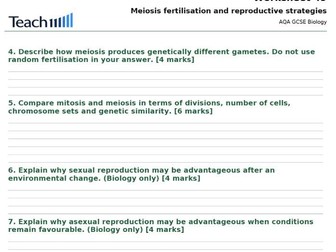
Meiosis, fertilisation and reproductive strategies, 4.6.1.2 to 4.6.1.3
DNA, genes, chromosomes and the genome, 4.6.1.4
DNA structure and protein synthesis, 4.6.1.5, Biology only
Genetic inheritance and Punnett squares, 4.6.1.6
Inherited disorders and embryo screening, 4.6.1.7
Sex determination, 4.6.1.8
Genetic and environmental variation, 4.6.2.1
Natural selection and evolution, 4.6.2.2
Selective breeding, 4.6.2.3
Genetic engineering, 4.6.2.4
Cloning plants and animals, 4.6.2.5, Biology only
Development of evolutionary and genetic theories, 4.6.3.1 to 4.6.3.3, Biology only
Evidence for evolution, fossils and extinction, 4.6.3.4 to 4.6.3.6
Antibiotic resistant bacteria and natural selection, 4.6.3.7
Classification and evolutionary relationships, 4.6.4
Topic 7: Ecology, Worksheets 64 to 72
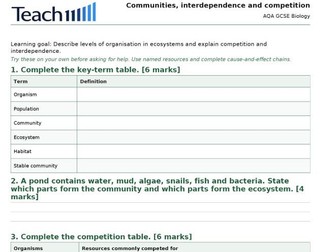
Communities, interdependence and competition, 4.7.1.1
Abiotic factors, biotic factors and adaptations, 4.7.1.2 to 4.7.1.4
Sampling populations with quadrats and transects, 4.7.2.1, Required Practical 9
Food chains, predator prey cycles and ecosystem organisation, 4.7.2.1
The water cycle and carbon cycle, 4.7.2.2
Decomposition and environmental change, 4.7.2.3 to 4.7.2.4, Required Practical 10
Biodiversity and human impacts on ecosystems, 4.7.3
Trophic levels, pyramids and biomass transfer, 4.7.4, Biology only
Food security, farming, fisheries and biotechnology, 4.7.5, Biology only
Nine print-ready AQA GCSE Biology Ecology worksheets with exam-style practice, required practicals and a complete teacher answer booklet.
A complete AQA GCSE Biology Ecology resource pack containing nine print-ready student worksheets and a separate teacher answer booklet. The worksheets cover communities, interdependence, competition, abiotic and biotic factors, adaptations, ecological sampling, food chains and food webs, predator-prey cycles, carbon and water cycles, decomposition, biodiversity, human impacts, trophic levels, biomass transfer, food security, farming, sustainable fisheries and biotechnology.
Each worksheet uses clear, student-friendly language, structured progression, exam-style questions, calculations, graph and data work, misconception checks, required-practical skills and appropriately sized answer spaces. Questions address recurring issues identified in AQA examiner reports, including confusion between biotic and abiotic factors, incorrect quadrat sampling, area-conversion errors, weak decomposition explanations, inaccurate biomass calculations and misconceptions about biodiversity and sustainable fishing.
The teacher booklet includes complete answers, acceptable alternatives, marking guidance, specification references and notes on common misconceptions. The pack is suitable for classroom teaching, homework, revision, intervention and independent study.
Thirteen print-ready AQA GCSE Biology Homeostasis and Response worksheets with exam-style practice, required practicals and a complete teacher answer booklet.
A complete AQA GCSE Biology Homeostasis and Response resource pack containing thirteen print-ready student worksheets and a separate teacher answer booklet. The worksheets cover homeostasis, the nervous system, reflexes, reaction time, the brain, the eye, body-temperature control, the endocrine system, blood glucose, diabetes, kidney function, water balance, reproductive hormones, contraception, fertility treatment, negative feedback, plant hormones and tropisms.
Each worksheet uses clear, student-friendly language, structured progression, exam-style questions, calculation practice, diagram work, misconception checks, required-practical skills and appropriately sized answer spaces. Questions address recurring issues identified in AQA examiner reports, including incomplete definitions of homeostasis, weak reaction-time methods, confusion between eye structures, inaccurate thermoregulation explanations, reversed ADH effects and insecure understanding of reproductive and plant hormones.
The teacher booklet includes complete answers, acceptable alternatives, marking guidance, specification references and notes on common misconceptions. The pack is suitable for classroom teaching, homework, revision, intervention and independent study.
Sixteen print-ready AQA GCSE Biology Inheritance, Variation and Evolution worksheets with exam-style practice and a complete teacher answer booklet.
A complete AQA GCSE Biology Inheritance, Variation and Evolution resource pack containing sixteen print-ready student worksheets and a separate teacher answer booklet. The worksheets cover sexual and asexual reproduction, meiosis, DNA, genes and chromosomes, protein synthesis, genetic inheritance, Punnett squares, inherited disorders, sex determination, variation, natural selection, evolution, selective breeding, genetic engineering, cloning, fossils, extinction, antibiotic resistance and classification.
Each worksheet uses clear, student-friendly language, structured progression, exam-style questions, genetic crosses, calculations, data interpretation, ethical evaluation, misconception checks and appropriately sized answer spaces. Questions address recurring issues identified in AQA examiner reports, including vague mutation definitions, incomplete natural-selection explanations, confusion between meiosis and fertilisation, errors in genetic diagrams, insecure DNA terminology and weak use of evidence for evolution.
The teacher booklet includes complete answers, acceptable alternatives, marking guidance, specification references and notes on common misconceptions. The pack is suitable for classroom teaching, homework, revision, intervention and independent study.
Nine print-ready AQA GCSE Biology Infection and Response worksheets with exam-style practice and a complete teacher answer booklet.
A complete AQA GCSE Biology Infection and Response resource pack containing nine print-ready student worksheets and a separate teacher answer booklet. The worksheets cover pathogens, viral, bacterial, fungal and protist diseases, human defence systems, vaccination, immunity, antibiotics, resistant bacteria, painkillers, drug development, monoclonal antibodies, plant diseases and plant defence responses.
Each worksheet uses clear, student-friendly language, structured progression, exam-style questions, data interpretation, misconception checks, practical reasoning and appropriately sized answer spaces. Questions address recurring issues identified in AQA examiner reports, including confusion between antigens and antibodies, inaccurate vaccination explanations, misunderstanding of antibiotic resistance, weak descriptions of viral replication and imprecise drug-testing terminology.
The teacher booklet includes complete answers, acceptable alternatives, marking guidance, specification references and notes on common misconceptions. The pack is suitable for classroom teaching, homework, revision, intervention and independent study.
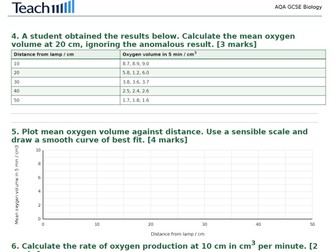
Six print-ready AQA GCSE Biology Bioenergetics worksheets with exam-style practice, required practicals and a complete teacher answer booklet.
A complete AQA GCSE Biology Bioenergetics resource pack containing six print-ready student worksheets and a separate teacher answer booklet. The worksheets cover the photosynthesis equation, leaf adaptations, limiting factors, investigating the rate of photosynthesis, uses of glucose, aerobic and anaerobic respiration, exercise, oxygen debt and metabolism.
Each worksheet uses clear, student-friendly language, structured progression, exam-style questions, calculation practice, graph interpretation, misconception checks, required-practical skills and appropriately sized answer spaces. Questions address recurring issues identified in AQA examiner reports, including confusion between rate and total production, weak limiting-factor explanations, poor graph interpretation, inaccurate respiration terminology and incomplete links between oxygen supply, respiration and muscle fatigue.
The teacher booklet includes complete answers, acceptable alternatives, marking guidance, specification references and notes on common misconceptions. The pack is suitable for classroom teaching, homework, revision, intervention and independent study.
Nine print-ready AQA GCSE Chemistry Atomic Structure and Periodic Table worksheets with exam-style practice and a complete teacher answer booklet.
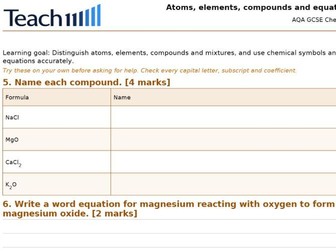
A complete AQA GCSE Chemistry resource pack containing nine print-ready student worksheets and a separate teacher answer booklet. The worksheets cover atoms, elements, compounds, mixtures, separation techniques, development of the atomic model, subatomic particles, isotopes, ions, relative atomic mass, electronic structures, development of the periodic table, Groups 0, 1 and 7, and transition metals.
Each worksheet uses clear, student-friendly language, structured progression, exam-style questions, calculation practice, particle diagrams, equation work, misconception checks and appropriately sized answer spaces. Questions address recurring issues identified in AQA examiner reports, including confusion between atoms and ions, inaccurate isotope definitions, relative atomic mass errors, incorrect formulae and weak explanations of periodic trends.
The teacher booklet includes complete answers, acceptable alternatives, marking guidance, specification references and notes on common misconceptions. The pack is suitable for classroom teaching, homework, revision, intervention and independent study.
Nine print-ready AQA GCSE Chemistry Using Resources worksheets with exam-style practice, required practicals and a complete teacher answer booklet.
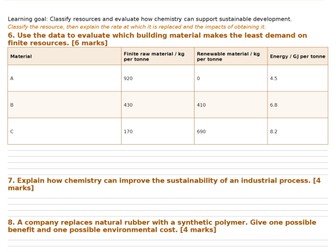
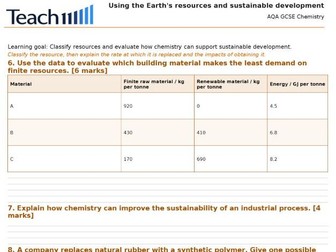
A complete AQA GCSE Chemistry Using Resources resource pack containing nine print-ready student worksheets and a separate teacher answer booklet. The worksheets cover Earth’s resources, sustainable development, potable water, water purification, waste-water treatment, desalination, alternative metal extraction, life-cycle assessments, recycling, corrosion, alloys, ceramics, polymers, composites, the Haber process and NPK fertilisers.
Each worksheet uses clear, student-friendly language, structured progression, exam-style questions, calculations, practical methods, process diagrams, data interpretation, misconception checks and appropriately sized answer spaces. Questions address recurring issues identified in AQA examiner reports, including confusing potable and pure water, inaccurate sewage-treatment stages, weak alloy and composite explanations, incomplete sacrificial-protection reasoning and poor understanding of recycled gases in the Haber process.
The teacher booklet includes complete answers, acceptable alternatives, marking guidance, specification references and notes on common misconceptions. The pack is suitable for classroom teaching, homework, revision, intervention and independent study.
Ten print-ready AQA GCSE Biology Organisation worksheets with exam-style practice, required practicals and a complete teacher answer booklet.
A complete AQA GCSE Biology Organisation resource pack containing ten print-ready student worksheets and a separate teacher answer booklet. The worksheets cover levels of organisation, the digestive system, enzymes, bile, food tests, the effect of pH on amylase, the heart, blood vessels, blood, coronary heart disease, health, non-communicable diseases, cancer, plant tissues, transpiration and translocation.
Each worksheet uses clear, student-friendly language, structured progression, exam-style questions, calculation practice, graph and data work, misconception checks, required-practical skills and appropriately sized answer spaces. Questions address recurring issues identified in AQA examiner reports, including confusion between food tests, weak digestive-enzyme knowledge, inaccurate cardiovascular explanations, poor comparison language and misconceptions about transport in plants.
The teacher booklet includes complete answers, acceptable alternatives, marking guidance, specification references and notes on common misconceptions. The pack is suitable for classroom teaching, homework, revision, intervention and independent study.


 Quick View