B3.2.15 Heart Structure REVISIONQuick View
biogradeable

B3.2.15 Heart Structure REVISION

(0)
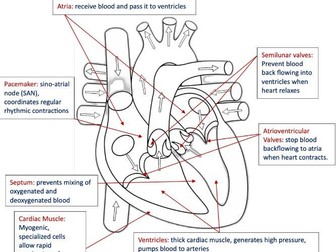
IB DP Biology Objective B3.2.15 Heart Structure Revision Can be used for learning, revision or retrieval. Full objective: B3.2.15(HL) Adaptations of the mammalian heart for delivering pressurised blood to the arteries: include form-function adaptations of these structures: cardiac muscle, pacemaker, atria, ventricles, atrioventricular and semilunar valves, septum and coronary vessels. Be able to identify these features on a diagram of the heart in the frontal plane and trace the unidirectional flow of blood from named veins to arteries.
D1.3 Mutation and Gene Editing REVISION SUMMARYQuick View
biogradeable

D1.3 Mutation and Gene Editing REVISION SUMMARY

(0)
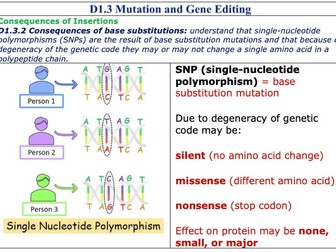
IB DP Biology D1.3 Mutation and Gene Editing A3 Revision Summary Student favourite - revision mat style revision summary to help condense and learn material before assessment or exam. Covers all objectives in D1.3 Mutation and Gene Editing.
B1.2 Proteins STUDENT BOOKLET and TEACHING NOTESQuick View
biogradeable

B1.2 Proteins STUDENT BOOKLET and TEACHING NOTES

(0)
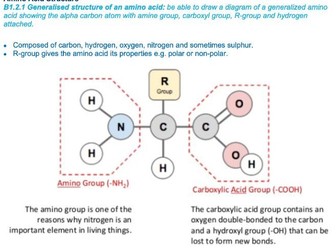
IB DP Biology Covering all objectives in B1.2 Proteins Student booklet: objectives and images to guide students in making focused, concise notes. Teaching notes: to support teachers with depth of knowledge and understanding required.
Biological MoleculesQuick View
biogradeable

Biological Molecules

3 Resources
IB DP Biology Covering A1.1 Water, B1.1 Carbohydrates and Lipids, and B1.2 Proteins Student booklet: objective and images to guide students in making focused concised summary notes Teaching Notes: to guide teachers in the depth of knowledge and understanding required. Usually £3 per subunit (£9 if bought separately). £6 for all three ubunits
A1.1 Water ACTIVITESQuick View
biogradeable

A1.1 Water ACTIVITES

(0)
IB DP Biology Covering A1.1 Water ACTIVITIES: YouTube links, questions, AI guidance to explore learning objectives. Works well with A1.1 Water STUDENT BOOKLET - which can be used to make written summary note after each activity.
B1.2 Proteins STUDENT BOOKLETQuick View
biogradeable

B1.2 Proteins STUDENT BOOKLET

(0)
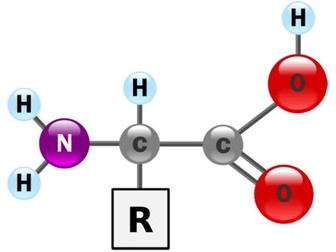
IB DP Biology Covers all objectives in B1.2 Proteins Student booklet with all objectives and images to help students make focused and structured summary notes. WORD for editing and PDF files provided.
A1.1 Water STUDENT BOOKLET and TEACHING NOTESQuick View
biogradeable

A1.1 Water STUDENT BOOKLET and TEACHING NOTES

(0)
IB DP Biology A1.1 Water Student Booklet - structured with objectives and images to help students make summary notes TEACHING NOTES also provided Covers all objectives in A1.1 Water WORD for editing and PDF files. Can be printed, uploaded to learning platform, given to students who miss or have lost work.
B2.3 Cell Specialisation REVISIONQuick View
biogradeable

B2.3 Cell Specialisation REVISION

(0)
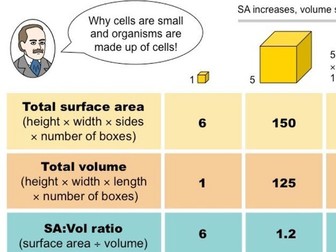
IB DP HL Biology Objectives: B2.3.6 and B2.3.7 A3 Revision Summary WORD (for editing) and PDF files. B2.3.6 Surface area-to-volume ratios and constraints on cell size: understand the mathematical ratio between volume and surface area and that exchange of materials across a cell surface depends on its area whereas the need for exchange depends on cell volume. B2.3.7 (HL) Adaptations to increase surface area-to-volume ratios of cells: include flattening of cells, microvilli, and invagination. Use erythrocytes and proximal convoluted tubule cells in the nephron as examples.
C1.1 Enzymes and Metabolism REVISIONQuick View
biogradeable

C1.1 Enzymes and Metabolism REVISION

(0)
IB DP HL Biology Objectives: C1.1.13(HL), C1.1.15(HL), C1.1.16(HL) - objectives that students want to revise. A3 Revision Summary WORD (for editing) and PDF files Full objective statements: C1.1.13(HL) Cyclical and linear pathways in metabolism: use glycolysis, the Krebs Cycle and the Calvin cycle as examples. C1.1.15(HL) Competitive inhibition as a consequence of an inhibitor binding reversibly to an active site: use statins as an example of competitive inhibitors. Include the difference between competitive and non-competitive inhibition in the interaction between substrate and inhibitor and therefor the effect of substrate concentration. C1.1.16(HL) Regulation of metabolic pathways by feedback inhibition: use the pathway that produces isoleucine as an example of an end product acting as an inhibitor.
B2.2 Organelles and Compartmentalisation REVISIONQuick View
biogradeable

B2.2 Organelles and Compartmentalisation REVISION

(0)
IB DP HL Biology Objectives: B2.2.2, B2.2.4 and B2.2.6(HL) A3. Revision Summary Blank student copy and with teaching notes WORD (for editing) and PDF files Full objective statements: B2.2.2 Advantage of the separation of the nucleus and cytoplasm into separate compartments: limit to separation of the activities of gene transcription and translation – post-transcriptional modification of mRNA can happen before the mRNA meets ribosomes in the cytoplasm. B2.2.4 (HL) Adaptations of the mitochondrion for production of ATP by aerobic cell respiration: including: a double membrane with a small volume of intermembrane space, large surface area of cristae and compartmentalisation of enzymes and substrates of the Kreb cycle in the matrix. In prokaryotes this is not possible – mRNA may immediately meet ribosomes. B2.2.6 (HL) Functional benefits of the double membrane of the nucleus: include the need for pores in the nuclear membrane and for the nuclear membrane to break into vesicles during mitosis and meiosis.
A1.2 DNA Structure RETRIEVAL PRACTICEQuick View
biogradeable

A1.2 DNA Structure RETRIEVAL PRACTICE

(0)
IB DP Biology Objective A1.2.6: Structure of DNA Purpose: retrieval practice/ revision. Can be used after the teaching of DNA structure to see what students remember. Full objective: A1.2.6 DNA as a double helix made of two antiparallel strands of nucleotides with two strands linked by hydrogen bonding between complementary base pairs: in diagrams of DNA structure, students should draw the two strands antiparallel, but are not required to draw the helical shape. Students should show adenine (A) paired with thymine (T), and guanine (G) paired with cytosine ©. Students are not required to memorise the relative lengths of purine and pyrimidines bases, or number of hydrogen bonds.
A1.1 Water RETRIEVAL PRACTICEQuick View
biogradeable

A1.1 Water RETRIEVAL PRACTICE

(0)
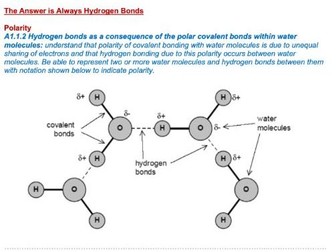
IB DP Biology A1.1 Water Retrieval Practice - quick recall/ retrieval at start of lesson after polarity of water has been taught. WORD (for editing) and PDF Student handout and teaching answers.
B1.1.4 Form & Function of Monosacharides DIFFIT READING COMPREHENSIONQuick View
biogradeable

B1.1.4 Form & Function of Monosacharides DIFFIT READING COMPREHENSION

(0)
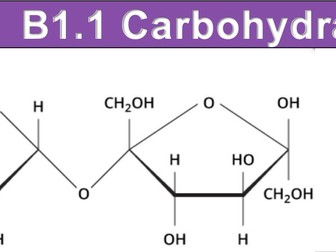
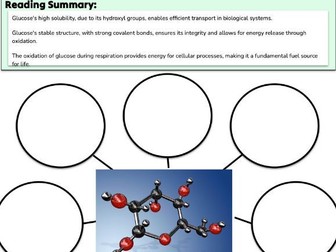
IB DP Biology B1.1.4 Form and Function of Monosaccharides Reaching comprehension created on DIFFIT. Covers objective: B1.1.4 Form and function of monosaccharides: recognise pentoses and hexoses as monosaccharides from molecular diagrams showing them in the ring forms. Use glucose as an example of the link between the properties of a monosaccharide and how it is used, emphasising solubility, transportability, chemical stability and the yield of energy from oxidation properties.