Comprehensive 27-page booklet containing notes and examples designed to cover all the course content of the AQA Further Maths Level 2 syllabus.
This qualification is an effective bridge between GCSE and A-level, and as such much of the content overlaps with both A/A* GCSE and AS Mathematics content. An ideal companion to those studying this course, similar Additional Maths courses, or just wanting to become familiar with some of the more advanced mathematics they will encounter in more detail when they begin A-level Maths.
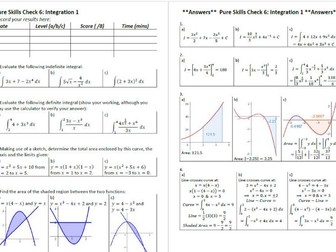
A complete set of fluency questions, one topic/chapter per page, for all of Pure, Mechanics and Statistics. Each page of questions is designed to take students no more than 20 minutes, and comes with full worked solutions on the back so they can check as they go.
Topics included:
Pure:
Quadratics
Graphs
Binomial Expansion
Trigonometry 1 (triangles, basic equations)
Differentiation 1 (polynomials, stationary points)
Integration 1
Exponentials and Logs
Algebra and Functions
Sequences and Series
Trigonometry 2 (radians, reciprocal trig)
Trigonometry 3 (compound angles)
Parametrics
Differentiation 2 (exponentials, logarithms, trigonometry)
Differentiation 3 (combining functions, implicit, parametric)
Numerical methods
Integration 2 (trigonometry, exponentials, identities)
Integration 3 (substitution, parts, differential equations)
Vectors
Mechanics:
Modelling with mechanics
Constant Acceleration
Forces and Motion
Moments
Projectiles
Variable Acceleration
Statistics:
Sampling techniques & Large Data Set
Measures of location and spread
Representation of data
Statistical distributions
Hypothesis testing
Regression, correlation and hypothesis testing
Venn diagrams, tree diagrams and conditional probability
Normal distribution
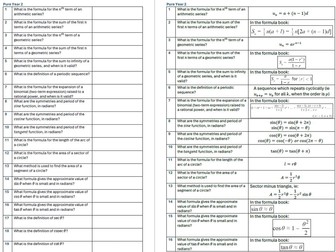
A comprehensive set of short questions designed to test fluency and recall for A-level Maths. Covers the whole span of topics, year 1 and year 2, pure and applied.
The questions are designed to be quick to answer, and are specifically testing knowledge and familiarity with key results.
Importantly, there are a number of questions where the answer can be found in the formula book - if a student knows this, and writes down ‘in formula book’, I still give them the mark, but if they just guess and get it wrong, they lose a mark! This is intended to encourage students not only to learn the key results that they need to commit to memory, but also to work with the formula book to ensure they know what is and isn’t provided.
Pure year 1: 38 quetsions
Pure year 2: 58 questions
Applied year 1: 18 questions
Applied year 2: 11 questions
Download includes:
Construction basics (measuring and drawing lines and angles, with true size images of rulers and protractors)
Circle construction (step-by-step instructions for making a Reuleaux triangle and other circle patterns)
Construction Instructions:
Detailed, true size instructions with accurate diagrams for the common mathematical constructions:
ASA triangle (angle-side-angle)
SAS triangle (side-angle-side)
SSS triangle (side-side-side)
Perpendicular bisector
Angle bisector
Cheat sheets (summary of the method for common constructions, from lines and angles to circles and sectors, triangles and bisectors)
Construction practice (opportunity for students to demonstrate each of the key skills)
Checklist (for a teacher to sign off as students demonstrate mastery of each construction)
Five different worksheets combined, with clear diagrams and full solutions:
Intro: An introduction to loci, identifying a circle as the locus of points a fixed distance from a point then considering shaded regions in overlapping circles.
Floodlit: Four overlapping circles, identifying regions lit up by 1, 2, 3 or 4 lights.
Equidistance: By identifying points halfway up or along a square, then halfway between points, developing the concept of equidistance.
Hidden Circles: Using perpendicular bisectors on a grid with vertical and horizontal lines to develop the method of finding the centre of a circle from three points on its circumference. Second page reminds students of the general construction method for a perpendicular bisector (with diagrams) and gives a question with three points (no grid, not vertically or horizontally aligned).
Signal Tower: More involved than just 'less than 3m from A', but using the same ideas - students have to identify regions within which one, two or all three signal towers might detect a mobile phone.
Designed specifically for the Mechanics 2 syllabus, but equally valid and useful for studying energy in A-level Physics, the booklet explains the key concepts that are so crucial and so often misunderstood:
Force, Energy, Power
Conservation of energy
Energy transfer examples
Common types of energy
How much energy? (compare fuels, food and drink, lightning, AA batteries, etc...)
Work done by a constant force (not necessarily acting in the direction of motion)
Gravitational Potential Energy
Kinetic Energy
Work done by variable forces (using integration)
Elastic Potential Energy
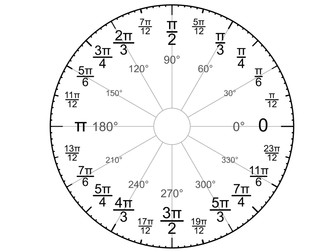
A high resolution image that can be printed for students learning to convert between degrees and radians, and building fluency working primarily with radians, for A-level Maths or A-level Further Maths.