lesson 4 Unicellular Organisms Worksheet + AnswersQuick View
Drsamera

lesson 4 Unicellular Organisms Worksheet + Answers

(0)
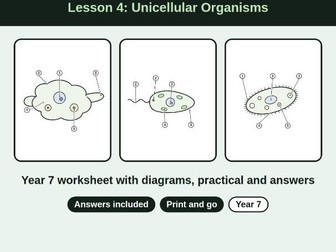
KS3 Year 7 Biology worksheet on unicellular organisms: amoeba, euglena, paramecium and binary fission. Diagrams, practical and full answers included. Lesson 4 of a five-lesson KS3 Cells unit. Use it for a class lesson, cover, revision, homework or home study. What students do: a retrieval starter, vocabulary and a short reading text. They label an amoeba, euglena and paramecium, and complete sequence diagrams for how an amoeba feeds and how binary fission works. A table compares unicellular and multicellular organisms. Short-answer questions have marks shown. The challenge task includes a population-doubling question and a design-your-own-organism activity. The practical observes yeast and uses magnification maths. Teacher answer key: labelled diagrams, model answers with mark points (61 marks), common misconceptions, three verbal check questions and a 50-minute timing plan. Details: 6-side student pack plus 5-side key, A4, with original diagrams. Foundation, core and challenge tasks, with sentence starters and word banks. Dyslexia-friendly layout, UK spelling. Check the practical against your school’s risk assessment before use. These are worksheets, not lesson plans or slides.
lesson 2 Year 7 Specialised Cells Worksheet + AnswersQuick View
Drsamera

lesson 2 Year 7 Specialised Cells Worksheet + Answers

(0)
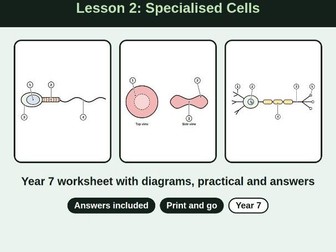
KS3 Year 7 Biology worksheet on specialised cells: sperm, nerve, red blood, root hair and palisade cells. Diagrams, practical and full answers included. Lesson 2 of a five-lesson KS3 Cells unit. Use it for a class lesson, cover, revision, homework or home study. What students do: a retrieval starter, vocabulary and a short reading text. They label sperm, red blood, nerve, root hair and palisade cells, match adaptations to cells and complete a table. Short-answer questions have marks shown. The challenge task includes a stem cell differentiation diagram. The practical uses prepared slides and magnification maths, and it ends with an exit ticket and a traffic-light self-assessment. Teacher answer key: labelled diagrams, model answers with mark points (66 marks), common misconceptions, three verbal check questions and a 50-minute timing plan. Details: 6-side student pack plus 5-side key, A4, with original diagrams that photocopy well. Foundation, core and challenge tasks, sentence starters and word banks. Dyslexia-friendly layout, UK spelling. Check the practical against your school’s risk assessment before use. These are worksheets, not lesson plans or slides.
lesson 3 Year 7 Cell Organisation Worksheet + AnswersQuick View
Drsamera

lesson 3 Year 7 Cell Organisation Worksheet + Answers

(0)
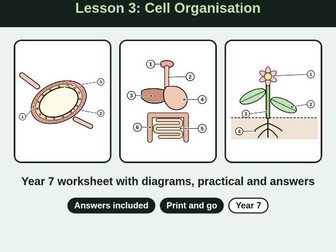
KS3 Year 7 Biology worksheet on cell organisation: tissues, organs, organ systems, digestive system and plant organs. Diagrams, practical and answers. Lesson 3 of a five-lesson KS3 Cells unit. Use it for a class lesson, cover, revision, homework or home study. What students do: a retrieval starter, vocabulary and a short reading text. They fill in the levels of organisation for a human and a plant, label the tissues in the stomach wall, the digestive system and plant organs, and sort items into cell, tissue, organ or organ system. Questions have marks shown, and the challenge task includes a draw-and-annotate activity. The practical uses a celery stalk and food dye to show tissue inside an organ. Teacher answer key: labelled diagrams, model answers with mark points (64 marks), common misconceptions, three verbal check questions and a 50-minute timing plan. Details: 6-side student pack plus 5-side key, A4, with original diagrams. Foundation, core and challenge tasks, with sentence starters and word banks. Dyslexia-friendly layout, UK spelling. Check the practical against your school’s risk assessment before use (the teacher cuts the celery). These are worksheets, not lesson plans or slides.
Lesson 2: Year 7 Specialised Cells Worksheet + AnswersQuick View
Drsamera

Lesson 2: Year 7 Specialised Cells Worksheet + Answers

(0)
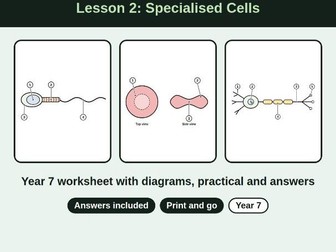
KS3 Year 7 Biology worksheet on specialised cells: sperm, nerve, red blood, root hair and palisade cells. Diagrams, practical and full answers included. Lesson 2 of a five-lesson KS3 Cells unit. Use it for a class lesson, cover, revision, homework or home study. What students do: a retrieval starter, vocabulary and a short reading text. They label sperm, red blood, nerve, root hair and palisade cells, match adaptations to cells and complete a table. Short-answer questions have marks shown. The challenge task includes a stem cell differentiation diagram. The practical uses prepared slides and magnification maths, and it ends with an exit ticket and a traffic-light self-assessment. Teacher answer key: labelled diagrams, model answers with mark points (66 marks), common misconceptions, three verbal check questions and a 50-minute timing plan. Details: 6-side student pack plus 5-side key, A4, with original diagrams that photocopy well. Foundation, core and challenge tasks, sentence starters and word banks. Dyslexia-friendly layout, UK spelling. Check the practical against your school’s risk assessment before use. These are worksheets, not lesson plans or slides.
Lesson 5: Year 7 Diffusion Worksheet + AnswersQuick View
Drsamera

Lesson 5: Year 7 Diffusion Worksheet + Answers

(0)
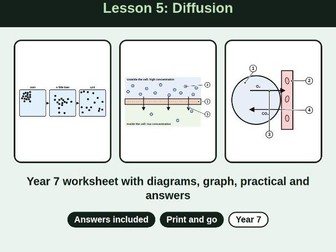
KS3 Year 7 Biology worksheet on diffusion: particles, cell membrane, gas exchange and a temperature graph. Diagrams, practical and full answers included. Lesson 5 of a five-lesson KS3 Cells unit. Use it for a class lesson, cover, revision, homework or home study. What students do: a retrieval starter, vocabulary and a short reading text. They draw the end result of dye spreading in water, then label oxygen entering a cell and gas exchange in the lungs. They complete gap-fills, plot a temperature graph and answer true or false questions and short answers with marks shown. The challenge task includes a draw-and-annotate activity. The practical compares colour spreading in hot and cold water and includes a mean calculation. Teacher answer key: labelled diagrams and a completed graph, model answers with mark points (58 marks), common misconceptions, three verbal check questions and a 50-minute timing plan. Details: 6-side student pack plus 5-side key, A4, with original diagrams. Foundation, core and challenge tasks, with sentence starters and word banks. Dyslexia-friendly layout, UK spelling. Check the practical against your school’s risk assessment before use. These are worksheets, not lesson plans or slides.
Bundle KS3 Biology Cells Unit: Year 7 WorksheetsQuick View
Drsamera

Bundle KS3 Biology Cells Unit: Year 7 Worksheets

(0)
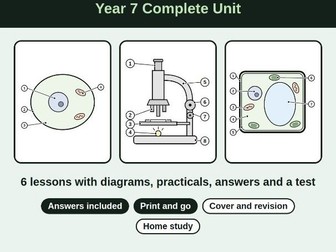
Bundle Title: KS3 Biology Cells Unit: Year 7 Worksheets Complete KS3 Year 7 Biology cells unit: 5 worksheet lessons and an end test with answers. Microscope, specialised cells, diffusion. Revision and cover. One download covers the whole cells unit: five lesson worksheet packs, an end-of-unit test, full teacher answer keys and a unit overview, about 65 pages in total, with around 25 original labelled diagrams. Use it for a full unit, a single lesson, cover, revision, homework, independent study or home education. Lessons: 1 Cells and the Light Microscope; 2 Specialised Cells; 3 Cell Organisation; 4 Unicellular Organisms; 5 Diffusion. Then the end-of-unit test. Every lesson pack includes: a retrieval starter, vocabulary, a short reading text, foundation labelling and matching, core short answers, challenge questions, a practical or skills task with maths, an exit ticket and a traffic-light self-assessment. Each key has labelled diagrams, model answers, misconceptions and verbal check questions. Check every practical against your school’s risk assessment before use. These are worksheets, not lesson plans or slides.
KS3 Biology: Cells. Lesson 1 with diagrams, practicals  answersQuick View
Drsamera

KS3 Biology: Cells. Lesson 1 with diagrams, practicals answers

(2)
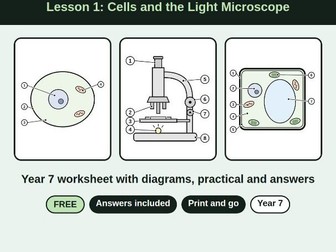
Description: A free, print-ready Year 7 Biology worksheet on cells and the light microscope. The student sheet and teacher answer key are separate files. This is Lesson 1 of a five-lesson KS3 Cells unit. Use it as a whole-class lesson, as cover work, for revision, for homework, or for independent study at home. What students do Starter: three quick recall questions. Vocabulary and reading: a key words table and a short reading text pitched at ages 11 to 12, split into short chunks. Activity 1 (Foundation): label an animal cell, a plant cell and a light microscope using word banks. Then match each cell part to its job and fill in the gaps. Activity 2 (Core): sort cell parts into a Venn diagram of animal and plant cells, then answer short questions with marks shown. Activity 3 (Challenge): an application question using onion cells seen through a microscope. Students also complete a flow diagram showing how to focus a microscope. Practical: observe onion cells. It has a method, a safety note, a results table, a drawing frame and magnification maths. Finish: a 3-2-1 exit ticket and a traffic-light self-assessment.