The Day , the Year and the SeasonsQuick View
nextpagescience

The Day , the Year and the Seasons

(2)
Comprehension and additional task exercises pages 190 and 191 from Next Page Science KS3 Complete. Accompanying PowerPoint and word searches available for free from the website. This exercise covers: • What causes a day and a year: 24 hrs and 365.25 days • A leap year • Earth’s orbit having an elliptical shape • Earth’s tilt as the cause of the seasons • A pictorial illustrating summer (solstice), winter (solstice), spring (equinox) and autumn (equinox) • An explanation explaining why light intensity changes from winter to summer using torches to represent how the same amount of light from the sun can be more or less intense • Earth’s path across the sky (northern hemisphere) • How earth’s spin causes the sun to rise in the east and set in the west • An exercise on plotting the average hours of daylight for each month • A matching the statements exercise • An exercise on what it would be like in the summer (continual daylight) and winter (continual night time) at the north pole • Amazing WHAT? facts
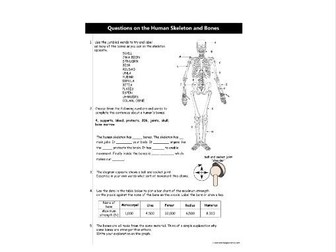
Questions on the Human Skeleton and Bones: KS3 worksheetQuick View
nextpagescience

Questions on the Human Skeleton and Bones: KS3 worksheet

(2)
A great classroom worksheet as a stand alone or to complement page 10 of Next Page Science KS3 when teaching about bones. Includes a labelling exercise with clues, a gap filling question and a chance for students to explain what they experience every day in the movement of joints. Also a graph plotting exercise with grid provided gets students to think about why some bones are stronger than others. Includes answers and a separate wordsearch.
Waves and their PropertiesQuick View
nextpagescience

Waves and their Properties

(1)
Comprehension and additional task exercises pages 162 and 163 from Next Page Science KS3 Complete. Accompanying PowerPoint and word searches available for free from the website. This exercise covers: • The properties of waves (what they do): oscillations that transfer energy, reflect refract and interfere • The difference between transverse and longitudinal waves • Amplitude and wavelength as measured from a transverse wave and a description of frequency • Light waves, water waves and waves on a string as examples of transverse waves • Sound as a longitudinal wave with a labelled diagram showing particle motion • Waves adding and cancelling (interference) pictorially represented • An exercise labelling a transverse wave in more than one place • An exercise showing the result of two waves interfering • Amazing WHAT? facts
Cells KS3 Science WHOLE LESSON RESOURCEQuick View
nextpagescience

Cells KS3 Science WHOLE LESSON RESOURCE

(0)
Great foundation for a lesson with built in writing practise, thinking and explaining. Best printed on A3 paper with the workbook questions adjacent to the student answer sheet. Accompanying lesson outline and answers provided.
Adaptation KS3 Science WHOLE LESSON RESOURCEQuick View
nextpagescience

Adaptation KS3 Science WHOLE LESSON RESOURCE

(0)
Great foundation for a lesson with built in writing practise, thinking and explaining. Best printed on A3 paper with the workbook questions adjacent to the student answer sheet. Accompanying lesson outline and answers provided.
Solar System, Galaxies and the UniverseQuick View
nextpagescience

Solar System, Galaxies and the Universe

(0)
Comprehension and additional task exercises pages 192 and 193 from Next Page Science KS3 Complete. Accompanying PowerPoint and word searches available for free from the website. This exercise covers: • What the solar system is and that ours is one of many • A pictorial of the solar system • A mnemonic for remembering the order of the planets • What a satellite is: the moon is our natural satellite and man-made satellites are used for communication, remote monitoring and meteorology • Planets’ orbit time varies with distance from the sun • Our galaxy: its name (Milky Way), what it is, how big it is and where we are in it • The definition of the light year • How far our nearest star (Alpha Centauri) and galaxy (Andromeda) are • An exercise plotting orbit time for the eight planets • An exercise ordering the size of objects • A true or false exercise on space • Amazing WHAT? facts
Aerobic and Anaerobic RespirationQuick View
nextpagescience

Aerobic and Anaerobic Respiration

(0)
Comprehension and additional task exercises pages 24 and 25 from Next Page Science KS3 Complete. Accompanying PowerPoint and word searches available for** free** from the website. This exercise covers: • Aerobic Respiration as the chemical reaction by which cells release energy using oxygen • Its similarity to burning • Anaerobic respiration and why it is sometimes required • Muscle burn through lactic acid production • Fermentation (brewing) and baking (proofing) • Recognition of a balanced chemical equation
Displacement Reactions (Reactivity Series)Quick View
nextpagescience

Displacement Reactions (Reactivity Series)

(0)
Comprehension and additional task exercises pages 82 and 83 from Next Page Science KS3 Complete. Accompanying PowerPoint and word searches available for free from the website. This exercise covers: • A non-chemical example of what it means for one element to displace another using X, Y and Z • The reactivity series as ordering elements from least reactive (weakest) to most reactive (strongest) • Sibling ‘stealing’ the toy as an analogy • A description of the classic displacing salts experiment: magnesium sulphate, zinc sulphate, iron sulphate and copper sulphate • Chemical equations pictorially represented • The results table for the experiment • An exercise on ‘what displaces what’ using the reactivity series • Amazing WHAT? facts
Acids, Alkalis, Neutralisation, pH ScaleQuick View
nextpagescience

Acids, Alkalis, Neutralisation, pH Scale

(0)
Comprehension and additional task exercises pages 84 and 85 from Next Page Science KS3 Complete. Accompanying PowerPoint and word searches available for free from the website. This exercise covers: • Acids and alkalis as chemical opposite that can cancel out (neutralise) • Acids and alkalis as chemicals that can damage skin and attack metals • Common examples and uses of acids to include: HCl, H2SO4 , fizzy drinks, vinegar, lemon, limes, bee stings • Common examples and uses of alkalis to include: NaOH, drain cleaner, bleach, washing powder, soap, indigestion tablets, wasp stings • The pH scale and indicators • Amazing WHAT? facts
Evolution and Natural SelectionQuick View
nextpagescience

Evolution and Natural Selection

(0)
Comprehension and additional task exercises pages 42 and 43 from Next Page Science KS3 Complete. Accompanying PowerPoint and word searches available for free from the website. This exercise covers: • What to evolve means • Genetic changes can happen naturally or due to the environment e.g. radiation • Survival of the fittest as those traits that help survival are passed on and become more common in the population • Extinction of a species • Charles Darwin as the scientist credited with first presenting the idea • The fact that evolution is still happening today • Amazing WHAT? facts
Earth's Atmosphere and Climate ChangeQuick View
nextpagescience

Earth's Atmosphere and Climate Change

(0)
Comprehension and additional task exercises pages 108 and 109 from Next Page Science KS3 Complete. Accompanying PowerPoint and word searches available for free from the website. This exercise covers: • The earth’s atmosphere as the gases that surround the earth: 78% nitrogen and 21% oxygen • Population rise and consumption of fossils fuels causing climate change • Carbon dioxide and methane as greenhouse gases • An explanation of the greenhouse effect • A description of the problems caused by climate change • What we can do discussed • A graph plotting exercise on average air temperature from 1880 to 2020 • A gap filling exercise explaining global warming • Amazing WHAT? facts
Atoms, Elements, Compounds and MoleculesQuick View
nextpagescience

Atoms, Elements, Compounds and Molecules

(0)
Comprehension and additional task exercises pages 56 and 57 from Next Page Science KS3 Complete. Accompanying PowerPoint and word searches available for free from the website. This exercise covers: • John Dalton as the scientist who developed the idea of atoms • Definition of an element, compound and molecule • Pictorial examples of elements, compounds and molecules • An exercise recognising the differences between compounds and elements • Amazing WHAT? facts
Electric Circuits and Series CircuitsQuick View
nextpagescience

Electric Circuits and Series Circuits

(0)
Comprehension and additional task exercises pages 176 and 179 from Next Page Science KS3 Complete. Accompanying PowerPoint and word searches available for** free** from the website. This exercise covers: • Why electricity is so useful • The requirement of a complete circuit with an illustration of ‘what is happening’ • Definition of voltage, current and resistance with a resistance analogy • The relationship between voltage, current and resistance • An example calculation highlighting the intuitive inverse relationship between current and resistance • Example circuit symbols • The four facts about series circuits operation explained step-by-step • An exercise calculating resistances, voltages and currents • Amazing WHAT? facts
Groups of the Periodic TableQuick View
nextpagescience

Groups of the Periodic Table

(0)
Comprehension and additional task exercises pages 94 and 95 from Next Page Science KS3 Complete. Accompanying PowerPoint and word searches available for free from the website. This exercise covers: • The properties of Group 1, Group 2, Group 7 and Group 8 • The alkali metals: reaction with water (alkaline solution and hydrogen gas formation), pattern in reactivity down the group, density and melting points pattern. All have only one electron in their outer shell as the reason for the similarities • The alkali earth metals: reaction with water, pattern in melting points, boiling points and density. All have two electrons in their outer shell as the reason for the similarity • The Halogens: patterns in melting and boiling points, decrease in reactivity down the group and chlorine’s use as a disinfectant. All have seven electrons in their outer shells as the reason for the similarities. • The noble gases: their use in ‘neon’ lights. All having a full outer shell as the reason for their unreactivity. • A melting point and boiling point plotting exercise on the alkali metals • Amazing WHAT? facts
Light and ReflectionQuick View
nextpagescience

Light and Reflection

(0)
Comprehension and additional task exercises pages 170 and 171 from Next Page Science KS3 Complete. Accompanying PowerPoint and word searches available for free from the website. This exercise covers: • Light as a wave that travels in straight lines with nothing moving faster • What is meant by transparent, translucent and opaque pictorially represented • How we obtain a ray of light • The law of reflection • Regular and diffuse reflection with a diagram illustrating that reflected light still obeys the law of reflection • How a virtual image is formed in a mirror • An exercise completing the reflection of incident rays after measuring the angle of incidence to apply the law of reflection • An exercise on showing the formation of a virtual image • An exercise demonstrating how a periscope works • Amazing WHAT? facts
Heat TransferQuick View
nextpagescience

Heat Transfer

(0)
Comprehension and additional task exercises pages 134 and 135 from Next Page Science KS3 Complete. Accompanying PowerPoint and word searches available for free from the website. This exercise covers: • The three methods of heat transfer: conduction, convection and radiation • Conduction as a method that occurs best in solids • The transfer of vibrations from particle to neighbouring particle: arm linked people as an illustration • Radiation as infrared waves that all objects emit, hotter objects emit more • Convection as a method of heat transfer in liquids and gases: an onshore breeze and a ‘radiator’ in a room explained with pictorial aids • A convection labelling exercise • An exercise explaining why cloudy evenings can be warmer • An exercise recognising heat transfer through temperature difference • Amazing WHAT? facts