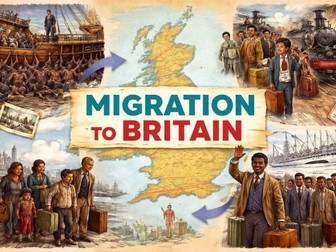
What is migration and when has it happened in British history?
A complete, enquiry-led History lesson introducing pupils to migration and its place within British history.
Pupils explore the meaning of migration before creating a chronological overview of key periods of migration to Britain. They then investigate push and pull factors, sorting reasons for migration and considering why people might migrate to Britain today.
Includes:
Ready-to-teach lesson PowerPoint
Separate PowerPoint containing printables/resources
Chronology/timeline activity
Push and pull factor activity
Venn diagram sorting task
Discussion and assessment opportunities
Modern Britain application task
This lesson forms part of a larger enquiry-led History unit on migration through British history and works particularly well as the introductory lesson. It can also be taught as a standalone lesson.
No additional resource creation required – simply print the accompanying resources and teach.
Part of a complete Migration Through British History unit
Complete, ready-to-teach History lesson exploring the impact of the Triangular Slave Trade on Britain. Includes PPT, sources and printable activities.
This enquiry-led lesson asks:
What was the impact of the Triangular Slave Trade on Britain?
Pupils develop their understanding of the Transatlantic Slave Trade before investigating its impact on Britain through historical evidence. They explore who benefited and who suffered, including enslaved Africans, British merchants, plantation owners, abolitionists and British consumers.
Rather than simply learning facts, pupils work as historians, examining sources and using evidence to reach their own conclusions.
The lesson develops understanding of the economic, social/cultural and political consequences of the slave trade before pupils evaluate which had the greatest impact on Britain.
Resource includes:
Ready-to-teach lesson PowerPoint
Separate printable resources
Clear enquiry question
Accessible introduction to the Transatlantic Slave Trade
Historical source investigation
Benefit/suffering evidence activity
Consequence sorting task
Economic, political and social/cultural analysis
Evaluation and Think Pink assessment
Opportunities for discussion and historical reasoning
The lesson provides important historical context while keeping the focus on evidence, interpretation, consequence and historical enquiry.
Part of a wider enquiry-led unit exploring migration and its impact on British history, but can also be taught as a standalone lesson.
Ready-to-teach History lesson on Irish migration to Britain, using real census evidence to develop historical enquiry and source analysis skills.
This enquiry-led lesson asks:
What can sources tell us about Irish migration to Britain?
Pupils investigate Irish migration during the nineteenth century, beginning with the Irish Famine as a major push factor before exploring what happened to migrant families after arriving in Britain.
At the heart of the lesson is a hands-on historical enquiry using census records. Pupils learn what a census is and what historians can discover from it before examining records of Irish-born people and families living in Britain.
Using the census evidence, pupils investigate where migrants lived, family structures, places of birth and occupations. They then use their findings to make historical inferences about when families migrated, employment and what life may have been like for Irish migrants in Britain.
Resource includes:
Ready-to-teach lesson PowerPoint
Clear historical enquiry question
Irish Famine and migration context
Introduction to census records as historical sources
Census source investigation
Local history links through Kent census evidence
Structured source-analysis questions
Historical inference and discussion
Push-factor retrieval
Think Pink assessment/plenary
A strong lesson for developing sources of evidence, historical enquiry, inference and chronological understanding while exploring the experiences of real migrant families.
Part of a wider enquiry-led Migration Through British History unit, but designed to work as a standalone lesson.
Ready-to-teach Windrush History lesson using migrant testimony and historical sources to explore the hopes, experiences and realities of life in Britain.
This enquiry-led lesson asks:
What were the hopes and realities for Windrush migrants to Britain?
Pupils explore the story of the Windrush Generation, beginning with the push and pull factors that encouraged Caribbean migrants to travel to Britain after the Second World War. They learn why Britain needed workers, why Commonwealth citizens migrated and what they hoped to find when they arrived.
The lesson then moves beyond a simple overview of Windrush. Pupils investigate individual migrant experiences, using testimony and historical evidence to compare expectations with reality.
Through structured enquiry questions, pupils investigate where migrants came from, why they migrated, the jobs they did and their experiences of life and racism in Britain.
The included testimony provides pupils with an opportunity to work directly with the experiences of a Windrush-era migrant, developing source analysis, empathy and historical interpretation rather than simply being told what happened.
Resource includes:
Ready-to-teach lesson PowerPoint
Separate printable resources
Clear historical enquiry question
Windrush Generation historical context
Push and pull factor retrieval
Migrant testimony and historical sources
Structured source-analysis activities
Comparison of hopes and realities
Exploration of work, belonging and racism
Opportunities for historical empathy and discussion
Think Pink assessment/plenary
The final reflection asks pupils to identify something surprising, empathise with an individual’s experience and explain a difference between migrants’ expectations and the reality they encountered.
A thoughtful, enquiry-led lesson centred on the voices and experiences of migrants themselves, while developing pupils’ understanding of evidence, migration and post-war Britain.
Part of a wider enquiry-led Migration Through British History unit, but can also be taught as a standalone lesson.
Ready-to-teach Kindertransport History lesson with child-friendly source work, historical empathy activities and separate printable resources included.
This sensitive, enquiry-led lesson asks:
What can we learn from the stories of Jewish children who came to Britain on the Kindertransport?
Pupils learn why Jewish children came to Britain on the Kindertransport in the late 1930s, exploring the difficult decision families made to send their children to safety without overwhelming younger pupils with unnecessary detail.
At the heart of the lesson is the story of Ruth Barnett, who travelled to Britain with her brother on the Kindertransport in 1939. Pupils use her story to consider what leaving home may have felt like, what children might have worried about and what helped them begin to feel safe in Britain.
The lesson has been deliberately designed with age-appropriate and sensitive teaching in mind, focusing on safety, kindness and children’s experiences rather than graphic or distressing detail. The accompanying teacher guidance includes safeguarding considerations and alternative approaches for pupils who may find the topic emotional.
Resource includes:
Ready-to-teach lesson PowerPoint
Separate printable resources PowerPoint
Clear historical enquiry question
Accessible Kindertransport historical context
Individual child story
Source-based historical enquiry
Scaffolded Think-Pair-Share questions
Sentence starters to support written responses
Historical empathy and evidence activities
Suitcase decision-making activity
Extended discussion questions
Safeguarding and age-appropriate teaching guidance
The suitcase activity encourages pupils to select and justify five objects a refugee child might take, considering both practical and emotional needs, safety, family and belonging.
A carefully framed lesson that develops historical enquiry, use of evidence and empathy while introducing the Kindertransport in an accessible and meaningful way.
Part of a wider enquiry-led Migration Through British History unit, but can also be taught as a standalone lesson.
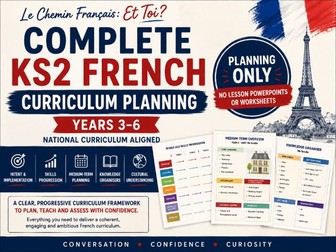
LE CHEMIN FRANCAIS: ET TOI?
A clear, progressive KS2 French Curriculum Planning Framework for Years 3-6, designed around the English National Curriculum for Languages.
Created by a primary teacher for MFL leads, curriculum leaders and non-specialist teachers, it makes clear what pupils need to know, how learning builds over time, what should be revisited and what pupils should achieve by the end of Year 6.
NATIONAL CURRICULUM ALIGNED
The curriculum develops speaking, listening, phonics and pronunciation, reading, writing, grammar and cultural understanding.
Rather than teaching isolated topics, language is deliberately:
INTRODUCED - REVISITED - EXTENDED - APPLIED
Vocabulary, grammar, phonics and sentence structures return in new contexts, helping pupils build knowledge and use French with increasing independence.
WHAT YOU RECEIVE
Intent, Implementation & Impact - Subject on a Page
Whole-KS2 Skills Progression
Speaking, Grammar, Connectives, Phonics & Accents, Cultural Capital and Retrieval progression
Curriculum Threads and Progression across Years 3-6
Year-group objectives and end points
Detailed Medium-Term Overviews for Years 3-6
Retrieval routines and links to prior learning
Key verbs, grammar, connectives, phonics and key questions
20 carefully selected Core Words per unit
Additional Mastery Vocabulary
Oral, Reading and Writing Targets
Cultural Capital
Knowledge Organisers for every unit
PROGRESSION, NOT REPETITION
The curriculum shows what pupils are learning, how it builds on previous knowledge and where learning goes next.
By Year 6, pupils work towards greater fluency and independence, short conversations, extended reading and structured writing, preparing them for KS3.
CREATED BY A PRIMARY TEACHER
Developed from my experience of schemes that could feel overwhelming, Le Chemin Francais is built around one principle:
LESS, BUT BETTER.
Carefully selected vocabulary. Reusable structures. Planned retrieval. Clear progression. Increasing independence.
PLEASE NOTE: This is the CURRICULUM & PLANNING EDITION ONLY.
It does NOT include lesson PowerPoints, worksheets or lesson-by-lesson classroom resources.
Ready-to-teach resources will be released separately.
Le Chemin Francais: Et Toi?
Conversation | Confidence | Curiosity
Ready-to-teach Ancient Maya History lesson with interactive challenge stations, printable resources, reasoning tasks and assessment included.
This enquiry-led lesson asks:
How did the ancient Maya settle in a rainforest?
Rather than beginning with a list of facts about the Maya, pupils are immediately presented with a historical problem: how could you build a city in the middle of a rainforest? They consider the advantages and difficulties of the environment before discovering how the Maya responded to these challenges.
Pupils establish where and when the Maya lived, locating the civilisation in Central America and developing their chronological and geographical understanding.
The main enquiry can be taught as an engaging station activity or whole-class investigation. Pupils match problems faced by the Maya with possible solutions, including farming techniques, maize cultivation, calendars, tools, water systems, buildings and religious practices.
Crucially, pupils don’t simply match information. Each stage develops historical reasoning and judgement, asking them to explain connections, rank solutions and decide which developments were most important. For example, pupils compare the importance of different farming solutions and justify their decisions.
Resource includes:
Ready-to-teach lesson PowerPoint
Separate, extensive printable resources PowerPoint
Pre-teach vocabulary
Clear historical enquiry question
Rainforest immersion/hook
Where and when did the Maya live?
Hinge question/AfL
Four challenge investigation stations
Challenge-and-solution matching activities
Farming and food investigation
Maya calendar and crop knowledge
Travel and tools investigation
Drought, reservoirs and environmental challenges
Ranking and comparison activities
Sentence stems and scaffolding
Historical reasoning and justification questions
Think Pink assessment/plenary
The lesson culminates in a “Vote with your feet” historical judgement, where pupils decide which challenge was hardest for the Maya and use their learning to justify their conclusion.
A highly interactive lesson that develops historical enquiry, cause and consequence, significance, chronological awareness and historical judgement while giving pupils a strong introduction to the Ancient Maya.
Part of a larger enquiry-led Ancient Maya History unit, but fully teachable as a standalone lesson.
Ready-to-teach Ancient Maya History lesson using artefacts and visual sources to investigate cacao, with scaffolded printables and assessment included.
This enquiry-led lesson asks:
How important was chocolate to the ancient Maya?
Using the familiar hook of chocolate, pupils discover that Maya cacao was very different from the chocolate they know today before investigating its importance to Maya society.
The lesson places historical source enquiry at its heart. Pupils examine artefacts and visual evidence, learning to move from observation to inference using the structure:
I can see… → This tells me… → I wonder…
Rather than simply being told how cacao was used, pupils use evidence to work it out for themselves. They investigate pottery to infer that cacao was drunk and consider the important limitation that artefacts provide clues but cannot tell historians everything.
Further sources encourage pupils to investigate who drank cacao and how valuable it was, including evidence suggesting connections with wealthy or important members of Maya society and the value of cacao beans.
Resource includes:
Ready-to-teach lesson PowerPoint
Separate printable resources PowerPoint
Pre-teach vocabulary
Clear historical enquiry question
Engaging chocolate hook
Maya food and cacao context
Hinge question/AfL
Artefact investigation
Visual source analysis
Observation and inference activities
“I can see / This tells me / I wonder” source framework
Scaffolded versions of activities
Source-matching task
Cacao as a drink, valuable commodity and part of Maya life
Then-and-now chocolate comparison
Maya vs modern hot chocolate recipe comparison
Historical judgement
Think Pink assessment
Optional Maya chocolate folklore extension
The printable pack includes scaffolded source-analysis sheets, allowing pupils to examine the evidence independently while supporting those who need greater structure.
The lesson culminates by returning to the enquiry question: How important was chocolate to the ancient Maya? Pupils must make a judgement and support their conclusion with evidence gathered during the lesson.
A highly engaging lesson that uses chocolate as the hook while developing genuine disciplinary History skills including sources of evidence, inference, interpretation, similarities and differences, historical enquiry and evaluating evidence to reach conclusions.
Part of a larger enquiry-led Ancient Maya History unit, but fully teachable as a standalone lesson.
Ready-to-teach Ancient Maya History lesson exploring gods, beliefs and Chichén Itzá, with interactive activities, printables and assessment included.
This enquiry-led lesson asks:
What did the ancient Maya believe?
Pupils investigate how religion was connected to nature and everyday Maya life, considering why people might have looked to gods to explain or influence things such as rain, food, health and the natural world.
Rather than simply memorising a list of gods, pupils explore four important Maya deities - Itzamna, Chaac, Kukulkan and Ix Chel - and match representations of the gods to their roles and attributes.
Pupils then apply their knowledge to historical scenarios, deciding which god a Maya person might turn to in different situations. For example, they consider a farmer facing drought, a sick family member and a priest recording dates and information.
The enquiry then moves from belief to physical evidence through an investigation of the Temple of Kukulkan at Chichén Itzá. Pupils explore its connection to Kukulkan alongside Maya calendars, cenotes, the sacred quetzal bird and the famous “descent of Kukulkan” at the equinox.
Resource includes:
Ready-to-teach lesson PowerPoint
Separate printable resources PowerPoint
Clear historical enquiry question
Engaging discussion-based lesson hook
Introduction to Maya polytheistic beliefs
Four key Maya gods and their attributes
God-and-symbol matching activity
Scenario-based application task
Exploration of nature, religion and everyday life
Chichén Itzá and Temple of Kukulkan investigation
Printable video/question sheet
Maya calendar and cenote links
Kukulkan and the equinox
Retrieval and discussion opportunities
Think Pink assessment
Challenge opportunities
The lesson culminates by returning to the key historical question: Why did the ancient Maya believe in so many gods? Pupils explain the relationship between Maya beliefs and nature, food, sun and rain, with an additional challenge to use specific gods as evidence.
A highly accessible, enquiry-led lesson that moves beyond simply learning the names of Maya gods and encourages pupils to understand why beliefs mattered and how religion connected with Maya society and the natural world.
Part of a larger enquiry-led Ancient Maya History unit, but fully teachable as a standalone lesson.
Two ready-to-teach History lessons developing chronology, timelines, BC/AD, decades and centuries through practical activities, challenges and assessment.
This two-lesson History skills resource explicitly teaches the chronological knowledge pupils need to access History confidently.
Rather than assuming pupils already understand timelines and centuries, the lessons break chronology down step-by-step before giving pupils repeated opportunities to apply, practise and explain their understanding.
Lesson 1 – Chronology & Timelines
Pupils develop their understanding of key chronological vocabulary including day, week, month, year, decade, century and millennium, before learning how historians use BC and AD and how dates are positioned and ordered on timelines.
Activities progressively develop pupils’ understanding of decades and centuries, making useful links to place value and maths before pupils apply their knowledge by ordering historical dates, including BC and AD dates.
Lesson 2 – Understanding Centuries
The second lesson tackles an area pupils often find difficult: working out which century a historical date belongs to.
Pupils learn the rules for converting dates into centuries and centuries back into date ranges, before exploring why the system works this way.
A monarch chronology investigation then gives pupils a meaningful historical context in which to apply their learning, with additional challenges encouraging greater depth.
Resource includes:
2 complete History lessons
Ready-to-teach PowerPoint
Chronology key vocabulary
Decades, centuries and millennia
BC and AD
Ordering dates
Building and interpreting timelines
Understanding century rules
Converting dates to centuries
Converting centuries to date ranges
Historical date activities
Monarch chronology investigation
Card-sort activities
Bronze and Chilli challenges
Retrieval and AfL opportunities
Plenaries and assessment
Greater-depth chronology vocabulary including change, continuity, sequence, duration and anachronism
Ideal as a start-of-year History skills unit, a chronology refresher before beginning a new historical period, or targeted intervention for pupils who struggle with dates, timelines and centuries.
Suitable for UKS2 and KS3, with activities that can be adapted to the needs of your class.
Ready-to-teach Ancient Maya History lesson exploring inventions, Pok-Ta-Tok and beliefs, with museum sorting task, scaffolds, printables and assessment.
This enquiry-led lesson asks:
How did the Maya reflect their beliefs in their inventions?
Pupils move beyond simply learning what the Maya invented to investigate the more challenging question of why their innovations developed and what they reveal about Maya society and beliefs.
The lesson begins by retrieving prior learning about Maya achievements including calendars, pyramids and temples, number systems and chocolate, helping pupils make connections across the wider unit.
Pupils then explore the Maya use of rubber and the ball game Pok-Ta-Tok, discovering how something that might initially appear to be simply a sport was connected to wider religious beliefs. This provides an engaging case study for considering the relationship between Maya inventions and their worldview.
The main activity places pupils in the role of historical investigators working for a museum. They must categorise Maya inventions - including rubber, calendars, the number system, temples, chocolate and farming tools - into Religion, Time, Everyday Life, Power and Trade, explaining the reasoning behind their decisions.
Importantly, there is not always one simple answer. Pupils are challenged to consider whether an invention could belong in more than one category, encouraging deeper historical reasoning, connections and justified interpretations.
Resource includes:
Ready-to-teach lesson PowerPoint
Separate printable activity resource
Clear historical enquiry question
Retrieval of previous Maya learning
Maya inventions and achievements
Pok-Ta-Tok case study
Links between religion, innovation and everyday life
Museum-style categorisation investigation
Religion, Time, Everyday Life, Power and Trade categories
Six Maya inventions to investigate
Reasoning and justification task
Challenge questions
Sentence starters and scaffolding
Hinge discussion/AfL
Links to modern-day inventions and beliefs
Think Pink assessment
The printable museum task includes structured spaces for pupils to categorise each invention and explain their reasoning, alongside optional sentence starters such as “We placed ___ under ___ because…” and “This links to Maya beliefs about…”.
The lesson culminates in a historical judgement:
Which invention BEST shows how the Maya’s beliefs influenced their inventions?
Pupils select evidence and justify their own conclusion rather than simply recalling facts.
A strong enquiry-led, reasoning-focused History lesson developing historical significance, interpretation, making connections, evaluating evidence and communicating historical conclusions.
Part of a larger enquiry-led Ancient Maya History unit, but fully teachable as a standalone lesson.
Teaching the Bible with confidence in KS2–KS3 Religious Education. This teacher-produced guide supports subject knowledge and confidence when teaching biblical texts in mixed-belief classrooms where pupils may hold Christian, agnostic or atheist perspectives. Using historical, cultural and ethical lenses, the resource helps teachers explore biblical stories academically and inclusively while maintaining the aims of Religious Education. It supports teachers in answering pupil questions, providing historical and archaeological context, and encouraging respectful discussion and critical thinking. The guide explores themes often described as the “Big Story of the Bible”, including Creation, the Fall, Moses and Exodus, Incarnation, Gospel and Salvation, with references to archaeology, literature, art and culture. Designed as a teacher support resource rather than pupil material, it aligns with UK RE curriculum aims and may complement lessons exploring similar themes used in some schemes including Understanding Christianity. Not affiliated with or endorsed by any organisation. No liability accepted for interpretation or classroom use.
Migration Through British History: Enquiry Unit (UKS2 / KS3)
A thoughtful, enquiry-driven history unit exploring how migration has shaped Britain across different periods of history.
Designed to develop curiosity and historical thinking, this unit encourages pupils to ask questions, analyse evidence, consider different perspectives and reach their own conclusions about the impact of migration on Britain over time.
This is a fully resourced sequence of lessons, including presentations, activities and source material. It has been designed to be flexible, allowing teachers to adapt and assess the learning in a way that best fits their own curriculum.
What’s included:
• 5 enquiry-led lessons with accompanying resources
• Lesson presentations
• Source-based activities and discussion prompts
• Opportunities for historical enquiry and interpretation
• Knowledge Organiser included
• Suitable for Upper KS2 or KS3 (and easily adaptable)
Lesson sequence:
L1: What is migration and when has it happened in British history?
L2: Exploring migration and its impact on Britain
L3: What can sources tell us about migration in the past?
L4: What can we learn from the experiences of migrants to Britain?
L5: What can individual stories reveal about migration and belonging?
Throughout the unit, pupils are encouraged to think critically about evidence, explore a range of experiences and consider how migration has helped shape the Britain we know today.
Historical concepts and skills developed include:
• Historical enquiry
• Source analysis and interpretation
• Cause and consequence
• Similarity and difference
• Significance
• Perspective and interpretation
• Using evidence to support conclusions
Ideal for teachers looking for a meaningful, engaging enquiry that combines substantive knowledge with disciplinary thinking.
Ancient Maya Unit – KS2 History (Year 4/5)
4 complete lessons + PowerPoints, printable activities and display resources
Bring the fascinating world of the Ancient Maya civilisation to life with this engaging KS2 history unit designed for Year 4 and Year 5 pupils.
This teacher-created unit includes four fully resourced lessons with clear PowerPoints, printable worksheets and a display banner to support classroom learning.
Pupils explore who the Maya were, where they lived, and what made their civilisation unique. Lessons encourage curiosity, discussion and historical thinking while remaining accessible for mixed-ability KS2 classes.
What’s included
4 ready-to-teach lesson PowerPoints
Printable activity sheets for each lesson
Teacher-friendly lesson structure
Display banner for classroom topic wall
Topics covered
Where the Maya civilisation was located
Maya cities and daily life
Achievements such as calendars, writing and mathematics
Understanding evidence and learning about the past
The lessons are designed to work well as part of a Year 5 Ancient Maya history topic, but they are also suitable for upper KS2 (Year 4–6) classes.
Ideal for teachers looking for low-prep, engaging history lessons that build pupils’ understanding of ancient civilisations.
Quick Overview
• Subject: French
• Suitable for: KS2
• Topic: Describing hair and eye colour
• Prep: Print and use
• Activity type: Vocabulary, sentence building and reading comprehension
This simple and engaging worksheet helps pupils learn how to describe hair and eye colour in French. It is designed to support teacher input when introducing basic descriptive vocabulary and simple sentence structure.
The activities guide pupils from recognising vocabulary to understanding how French descriptions are structured.
Activities included:
• Matching French colour words to the correct vocabulary
• Using colour-coded language to support understanding of sentence structure
• Reading and matching a superhero description to the correct character
• A challenge activity where pupils write their own sentence describing a teacher in school
This worksheet works well as a KS2 French lesson activity, practice task, or consolidation exercise when teaching how to describe people in French.
Keywords: KS2 French, describing people in French, hair and eye colour French, primary French worksheet, French descriptions KS2.